Hi, what do you want to do?





AdLit
Ad lit.org: For Middle Schoolers: Activities to Build College Level Reading Skills
ACT has developed this list of activities to help middle-school students improve their reading ability. Parents and educators can use this information to help ensure that these students are on target for college and career readiness.
ReadWriteThink
Read Write Think: Using Word Storms to Explore Vocabulary and Encourage Thinking
Contains plans for seven lessons about working dogs that teach critical thinking skills and a vocabulary strategy called Word Storms. In addition to objectives and standards, this instructional plan contains links to sites used in the...

Mind Tools
Mind Tools: Reading Strategies
This site from Mind Tools reviews six different strategies to help you read more effectively. RI.11-12.10a Text Complexity
E Reading Worksheets
E Reading Worksheets: Figurative Language Activities
Numerous activities, games, quizzes, lessons, and PowerPoint presentations are provided for the topic of "figurative language" in writing. Students will have numerous exposures to examples. Students will also be able to practice...
E Reading Worksheets
E Reading Worksheets: Point of View Activities
This learning module provides assorted activities for teaching and reviewing the concept of point of view with students. The following activities are provided: point of view comic strip; point of view flash cards; point of view practice...
Curated OER
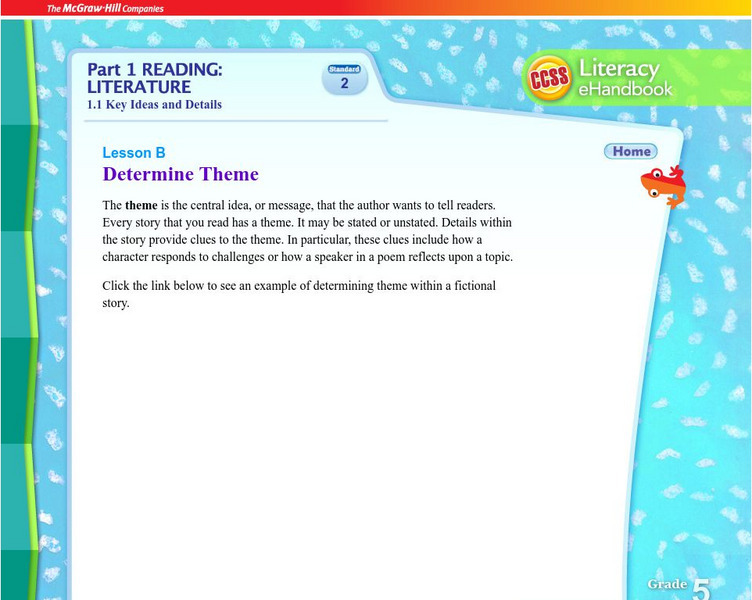
Mc Graw Hill: Part 1 Reading: Literature: Determine Theme
Determine the theme of a story with this reading activity. See the model and then practice identifying the theme.
Other
New York State Library: Student Activity: Primary Versus Secondary Sources
Read about the Railroad Strike of 1877 using three excerpts from textbooks and three original newspaper articles. Compare and contrast the information in the primary and secondary sources.
ReadWriteThink
Read Write Think: Text Features: Non Fiction [Pdf]
Compare the printed page to an electronic web page and use this activity to discuss the similarities and differences. A cross-curricular tie-in with ecosystems. Could easily be adapted to another subject area.
Curated OER
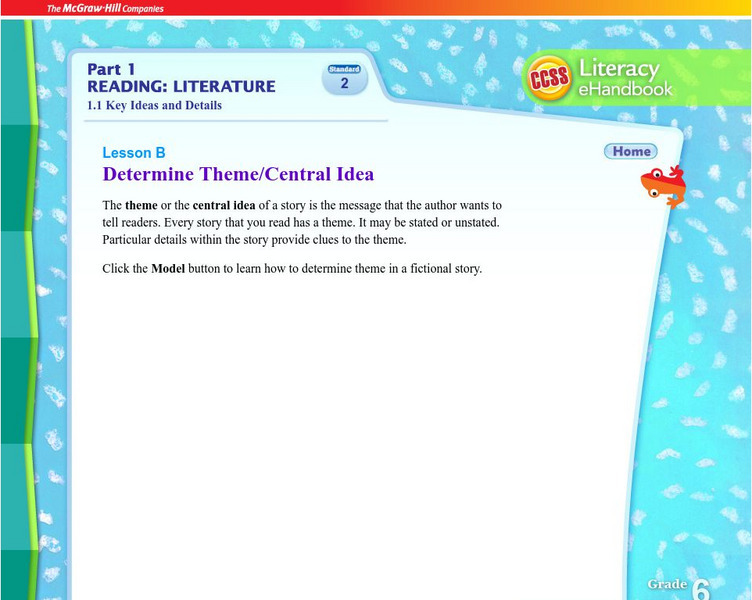
Mc Graw Hill: Reading Literature: Determine Theme/central Idea
A definition of theme or central idea along with a link to a practice activity. CCSS.ELA-Literacy.CCRA.R.2
AdLit
Ad lit.org: Seven Strategies to Teach Students Text Comprehension
Comprehension strategies are conscious plans - sets of steps that good readers use to make sense of text. Comprehension strategy instruction helps students become purposeful, active readers who are in control of their own reading...
E Reading Worksheets
E Reading Worksheets: Summarizing Worksheets and Activities
In this instructional resource, students will learn more about summarizing texts. Worksheets and PowerPoint lessons are provided to reinforce understanding about ways to summarize nonfiction texts and to identify main ideas. This module...
Better Lesson
Better Lesson: Sl.4.1a: Come to Discussions Prepared
Links to 36 lessons and activities that build student skills in standard SL.4.1a: Come to discussions prepared, having read or studied required material; explicitly draw on that preparation and other information known about the topic to...
Better Lesson
Better Lesson: Sl.4.2: Pose an Respond to Specific Questions
Links to 38 lessons and activities that build student skills in standard SL.4.2: Pose and respond to specific questions to clarify or follow up on information and make comments that contribute to the discussion and link to the remarks of...

Alabama Learning Exchange
Alex: Identifying Sequence of Events Using Dr. Seuss
After listening to a reading of Dr. Seuss' Bartholomew and the Oobleck, students use graphic organizers and comic strips to practice sequencing. In a fun activity, small groups follow directions to make oobleck.
Better Lesson
Better Lesson: Speaking, Listening and Writing Compound Contrasting Sentences
Students will be answering text-dependent questions in which they will have to describe the differences between the different characters, settings, and major events in our stories using complex contrasting sentences. The students will...

Library of Congress
Loc: Teachers: Personal Stories and Primary Sources
Young scholars will explore the value of personal stories and first-hand accounts when exploring history, in this case, the events of the early twentieth century, which included World War I and the Great Depression. Through this...