Hi, what do you want to do?






Curated OER
Claims in "The Crisis, No. 1"
"The Crisis, No. 1" is the focus of a series of exercises that ask learners to read closely and annotate Thomas Paine's text. Groups identify claims and evidence in the essay and present their arguments to the class. Teacher background...

Curated OER
The American Crisis, Number 1
Use this presentation about Thomas Paine's The American Crisis series to guide any number of assignments. The slides provide instructions for a literary terms assignment, an open response journal entry, two research writing...

Curated OER
The Human Jigsaw
Fourth graders, using Thomas Paine's "The Crisis, No. 1" from The American Crisis, form a human jigsaw.

Shmoop
ELA.CCSS.ELA-Literacy.RI.11-12.10
Assess whether your class members can comprehend complex informational text with a series of drills based on selections from Emerson, Thoreau, and G.K. Chesterton. The exercises could also be used for group work or a full-class discussion.

National Endowment for the Humanities
Lesson 2: Religion and the Argument for American Independence
Young scholars examine how religion affected arguments justifying American independence. They read and analyze primary source documents, and write an essay analyzing how Americans used religious arguments to justify revolution against a...

Curated OER
My Brother Sam is Dead: A study of the Revolutionary War
Fifth graders complete an analysis of the Revolutionary War through literature. After "My Brother Sam Is Dead," students create a time capsule containing items that would be relevant during the Revolutionary War. They identify key...

Curated OER
Foundations
Students investigate the history of literature in America by looking at the types of genres first read in the United States. They look at the foundations of how the original colonists had the intention of transmitting religious and moral...

Curated OER
Introducing the Essay: Twain, Douglass, and American Non-Fiction
Students analyze American essayists Mark Twain and Frederick Douglass in an introduction to American literary non-fiction writing. In this essay history lesson, students identify methods for writing essays. Students read and analyze...

Other
The Quotations Page: Common Sense by Thomas Paine
This site provides quotes from Thomas Paine's Common Sense.
Georgia Department of Education
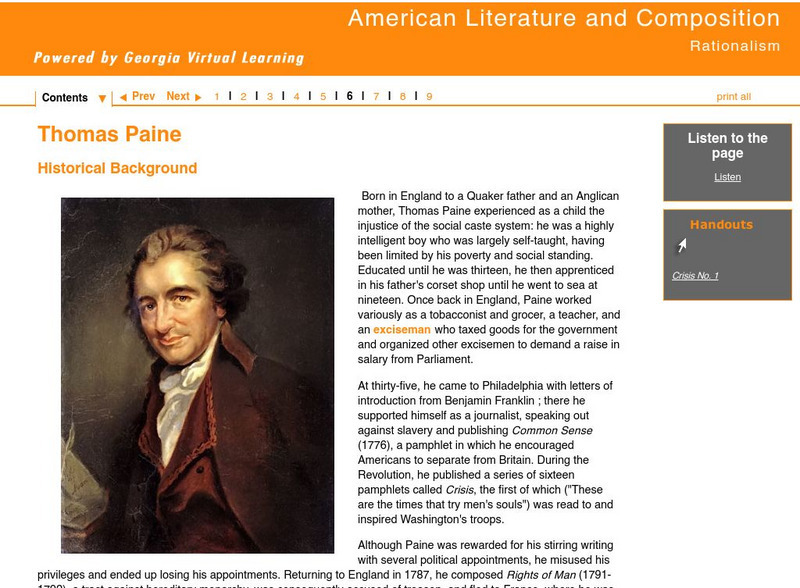
Ga Virtual Learning:american Literature and Comp: Rationalism:thomas Paine
This lesson focuses on Thomas Paine including his background, writings, and political career. A link to "The Crisis No. 1" by Thomas Paine is provided; students are to read it and underline examples of rhetoric. There is also a quiz over...

C-SPAN
C Span American Writers: Thomas Paine
Read about Thomas Paine's revolutionary publication "Common Sense" of 1776. Be sure to click on 'featured place' and 'classroom resources' for more facts and information about Paine.
Other
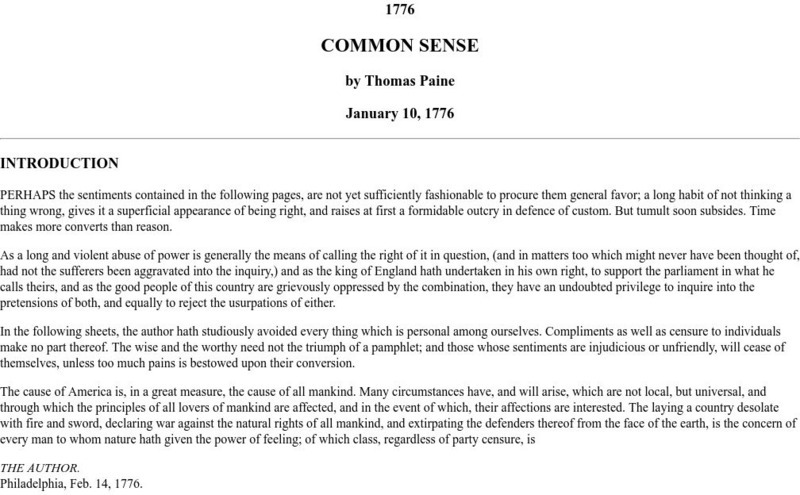
Common Sense Complete Text
Text of Thomas Paine's "Common Sense." Click onto introduction for full text or if you are looking for a specific section, then click onto the heading.
Cengage Learning
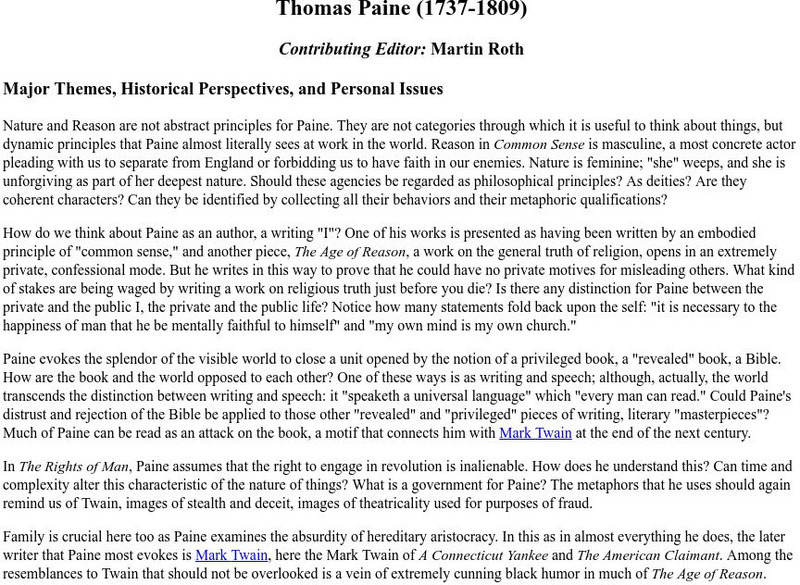
Paine/common Sense
This site takes a brief look into Thomas Paine (1737-1809). The site includes Paine's thoughts and beliefs as well as providing an analysis of his writings.
Other
Media Vision Voices: Meet Thomas Paine
Read an extensive biography of 18th century political writer Thomas Paine, click to read about his ideas placed in a contemporary context, and use research links to read more online.

Learn Out Loud
Learn Out Loud: Common Sense by Thomas Paine
Listen to the text of the most famous pamphlet in American literary history. Available for listening as an excerpt or as the entire work.
University of Groningen
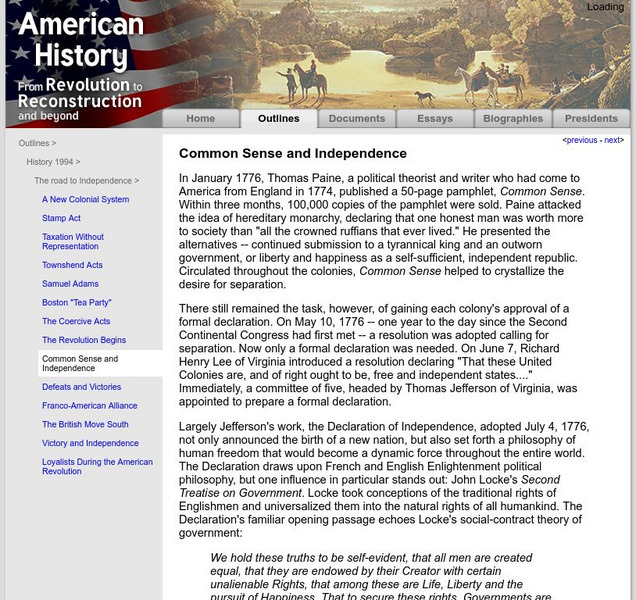
American History: Outlines: Common Sense,independence
Discussion of comparison and contrast of Declaration of Independence and Common Sense. If you click the "documents" link in the sidebar, you can also access the text of Common Sense.
Other
Positive Atheism: The Philosophy of Paine
This site displays the text as delivered by Thomas A. Edison about the philosophies of Thomas Paine (1737-1809 CE). According to Edison, Paine is one of the great members of society who was never recognized for his outstanding achievements.