Hi, what do you want to do?






Curated OER
Chinese Kite
Students create their own Chinese kite. In this multicultural art lesson plan, students use butcher paper, newspapers, string, pipe cleaners and paint to create a Chinese kite. Students follow the given steps and attempt to fly their kite.

Curated OER
Mystery Minerals
Learners minerals and how they form. They investigate the classification of minerals according to physical properties. Students watch a video about mineral characteristics. In groups, learners participate in hands-on activities and...

Curated OER
Polymers: The Discovery
Students examine various polymers. In this polymers lesson, students perform three experiments with polymers to identify them and observe their interesting properties.

Creative Chemistry
Oxidation of Ethanol to Ethanoic Acid
High schoolers covert ethanol to ethanoic acid using a condenser for this oxidation reaction worksheet. They test the smell of the final product, add sodium carbonate, and test the product with indicator paper. They explain their...
Science Buddies
Science Buddies: Shape Changing With the Cyber Squad
In this project, you will make 2-dimensional templates, called nets, that fold up into 3-dimensional (3-D) shapes. By making shapes of different sizes, you will be able to see how 3-D shapes change with size. In your findings you will...

PBS
Pbs Learning Media: The Largest Container: Problems Using Volume and Shape
This interactive exercise focuses on volume equations, measurement, and problem solving skills to compare the volume of 3D figures constructed from similar amounts of construction materials.
Other
Kindergarten Works: 10 Activities for Describing 3 D Shapes in Kindergarten
Describing 3D shapes in Pre-K and Kindergarten is now an expectation as it is a key geometry standard. This resource contains 3D shapes activities and resources for practicing this standard. Included are chants, videos, games, poetry,...
PBS
Pbs Learning Media: Comparing Volumes of Cylinders, Spheres, and Cones
This interactive exercise focuses on comparing volumes between figures that have the same height and diameter and drawing conclusions based on the ratios of the sizes.

National Council of Teachers of Mathematics
The Math Forum: The Cylinder Problem: High School Lesson
Using an engaging approach, this lesson requires students to record the volume of cylinders as a function of the radius. Students will construct and measure the volume of several cylinders and then begin comparing these shapes.
E-learning for Kids
E Learning for Kids: Math: Street Orchestra: 3 D Space
Join Allegro in his street orchestra and learn about 3D shapes.
National Council of Teachers of Mathematics
The Math Forum: The Cylinder Problem: Elementary Lesson
Use this lesson plan to help students learn about cylinders. Students will be creating cylinders, and comparing them and their capacity. This engaging, hands-on lesson will hold student interest and be very beneficial to student learning.
National Council of Teachers of Mathematics
The Math Forum: The Cylinder Problem: Middle School Lesson
This lesson offers an interesting, hands-on experience for middle school students studying cylinders. Students will create cylinders, and measure and compare their volumes.
E-learning for Kids
E Learning for Kids: Math: World of Fish: 3 D Space & Size
Discover the characteristics of 3D shapes in this fantasy world of fish.
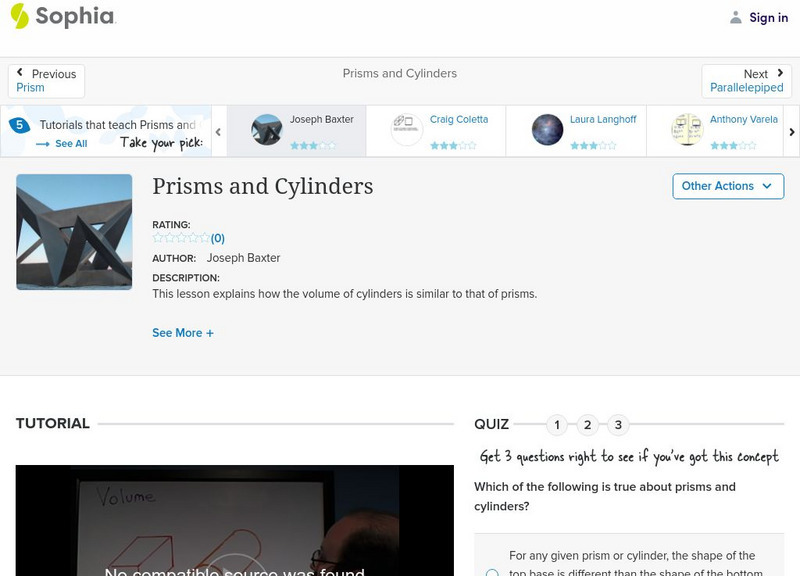
Sophia Learning
Sophia: Prisms and Cylinders Tutorial
Compare a prism and a cylinder in order to determine the similarities of calculating the volume.
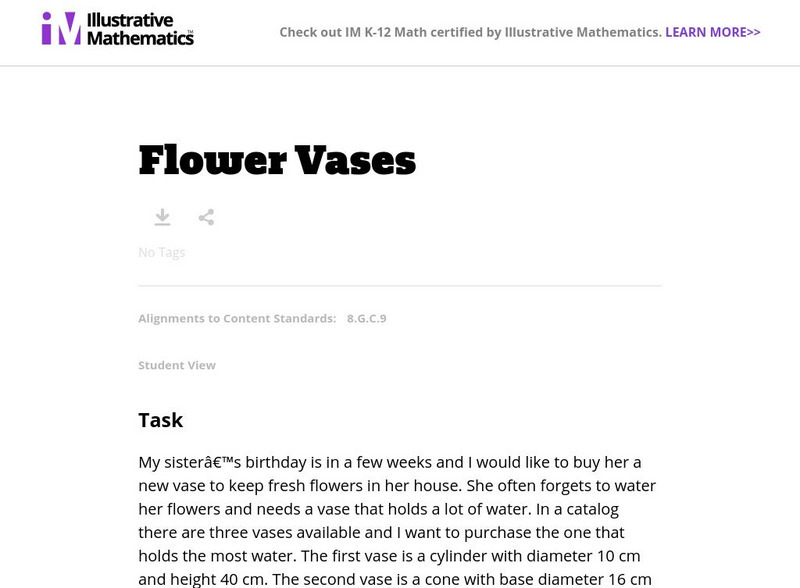
Illustrative Mathematics
Illustrative Mathematics: 8.g Flower Vases
This task asks students to compare the volumes of three vases that are different shapes - a cylinder, a cone, and a sphere - as well as one with a combination of shapes. They are then asked to create a vase with composite shapes, find...
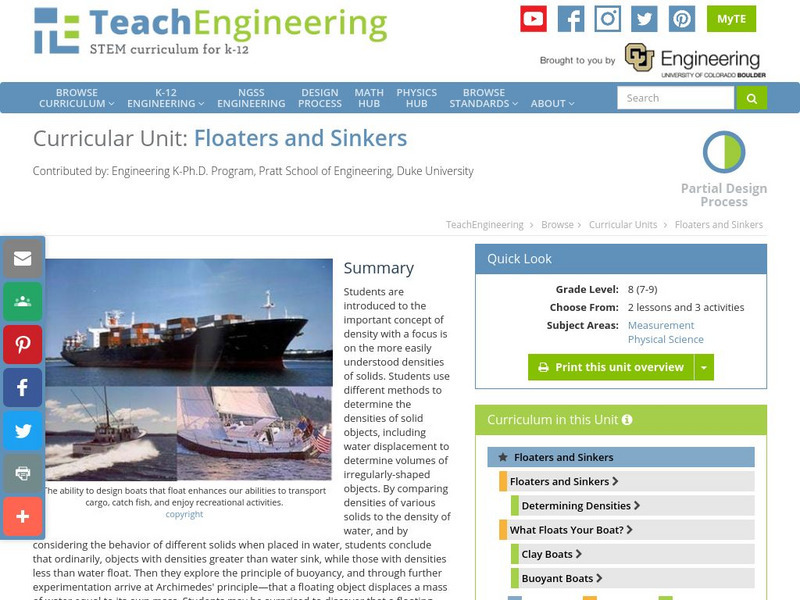
TeachEngineering
Teach Engineering: Floaters and Sinkers
Through this curricular unit, students are introduced to the important concept of density. The focus is on the more easily understood densities of solids, but students may also explore the densities of liquids and gases. Students devise...
TeachEngineering
Teach Engineering: Floaters and Sinkers
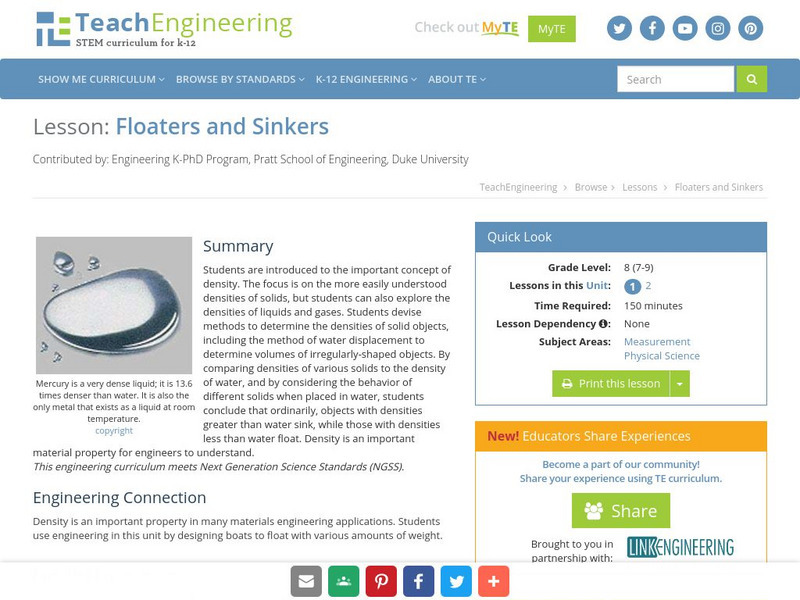
This lesson introduces learners to the important concept of density. The focus is on the more easily understood densities of solids, but students can also explore the densities of liquids and gases. Learners devise methods to determine...
TeachEngineering
Teach Engineering: Density Column Lab Part 2
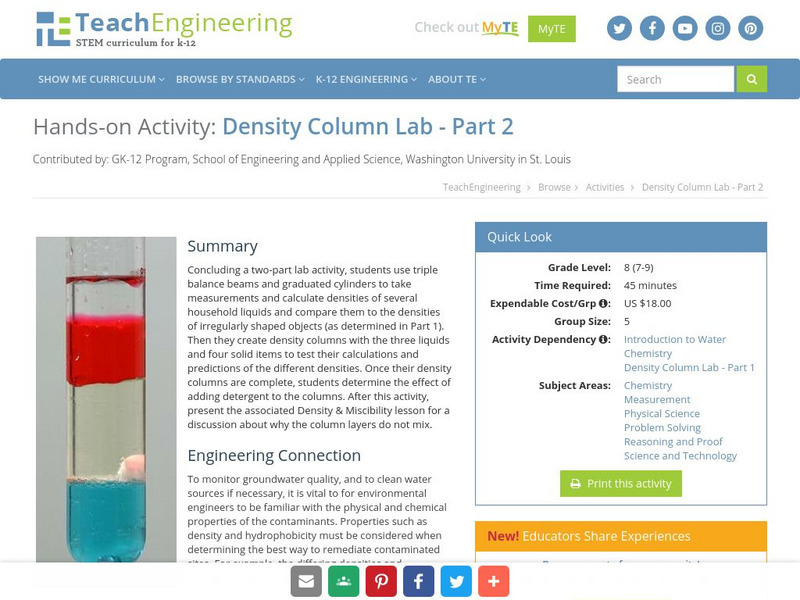
Concluding a two-part lab activity, students use triple balance beams and graduated cylinders to take measurements and calculate densities of several household liquids and compare them to the densities of irregularly shaped objects (as...