Hi, what do you want to do?






National High Magnetic Field Laboratory
Magnet Academy: Drawing Field Lines
A well illustrated activity where students investigate and draw the magnetic field lines created with a bar magnet and a compass.
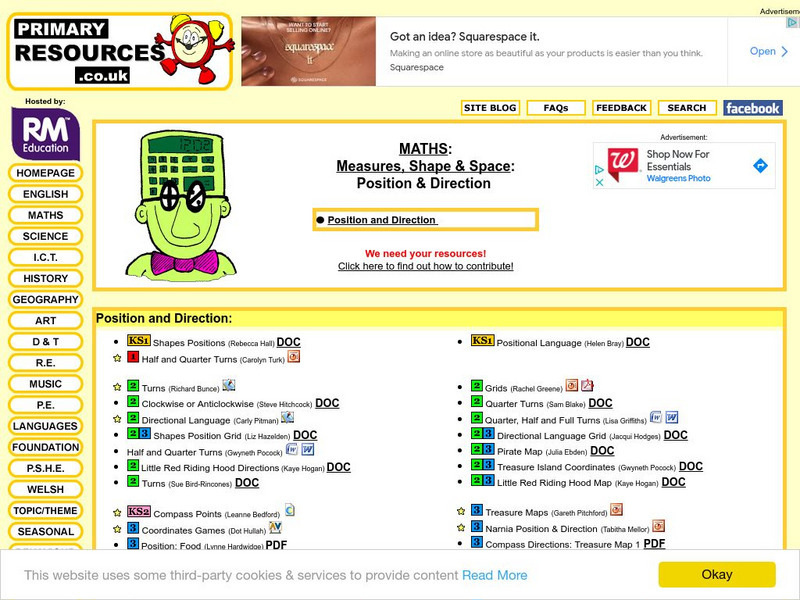
Primary Resources
Primary Resources: Position and Direction
A large collection of teacher resources dealing with position and direction (coordinates and compass directions). Includes worksheets, PowerPoint presentations, games, presentations, and smartboard files.

Exploratorium
Exploratorium: Science Snacks: Circles of Magnetism
Create a magnetic field that is stronger than Earth so a compass needle will orient itself to the new field in this activity.
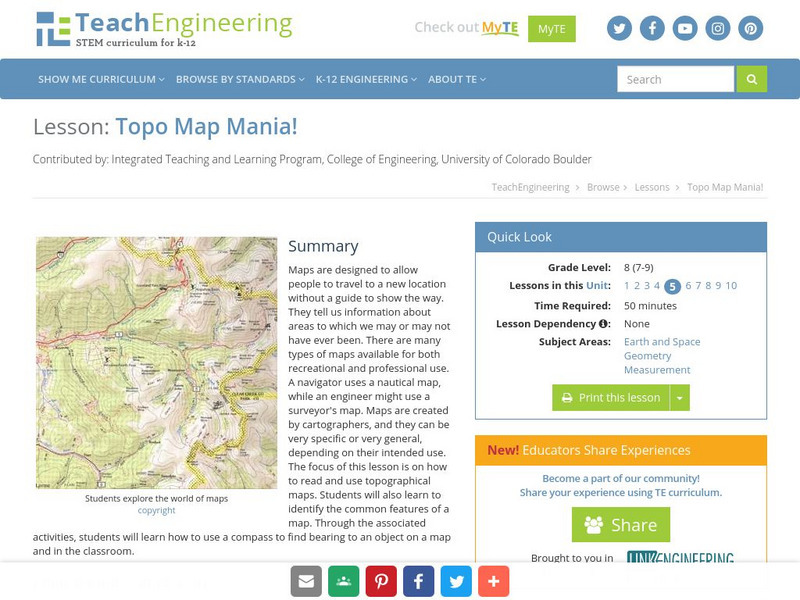
TeachEngineering
Teach Engineering: Topo Map Mania!
Maps are designed to allow people to travel to a new location without a guide to show the way. They tell us information about areas to which we may or may not have ever been. There are many types of maps available for both recreational...
BBC
Bbc: Ks3 Bitesize: Constructions and Locus
This BBC Bitesize focuses on constructions and locus. To understand this activity, you must already know how to define perpendicular, bisect, and locus.
Mariners' Museum and Park
Mariners' Museum: Resources: Age of Exploration
Scroll to the bottom of this page to access activity resources and lesson plans that encourage students to explore an understand the practicalities and difficulties involved in sailing to new places during the Age of Exploration.
American Geosciences Institute
American Geosciences Institute: Earth Science Week: Find Your Bearing: Mapping
In this exercise, learners use compasses to make a map of the school's campus.
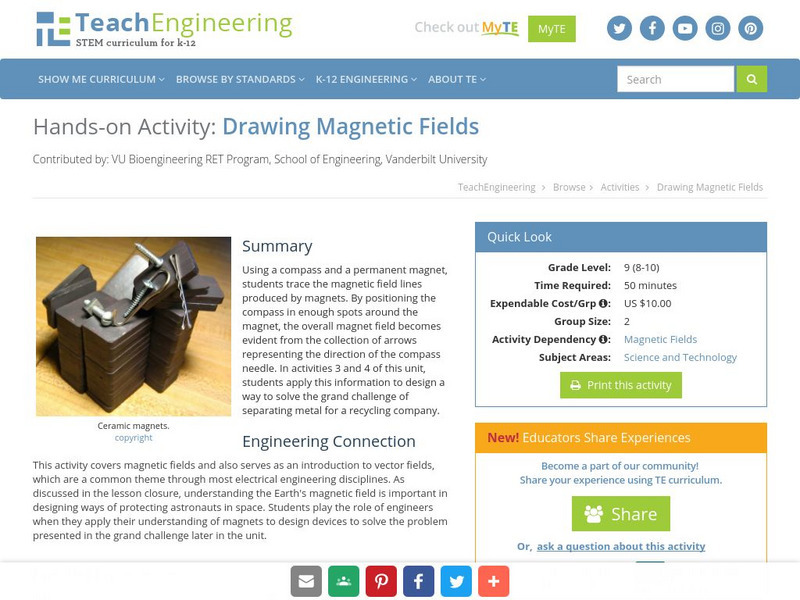
TeachEngineering
Teach Engineering: Drawing Magnetic Fields
Students use a compass and a permanent magnet to trace the magnetic field lines produced by the magnet. By positioning the compass in enough spots around the magnet, the overall magnet field will be evident from the collection of arrows...
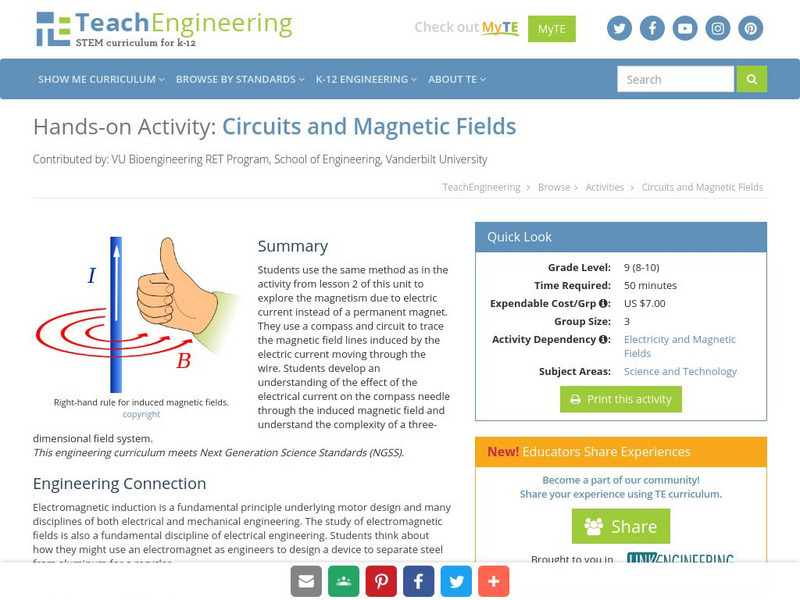
TeachEngineering
Teach Engineering: Circuits and Magnetic Fields
In this activity, students use the same method as in the activity from lesson 2 to explore the magnetism due to electric current instead of a permanent magnet. Students use a compass and circuit to trace the magnetic field lines induced...
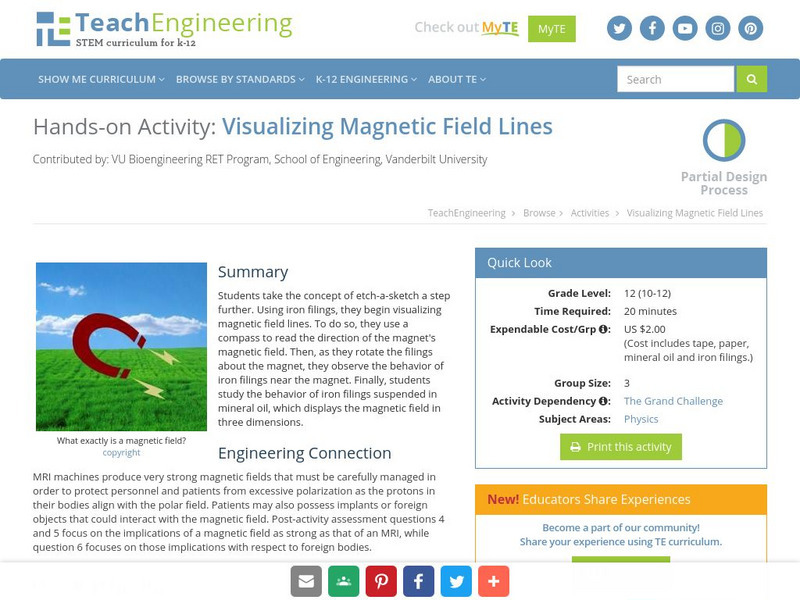
TeachEngineering
Teach Engineering: Visualizing Magnetic Field Lines
In this activity, students take the age old concept of etch-a-sketch a step further. Using iron filings, students begin visualizing magnetic field lines. To do so, students use a compass to read the direction of the magnet's magnetic...

Other
Family Education Network: Heavy Metal
An engaging site that provides interesting facts about magnets. Solve a problem and discover how to create a compass.

ClassFlow
Class Flow: Introduction to Maps
[Free Registration/Login Required] Students are expected to: explain the purpose of a map; identify and use a compass rose; use a grid to locate objects on maps; and use a map key. Activities are hands-on with students manipulating...
Texas Instruments
Texas Instruments: Got an Equilateral Triangle? With Cabri Jr.
Using the Compass tool in Cabri Jr., students will construct an equilateral triangle, and check the length of each side. When a vertices is moved using the Alpha hand, the triangle remains equilateral.
TeachEngineering
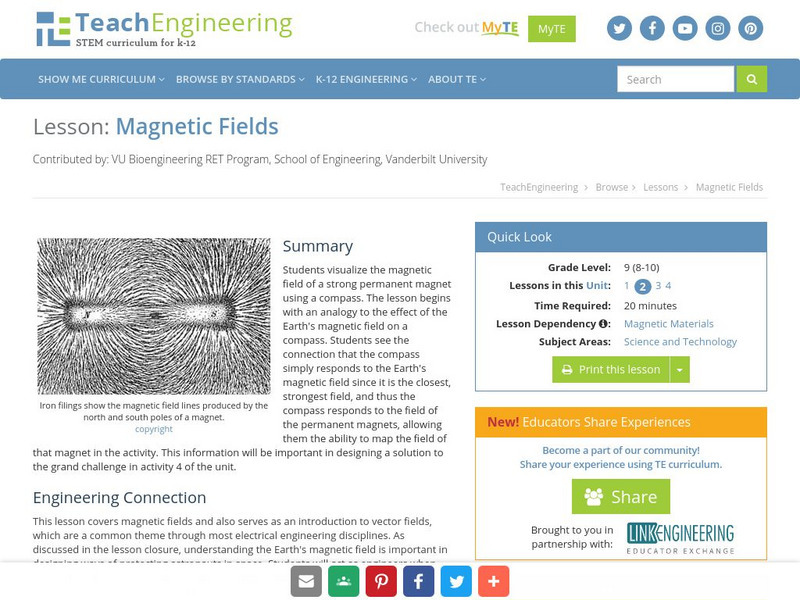
Teach Engineering: Magnetic Fields
Students visualize the magnetic field of a strong permanent magnet using a compass. The lesson begins with an analogy to the effect of the Earth's magnetic field on a compass. Students see the connection that the compass simply responds...
Other
Bc Hydro: Power Smart for Schools: Electromagnetism
This set of activities has middle schoolers using everyday items (batteries, magnets, compasses, iron and paper clips) to reveal the connection between electricity and magnetism. Ideally, students will already have experience building...

Oswego City School District
Regents Exam Prep Center: Concurrence
Find resources for class instruction on concurrence: a lesson on concurrence of medians, altitudes, angle bisectors, and perpendicular bisectors complete with definitions and example diagrams; a six-question practice quiz; and...

Oswego City School District
Regents Exam Prep Center: Mid Segment of a Triangle
Three resources to help you plan instruction on the mid-segment of a triangle: a lesson with definition, properties, and examples of a mid-segment of a triangle; a seven-question quiz through which students can practice working with...

National Geographic
National Geographic: Cardinal Directions and Maps
What are the cardinal directions and how are they used? Discover them and practice using them to find places on maps.
Science and Mathematics Initiative for Learning Enhancement (SMILE)
Smile: About Magnets (Lesson Plan)
This site provides a lesson plan which includes a hands-on activity about magnetism and magnetic fields. Parts of the plan would be easily adaptable as a student project (for any grade level).
Science and Mathematics Initiative for Learning Enhancement (SMILE)
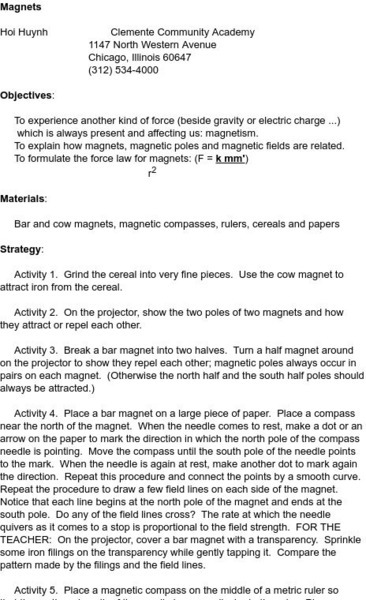
Smile: Magnets (Lesson Plan)
A teacher lesson plan which includes six hands-on activities regarding magnets. Students will be able to experience magnetism; explain how magnets, magnetic poles and magnetic fields are related; and formulate the force law for magnets.
Science and Mathematics Initiative for Learning Enhancement (SMILE)
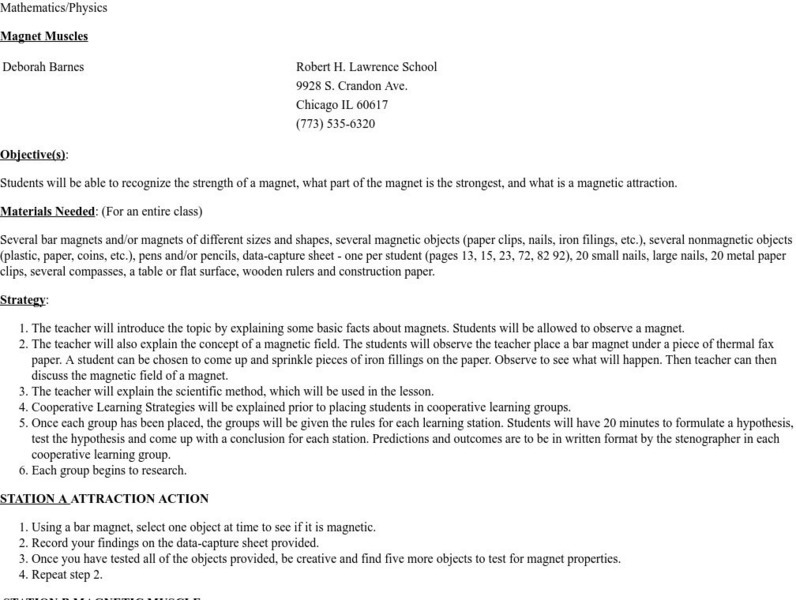
Smile: Magnet Muscles (Lesson Plan)
A teacher lesson plan which includes a station lab; learners navigate through four stations with separate activities on magnetic principles. Easily adaptable as a student project.

My Learning
My Learning: Art4 Maths
Two fun projects to try with your students that get them utilizing math concepts in the art classroom.