Hi, what do you want to do?






Curated OER
World of Escher: Concave and Convex
This website, although mostly for selling artwork prints by M.C. Escher, provides a good picture of Escher's famous piece lithograph, "Convex and Concave." Includes some informative text.
Curated OER
World of Escher: Concave and Convex
This website, although mostly for selling artwork prints by M.C. Escher, provides a good picture of Escher's famous piece lithograph, "Convex and Concave." Includes some informative text.
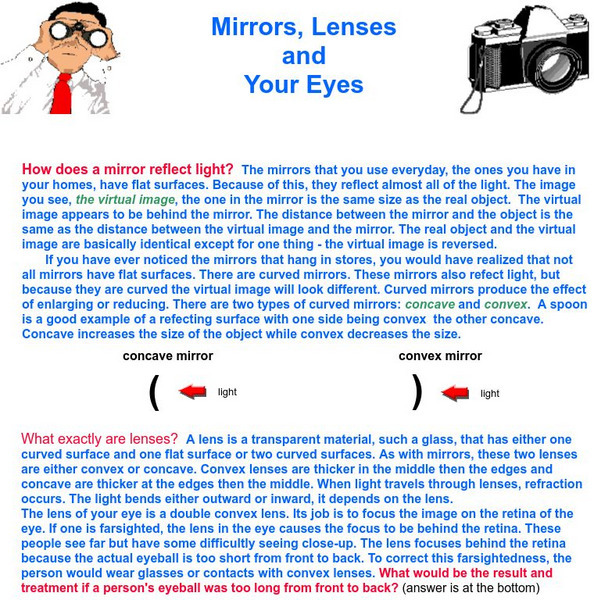
My Science Site
Mirrors, Lenses and Your Eyes
This resource explores the science behind light and how mirrors reflect it. Also contains information on lenses both convex and concave.
Physics Classroom
The Physics Classroom: Refraction and the Ray Model of Light: Anatomy of a Lens
Illustrated diagrams in this tutorial help students understand the properties and functions of lenses.
Mathigon
Mathigon: Geometry: Polygons and Polyhedra: Polygons
This lesson focuses on polygons; a polygon is a closed, flat shape that has only straight sides. Polygons can have any number of sides and angles, but the sides cannot be curved.
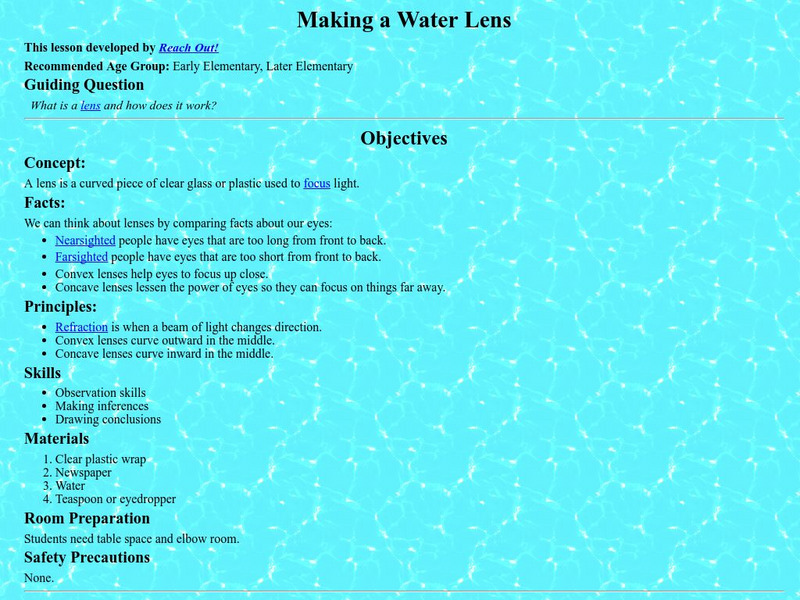
Michigan Reach Out
Making a Water Lens
This site provides a basic experiment that shows how a lens works. This lesson plan explains nearsightedness and farsightedness. It also explains concave and convex lenses.
Optical Society
Optical Society of America: Optics for Kids: Shimmering Lenses
An experiment using Jell-O to create lenses, to see how light behaves with flat, concave, and convex lens surfaces. With an explanation of what is observed, and a link to an informative article on lenses.

ClassFlow
Class Flow: Polygons
[Free Registration/Login Required] This flipchart defines a polygon and the classification of concave and convex polygons.
Optical Society
Optical Society of America: Optics for Kids: Lens Activity
An investigation into how lenses behave. Students explore using convex and concave lenses in various ways and record their observations. They are then are directed to another site to try activities where they can manipulate virtual lenses.

Georgia State University
Georgia State University: Hyper Physics: Mirror Instruments
This site from Georgia State University discusses the means by which mirrors and lenses are combined to produce an optical instrument which accomplishes a specific purpose. Good illustrations.
The Math League
The Math League: Figures and Polygons
This website has basic definitions for most polygons, regular and irregular.
Other
University of Montana: Curved Mirrors
This calculus tutorial with curved mirrors includes narrative and video presentations as well as other interactive tools.
Math Open Reference
Math Open Reference: Polygons
Get the definition and properties of a polygon. Then explore such topics as: 1) types of polygon 2) area 3) Perimeter 4) angles associated with polygons and 5) names of polygons.
Cuemath
Cuemath: Polyhedron
Introduces the concept of polyhedrons by learning the definition, types, and where they are found. Check-out the solved examples for better understanding and try your hand at solving a few interactive questions at the end of the page.

Georgia State University
Georgia State University: Hyper Physics: Ray Diagrams for Mirrors
Provides a discussion of curved mirrors and ray diagrams. Shows and explains the process of drawing a ray diagram to determine the image location, size, and orientation.
Curated OER
Concave & Convex, 1955
This website, although mostly for selling artwork prints by M.C. Escher, provides a good picture of Escher's famous piece lithograph, "Convex and Concave." Includes some informative text.

Ducksters
Ducksters: Physics for Kids: Lenses and Light
Kids learn about lenses and light in the science of physics including concave, convex, converging, diverging, focal point, meniscus, and Plano lenses.

ClassFlow
Class Flow: What Is Light?
[Free Registration/Login Required] This flipchart reviews the characteristics of light and its properties. Students are given examples of reflection, refraction, and lens types. An assessment component is included.
Math Open Reference
Math Open Reference: Irregular Polygon
A complete reference guide to irregular polygons. It provides definitions and an interactive activity that enhances further explanation. Includes links to related topics.
CK-12 Foundation
Ck 12: Interactive Geometry: 1.3 Polygons
Explore the structure and measurement of polygons.

ClassFlow
Class Flow: Introduction to Light
[Free Registration/Login Required] This flipchart introduces fifth graders to the science of light. Principles such as transparent, translucent, opaque, reflection, and refraction are covered. Concave and convex mirrors and lenses are...
Physics Classroom
The Physics Classroom: Image Formation by Lenses
This lesson explains what lenses are, the different between a converging and diverging lens, the difference between a double convex and double concave lens, and gives definitions for terms related to lenses.
Georgia State University
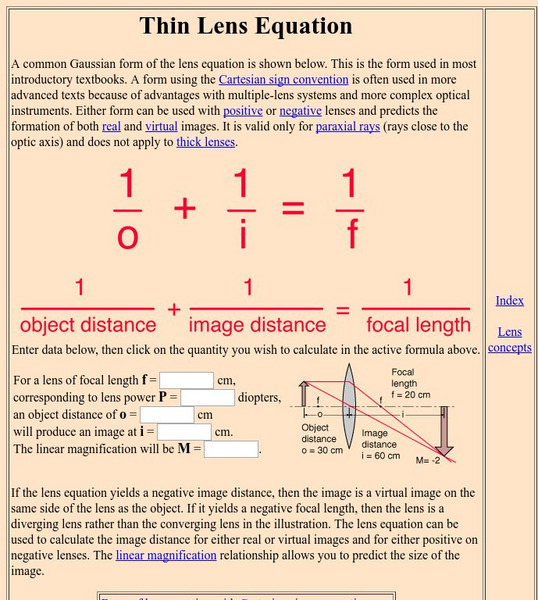
Georgia State University: Hyper Physics: Thin Lens Equation
This is an informative site from Georgia State University. It gives a discussion of the thin lens equation and an illustration of its use in determining the image distance based upon the object distance and the focal length.
Sophia Learning
Sophia: Sum of Angles in Polygons
This tutorial with video and slideshow components investigate the characteristics of polygons as well as how to calculate the interior and exterior angles of any polygon. It offers two PowerPoint presentations and two videos that feature...
Other popular searches
- Convex and Concave Lenses
- Convex and Concave Polygons
- Convex and Concave Mirrors
- Concave and Convex Lens
- Convex and Concave
- Convex and Concave Angles
- Concave and Convex Shapes
- Concave and Convex Spoons
- Concave and Convex Polgons