Hi, what do you want to do?





Sophia Learning
Sophia: Active Transport: Lesson 2
This lesson introduces the process of active transport, explaining that it is a form of transport that requires energy, and moves molecules against their concentration gradient. It is 2 of 4 in the series titled "Active Transport."
Sophia Learning
Sophia: Active Transport: Lesson 4
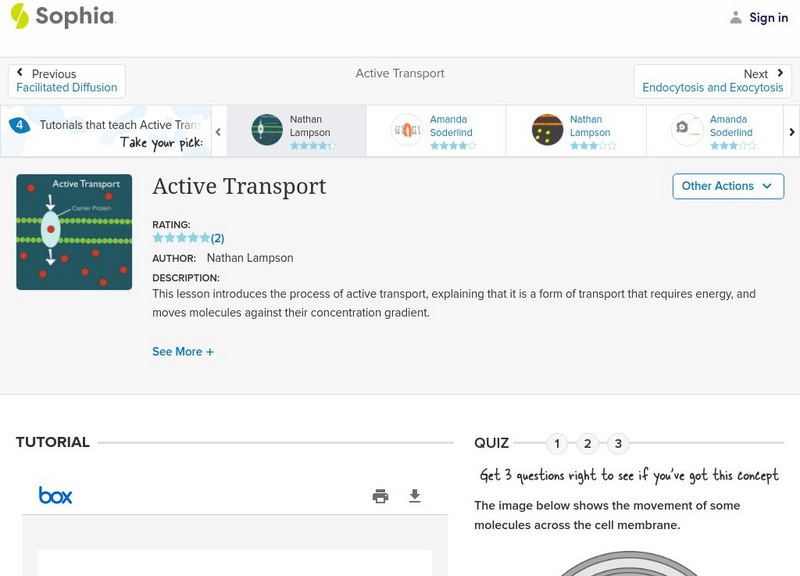
This lesson introduces the process of active transport, explaining that it is a form of transport that requires energy, and moves molecules against their concentration gradient. It is 4 of 4 in the series titled "Active Transport."
Sophia Learning
Sophia: Active Transport: Lesson 1
This lesson introduces the process of active transport, explaining that it is a form of transport that requires energy, and moves molecules against their concentration gradient. It is 1 of 4 in the series titled "Active Transport."
TeachEngineering
Teach Engineering: Active and Passive Transport: Red Rover Send Particles Over
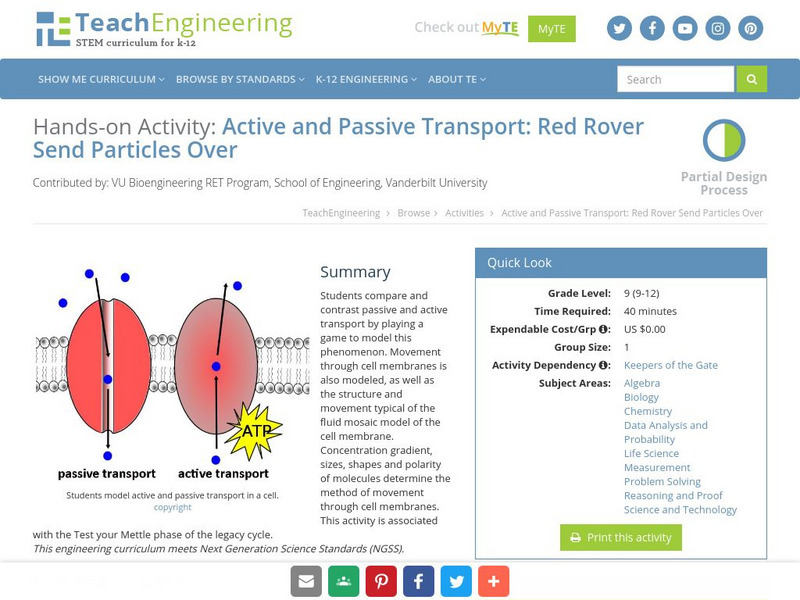
Students compare and contrast passive and active transport by playing a game to model this phenomenon. Movement through cell membranes is also modeled, as well as the structure and movement typical of the fluid mosaic model of the cell...
Sophia Learning
Sophia: Facilitated Diffusion: Lesson 3
This lesson explains the process of facilitated diffusion, explaining that it is a passive form of transport which uses protein channels to move larger molecules down their concentration gradient. It is 3 of 9 in the series titled...
Sophia Learning
Sophia: Facilitated Diffusion: Lesson 4
This lesson explains the process of facilitated diffusion, explaining that it is a passive form of transport which uses protein channels to move larger molecules down their concentration gradient. It is 4 of 9 in the series titled...
Sophia Learning
Sophia: Facilitated Diffusion: Lesson 5
This lesson explains the process of facilitated diffusion, explaining that it is a passive form of transport which uses protein channels to move larger molecules down their concentration gradient. It is 5 of 9 in the series titled...
Sophia Learning
Sophia: Facilitated Diffusion: Lesson 1
This lesson explains the process of facilitated diffusion, explaining that it is a passive form of transport which uses protein channels to move larger molecules down their concentration gradient. It is 1 of 9 in the series titled...

Khan Academy
Khan Academy: Neuron Action Potentials: The Creation of a Brain Signal
Explains how neurons work during the formation and transmission of brain signals.
BBC
Bbc: Gcse Bitesize: Supplying the Cell
For an organism to function, substances must move into and out of cells. Three processes contribute to this movement - diffusion, osmosis and active transport. Diffusion is the process by which useful materials and waste products move in...
CK-12 Foundation
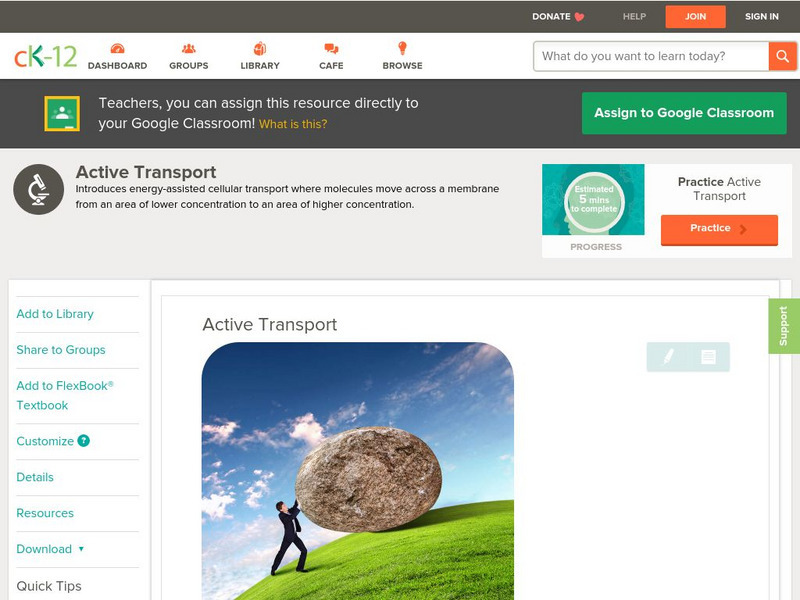
Ck 12: Life Science: Active Transport
[Free Registration/Login may be required to access all resource tools.] During active transport, molecules move from an area of low concentration to an area of high concentration. This is the opposite of diffusion, and these molecules...
Macmillan Education
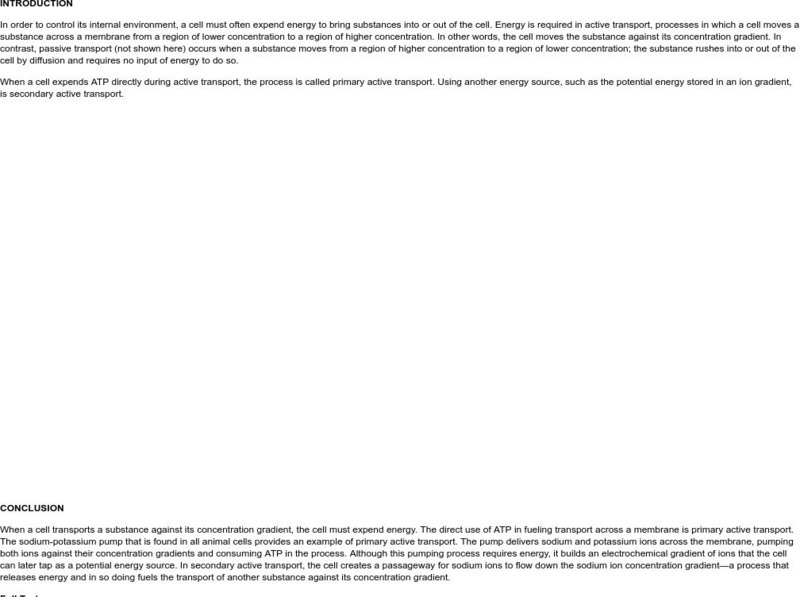
W.h. Freeman Publishing: Active Transport
Moving materials across the cell membrane sometimes requires energy, called active transport. This tutorial covers both primary and secondary active transport with good clear animations.
Simon Fraser University
Chem1 Virtual Textbook: Diffusion: Random Motion With Direction
The General Chemistry Virtual Textbook, or Chem 1, is broken into several sections covering various aspects of topics related to chemistry. This section deals with diffusion along with topics such as concentration gradient and random...
CK-12 Foundation
Ck 12: Biology: Active Transport
[Free Registration/Login may be required to access all resource tools.] Introduction to active transport.