Hi, what do you want to do?






Concord Consortium
Concord Consortium: Molecular Workbench Showcase: Chemistry, Chemical Bonds
Simulations to show students the nature of chemical bonds. Simulations include an explanation of stereochemistry, atomic orbitals, chemical polarity, formation of an atom, and a summary quiz.

Concord Consortium
Concord Consortium: Molecular Workbench Showcase: Physics, Mechanics
A collection of simulations representing concepts discussed in a mechanics unit of physics.
Concord Consortium
Concord Consortium: Molecular Workbench Showcase: Chemistry, Reactions
Simulations that can help students visualize and understand concepts in chemistry like the collision theory, chemical reaction equilibrium, and polymerization.
Concord Consortium
Concord Consortium: Molecular Workbench Showcase: Chemistry, Vapor Pressure
A series of virtual experiments that show students the power and importance of evaporation.
Concord Consortium
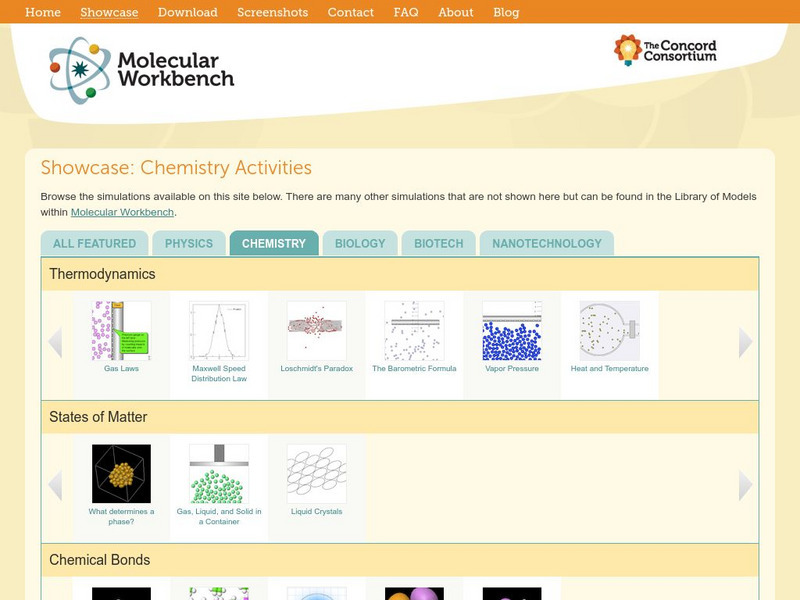
Concord Consortium: Molecular Workbench Showcase: Chemistry, Thermodynamics
Explore some virtual experiments on gases and vapor pressure, the Maxwell speed distribution, the barometric formula, and heat and temperature.
Concord Consortium
Concord Consortium: Molecular Workbench Showcase: Chemistry, States of Matter
See how gas, liquid, and solid molecules react to external pressure in this simulation. Also see a model of intermolecular motion through elliptical particles.
Concord Consortium
The Concord Consortium: Molecular Workbench: When a Ladder Falls
View an animation of a ladder falling due to the force of gravity.
Concord Consortium
The Concord Consortium: Molecular Workbench Micelle Formation
Watch how micelle formation changes in a solution with water compared to a solution consisting of oil.
Concord Consortium
The Concord Consortium: Molecular Workbench Lipids Forming a Monolayer
Interact with lipids and see how they form a monolayer in water and oil.
Concord Consortium
The Concord Consortium: Molecular Workbench: Dna Polymerase
Observe the animated model to see DNA being replicated.
Concord Consortium
Concord Consortium: Molecular Workbench: Collision Between Molecular Particles
View the interactions between an atom of xenon and a buckyball when they collide.
Concord Consortium
Common Online Data Analysis Platform (Codap)
CODAP is a free, easy-to-use data analysis environment for students. Students can load their own data into an easy-to-use web-based data analysis tool to create their own datasets, share visualizations, and discover data-driven insights....
Concord Consortium
What Are the Factors That Affect How Strongly Objects Interact With Each Other?
Exploration of models of electric field to explain how charged objects interact with other objects via simulations, practice and activities. Sponsored by Concord Consortium and the CREATE for STEM Institute at Michigan State University.

Concord Consortium
Seeing Math: Linear Transformer
Transformations of linear functions, with links between the symbolic and graphic forms, can be powerful tools to help students overcome conceptual hurdles in algebra.

Concord Consortium
Seeing Math: Function Analyzer
The Function Analyzer allows learners to see the connections among three representations of a function: symbolic, area, and graphic. In addition, by allowing learners to change the value of four elements of a function - the coefficient...

Concord Consortium
Seeing Math: Quadratic Transformer
The Quadratic Transformer was developed to support the learning of quadratic functions, and in particular to help you understand the connections between symbolic and graphic representations. Indirectly, it also helps you connect either...

Concord Consortium
Seeing Math: System Solver
Deepen your understanding of systems of linear equations with the System Solver. This interactive offers unique opportunity to perform operations on a system and immediately observe the graphic, tabular, and symbolic results of the...

Concord Consortium
Seeing Math: Plop It
Plop It! lets you experiment with the concepts of mean, median, and mode (measures of center). You see the differences among them on a bar graph, as you add or remove blocks to an axis with a given range.
Concord Consortium
How Are Interactions With Water Important for Maintaining My Life?
An investigation of how polar and nonpolar interactions affect shapes of biological molecules and their function. Modules explore the following: 1. Why don't oil and water mix? 2. Can a substance dissolve in both a nonpolar and a polar...
Concord Consortium
What Happens to the Energy of Water Molecules During Hurricanes?
How does energy charge when evaporation is reversed? and What powers a hurricane? are explored in this module.