Hi, what do you want to do?






Concord Consortium
Concord Consortium: Stem Resources: Transistors
Understand what a field effect transistor does as the building blocks of modern electronic devices. The module has several simulations that explore properties of the field effect transistor. Students will learn about logic gates as well...
Concord Consortium
Concord Consortium: Geniverse Software
A collection of virtual labs focusing on genetic activities relating to a made up dragon genome. Students explore how inheritance works by studying different cases and running breeding experiments. By changing alleles, students perform...
Concord Consortium
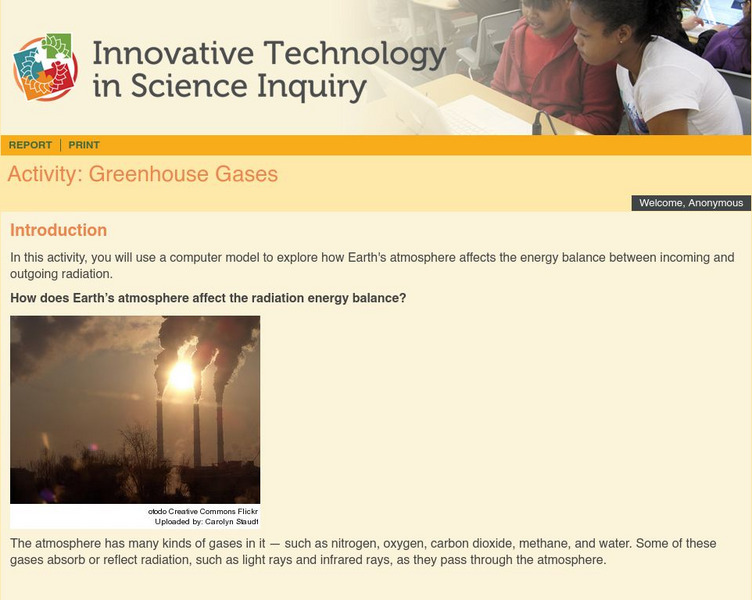
Concord Consortium: Stem Resources: Greenhouse Gases
Do you understand the relationship between temperature and carbon dioxide in our atmosphere? This computer model shows factors such as clouds and carbon dioxide that could cause global temperatures to rise. Students investigate how the...
Concord Consortium
Concord Consortium: Stem Resources: Competition
An interactive activity where students study how two species of producers are affected by a consumer. By completing several virtual experiments and collecting data, students will be able to summarize what plants can do to defend...
Concord Consortium
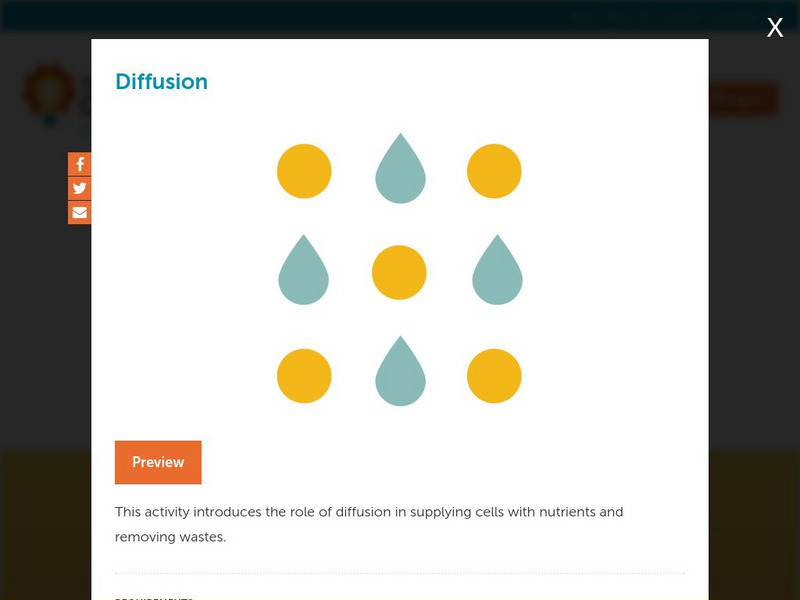
Concord Consortium: Stem Resources: Diffusion
An activity to understand how diffusion is a result of random motion and collisions of particles. With the virtual labs, explore how a drop of food coloring into a glass spreads and how perfume diffuses at different temperatures and...

Concord Consortium
Concord Consortium: Stem Resources: Electrons in Atoms and Molecules
A module with animations, explanations, and questions about the importance of electrons in the structure of an atom. Understand the definition and locations of electrons in the atom. Explore the role of electrons in bonding, polarity,...

Concord Consortium
Concord Consortium: Stem Resources: Intermolecular Attractions
Learn that boiling point, solubility, and DNA are affect by intermolecular forces in this module. Module includes lessons with questions and animations to explain London dispersion and dipole-dipole attractions. To conclude the lessons,...
Concord Consortium
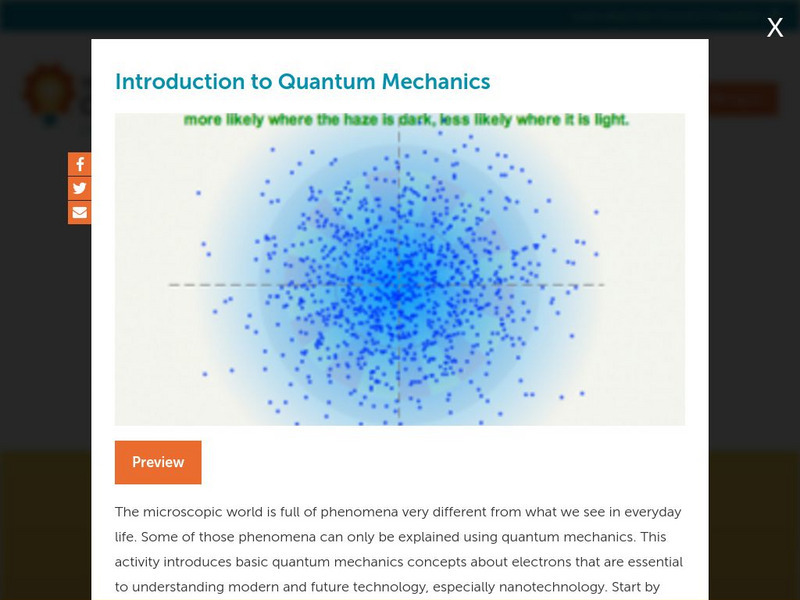
Concord Consortium: Stem Resources: The Quantum Basics of Electrons
Simulations that show the concepts of probability distribution and the behavior of electrons that will help students understanding of quantum mechanics. Students will learn about electrons movement when they are in an excited state. At...
Concord Consortium
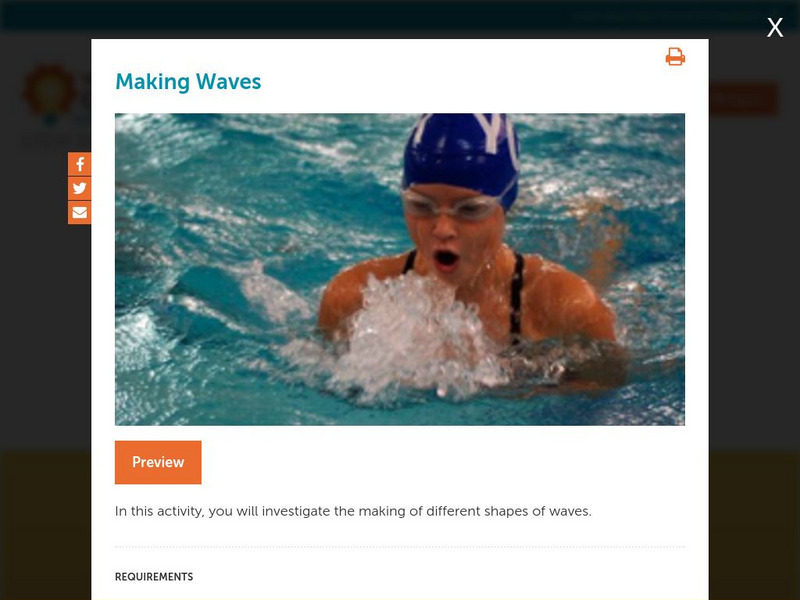
Concord Consortium: Stem Resources: Making Waves
Learn how to make waves! Using a motion sensor, students will recreate distance vs. time graphs given in the lab. Lab gives a detailed procedure as well as questions that can be saved online.
Concord Consortium
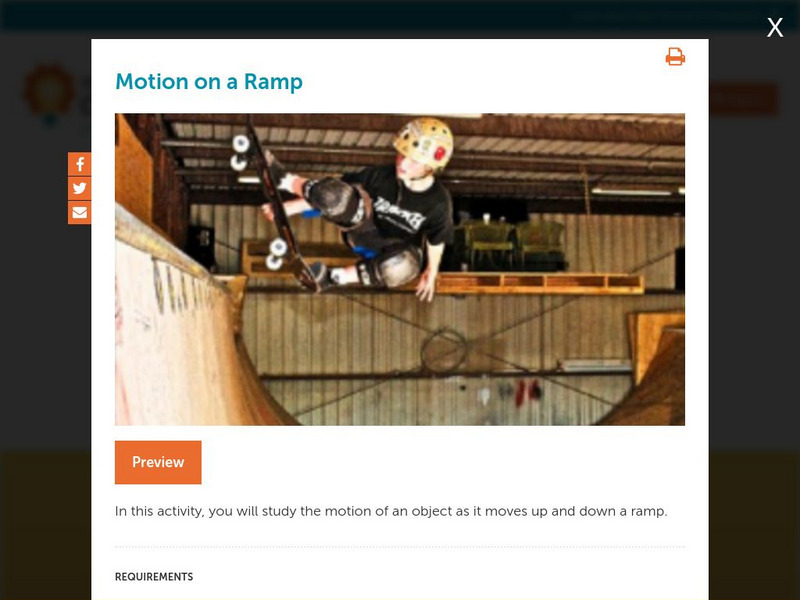
Concord Consortium: Stem Resources: Motion on a Ramp
Using a motion detector, students produce graphs that show the motion of a toy car as it moves on a ramp. Students collect distance versus time graphs and velocity versus time graphs as well as predict what the motion will look like on...
Concord Consortium
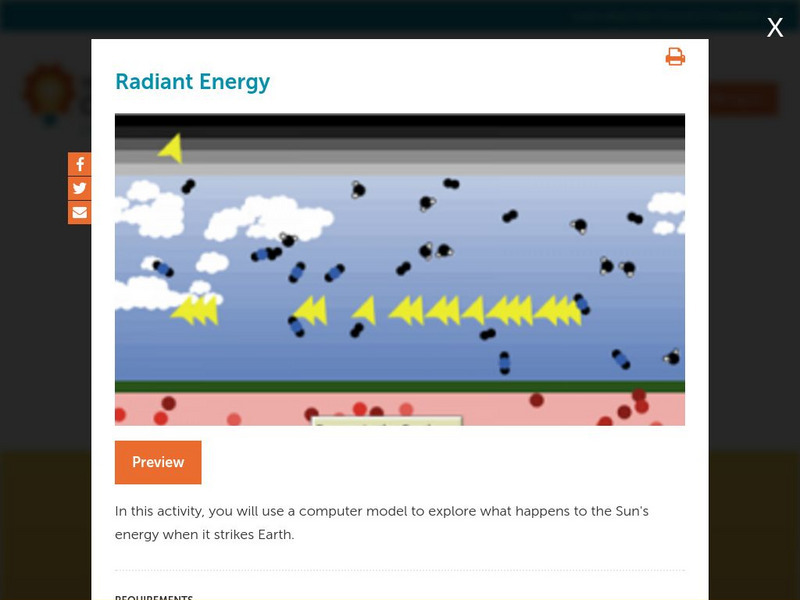
Concord Consortium: Stem Resources: Radiant Energy Flow
A virtual lab to look at the physical features of Earth that affect the amount of the Sun's energy that hits Earth. Students investigate how solar and infrared radiations enters and leaves the atmosphere with this model. Virtual lab...
Concord Consortium
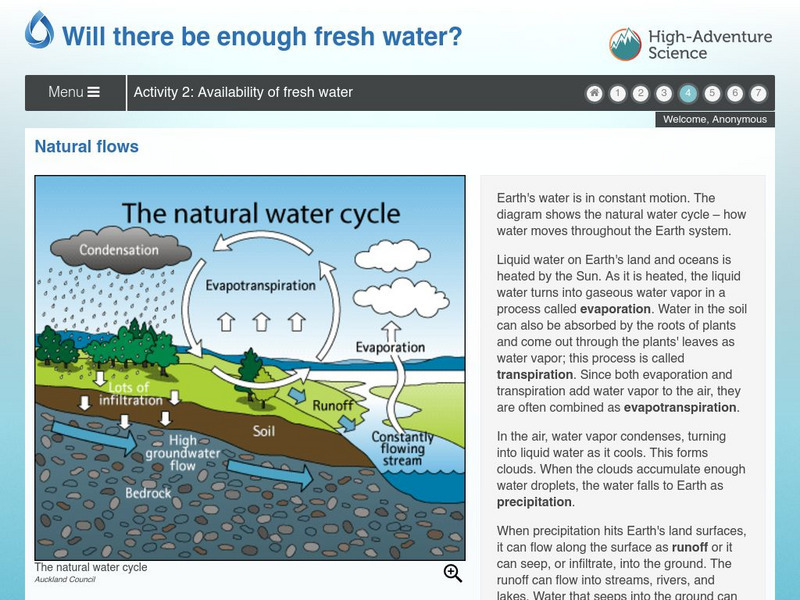
Concord Consortium: Stem Resources: Will There Be Enough Fresh Water?
Using groundwater models, students will analyze whether there will be enough fresh water available for the growing human population. Students will investigate how groundwater moves, what surface water is, and how we can use water...
Concord Consortium
The Concord Consortium: Why Do Some Things Stick Together and Other Things Do Not?
In this learning module, students will observe interactions between objects, including objects with electric charges to identify patterns in how things interact.

Concord Consortium
Concord Consortium: Stem Resources: The Virtual Ecosystem
What does competition for food do to a population? Experience what happens to a rabbit population with limited resources in this virtual ecosystem. At the end of the exercise, there are questions relating to concepts reviewed.

Concord Consortium
Concord Consortium: Stem Resources: The Virtual Field
A virtual lab that explores how offspring inherit different traits from their parents. Investigate these traits both in animals and plants. Understand that variations in offspring can lead to traits that allow survival. Lab includes...

Concord Consortium
Concord Consortium: Stem Resources: The Virtual Greenhouse
A virtual greenhouse to study how plants adapt to live in different environments. Students will "plant" three different types of plants that thrive with different amounts of sunlight. Lab includes questions that could be saved and graded...
Concord Consortium
Concord Consortium: Stem Resources: Variations and Adaptations
Experiment with variations in grass to see which size grows best with different amounts of water. Understand that grass that can live in different levels and change to its environment has a better chance of surviving. Also, experiment...
Concord Consortium
Concord Consortium: Molecular Workbench Showcase:transistors
A learning module that explores the transistor. Learn about the field effect transistor and how transistors are used as switches. Learning module includes interactive activities, assessment, and much more.

Concord Consortium
Concord Consortium: Molecular Workbench Showcase:scanning Tunneling Microscopy
A learning module that investigates a powerful tool to observe and manipulate atoms called the scanning tunneling microscope.
Concord Consortium
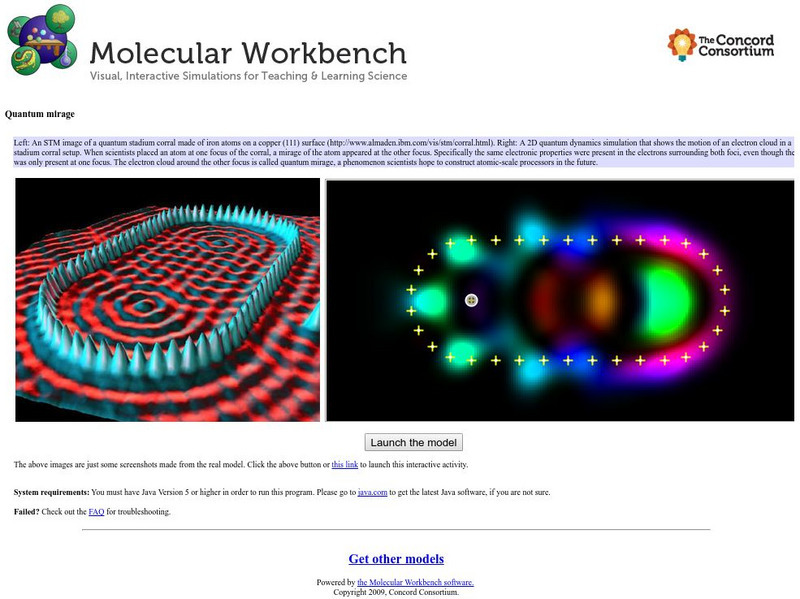
Concord Consortium: Molecular Workbench Showcase: Quantum Mirage
An animation of a scanning tunneling microscope, STM, image of a quantum stadium corral made of iron atoms on a copper surace.
Concord Consortium
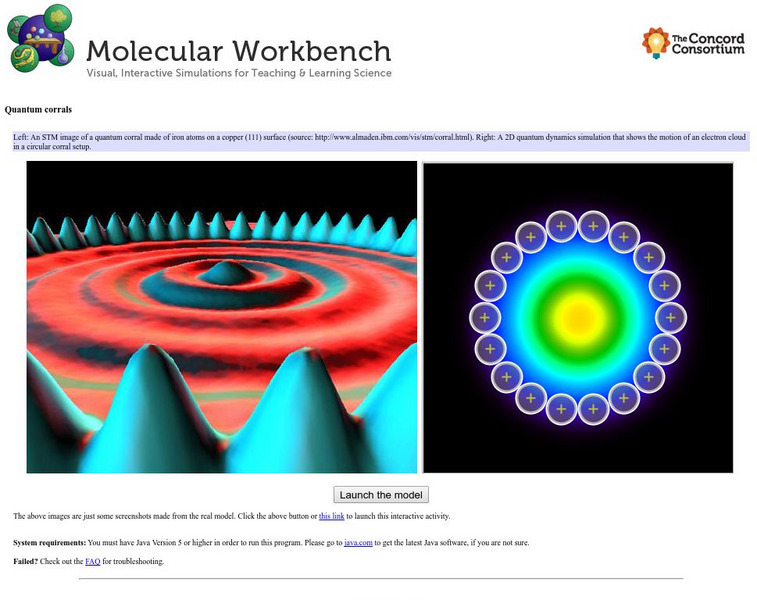
Concord Consortium: Molecular Workbench Showcase: Quantum Corrals
An animation of a quantum corral made by iron atoms on a copper surface.
Concord Consortium
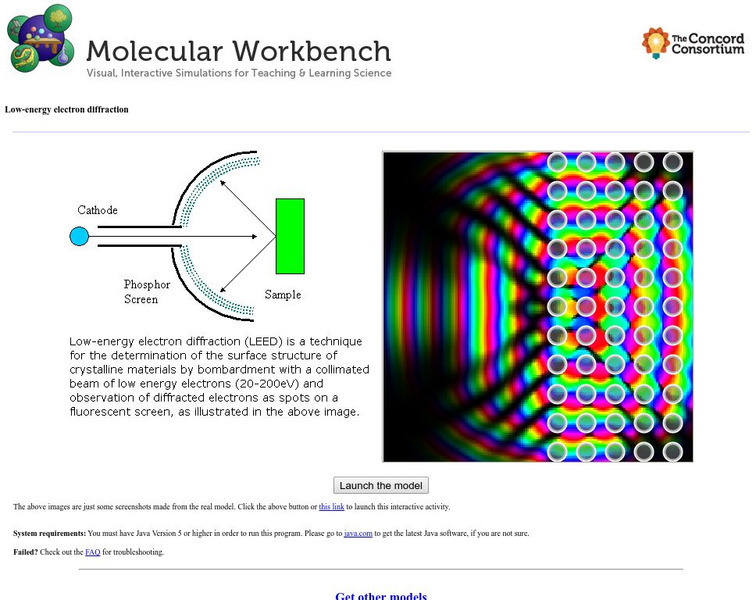
Concord Consortium: Molecular Workbench: Low Energy Electron Diffraction
Learn about the technique used to determine the surface structure of crystalline materials called low-energy electron diffraction in this animation.
Concord Consortium
Concord Consortium:molecular Workbench:quantum Motion in a Static Magentic Field
Explore quantum motion in a static magnetic field in this animation.

Concord Consortium
Concord Consortium: Molecular Workbench Showcase: An Electronic Star Coupler
"This model shows a design of an electronic star coupler that can split an input electric signal into three outputs."