Hi, what do you want to do?






Exploratorium
Hand Battery
Get hands-on in your physical science class by having learners conduct electricity with their own hands! By placing one hand on each of two different metals, a current can be generated and measured on a microammeter. Make an experiement...

Baylor College
Lungometer
Life science learners construct lung-o-meters from gallon-sized milk jugs and then measure their lung capacities. For older students, have them graph the vital lung capacities of each person in the class. Cross-curricular pieces are...

Baylor College
There's Something in the Air
Clever! In order to compare indoor and outdoor dispersal rates for the movement of gases and particles through air, collaborators will participate in a classroom experiment. Set up a circular grid and set learners on lines that are...

National Nanotechnology Infrastructure Network
Can We Absorb Nanoparticle Pollutants?
Just because we can't see it doesn't mean it isn't there! A growing concern for environmental scientists is toxic nanoparticles in our air and water. Young scholars conduct an experiment to demonstrate how these particles can cross our...

It's About Time
Run and Jump
Has your class wondered how fast a human could run or how high they are capable of jumping? Help them understand these concepts as they explore acceleration and use an accelerometer to make semiquantitative measurements of acceleration...

Foundation for Water & Energy Education
How is Flowing Water an Energy Source? Activity B
Explore the world's water without leaving the classroom! In this second of three uncomplicated but wonderful activities, physical science learners feel the pressure of water. They discover that the deeper the water, the stronger the...

Exploratorium
Whack-a-Stack
Go wild as you hit a stack of wooden blocks to demonstrate Newton's first and second laws of motion. The blocks at the top of the stack stay put as you knock one at a time out of the bottom. Note, however, that you will need to...

Foundation for Water & Energy Education
How is Flowing Water an Energy Source? Activity C
Can the force of falling water through a tube vary by altering the diameter of the tube or its height? That is what physical scientists aim to discover in this activity, the third in successively more revealing activities on the power of...
Exploratorium
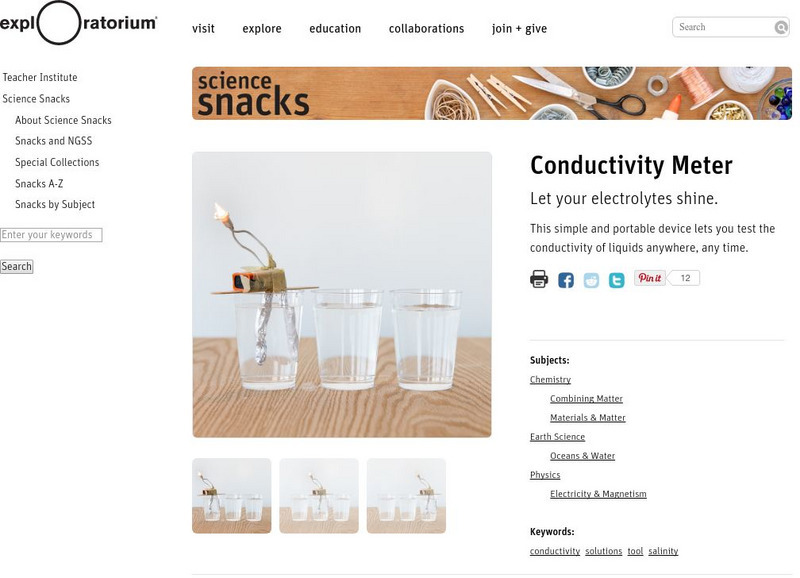
Exploratorium: Science Snacks: Conductivity Meter
Create a conductivity meter with everyday materials in this activity. This conductivity meter is portable and allows students to test the conductivity of liquids easily.
TeachEngineering
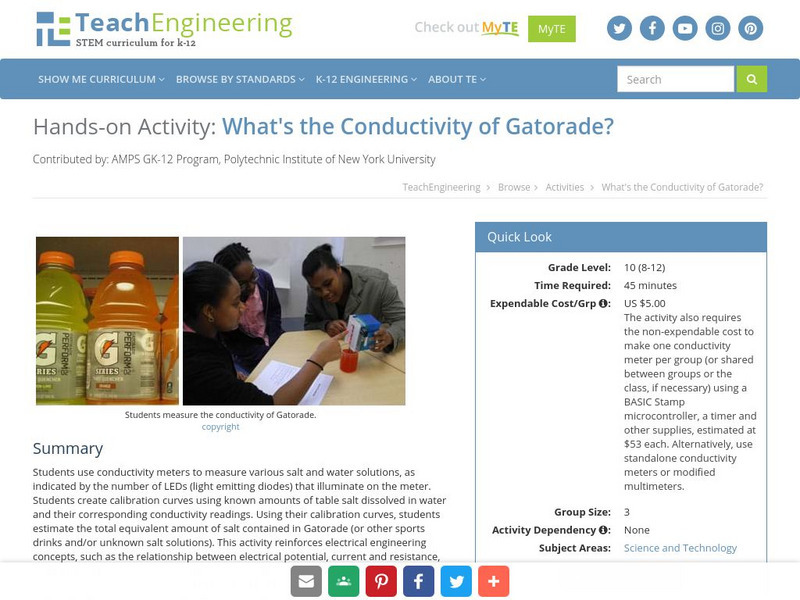
Teach Engineering: What's the Conductivity of Gatorade?
Students use conductivity meters to measure various salt and water solutions, as indicated by the number of LEDs (light emitting diodes) that illuminate on the meter. Students create calibration curves using known amounts of table salt...