Hi, what do you want to do?





Thomson Reuters
Find Law: Article Iii: Judicial Power
Annotations to Article III on the characteristics and attributes of judicial power as related to specific Supreme Court decisions. The author distinguishes between judicial power and jurisdiction.

Thomson Reuters
Find Law: u.s. Supreme Court: Mapp v. Ohio (1961)
Detailed account of the Supreme Court case of Mapp v. Ohio with the ruling that states are required to exclude evidence seized by illegal search and seizure in violation of the 4th Amendment.
Other
Alabama's 1901 Constitution
This simply organized site gives a summary of Alabama's 1901 Constitution. It also gives other details about the Constitution as well as a long list of resources in a bibliography.

The History Cat
The History Cat: The Constitutional Convention: Creating the Constitution
Explains why the Articles of Confederation were not strong enough to hold the country together. One result was a farmers' rebellion in Massachusetts led by Daniel Shays, which was precipitated by a debt crisis that caused many farmers to...

Khan Academy
Khan Academy: Us Government and Civics
An entire course on US government and civics - we don't seem to have any of it; many individual lessons to harvest. Should be cross-checked against embedded videos.
Other
Touro Law Center: William Marbury vs. James Madison
Transcript of the landmark court case that established the constitutional principle of judicial review. Judicial review is the concept that the federal judiciary has final power as to whether an act of the Congress or the Executive...
Independence Hall Association
U.s. History: The Tough Issues
Read about the change of plans when delegates to the Philadelphia convention decided to write a new constitution to replace the Articles of Convention. See the ideas delegates had to address concerns of large and small states.
Other
First Amendment Center
This First Amendment site, partly news and partly background, contains information related to all the aspects of the freedoms outlined in the First Amendment.

Siteseen
Siteseen: Government and Constitution: Preamble to the Constitution
This article contains the history, meaning, and words to the Preamble to the Constitution which encompassed the reasons why the thirteen original colonies separated from Great Britain to become an independent nation.
Other
Pennsylvania Historical & Museum Commission: Independence to the Civil War
Discusses a variety of topics concerning the time period of 1776-1861, including Pennsylvania in the revolution, founding a commonwealth, founding a nation, population and immigration, political developments, industry, transportation,...
Scholastic
Scholastic: Who Shall Judge?
Well-written description of the process, qualifications, and constitutional background on selecting Supreme Court justices.
Thomson Reuters
Find Law: u.s. Supreme Court: Naacp v. Alabama (1958)
Use this site to learn about this Supreme Court decision delivered by Justice Harlan in 1958 that dealt with the NAACP conducting business in Alabama and failure to reveal its membership lists.
C3 Teachers
C3 Teachers: Inquiries: Great Compromise
A learning module on the Great Compromise and the role it played in developing the US Constitution in 1787. It includes several supporting questions accompanied by formative tasks and source materials, followed by a summative performance...
Curated OER
National Park Service: Andrew Johnson National Historic Site
The "Constitutional President," Andrew Johnson lived in this Tennessee historic site for 24 years. Peruse the history, culture, and photographs about the 17th president of the United States. Educators can take advantage of resources....
Curated OER
National Park Service: Andrew Johnson National Historic Site
The "Constitutional President," Andrew Johnson lived in this Tennessee historic site for 24 years. Peruse the history, culture, and photographs about the 17th president of the United States. Educators can take advantage of resources....

Ducksters
Ducksters: Us Government for Kids: Constitution Amendments
Kids learn about the amendments in the United States Constitution. Seventeen not included in the Bill of Rights of the twenty-seven total.

Ducksters
Ducksters: Kids History: The Magna Carta
Study the Magna Carta on this website. Learn about this famous document set the course for English Common Law as well as the US Constitution and Bill of Rights.
PBS
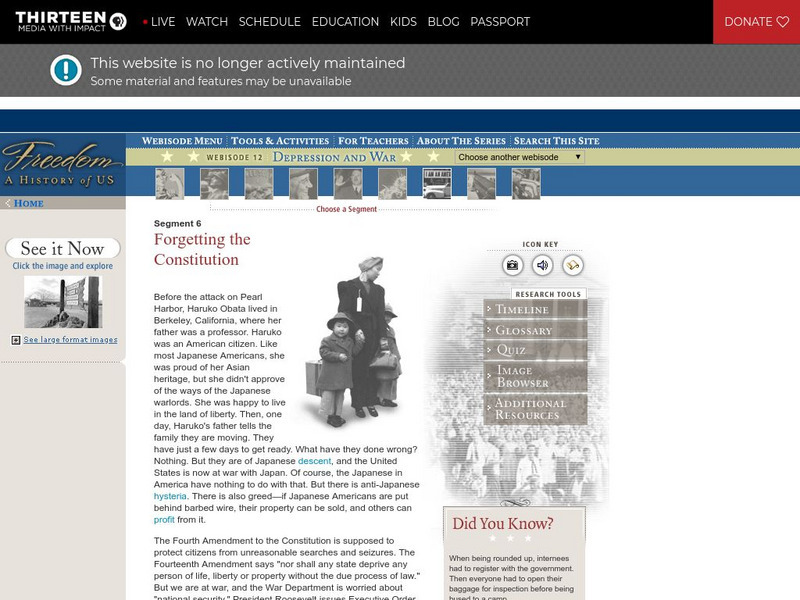
Wnet: Thirteen: Freedom: A History of Us: Forgetting the Constitution
Read the story of a young Japanese-American girl whose family was sent to an internment camp after Pearl Harbor.

Other
Us Courts: Sixth Amendment Activities
Activities for the classroom in which students apply landmark Supreme Court cases to contemporary scenarios related to the right to counsel and right to a fair trial. With plan for teachers, word bank, and links to related resources.
Other
Us Courts: Fourth Amendment Activities
Activities for the classroom on the 4th Amendment in which students apply landmark Supreme Court cases to contemporary scenarios related to search and seizure issues at school, in the car, and the home. With lesson plan and links to...

Bill of Rights Institute
Bill of Rights Institute: Founding Principles
Below, you will find suggested definitions of each principle. Click here to read the words of James Madison, a primary contributor to the Constitution, and other Founders on these principles.
A&E Television
History.com: When the Supreme Court Ruled a Vaccine Could Be Mandatory
In 1901 a deadly smallpox epidemic tore through the Northeast, prompting the Boston and Cambridge boards of health to order the vaccination of all residents. But some refused to get the shot, claiming the vaccine order violated their...
Other
Semper Liber: American Rule of Law the American Way
American rule of law is based on the premise that increase in government means decrease in liberty. That being given, the underlying assumption about American rule of law is that limits must be placed on government, since the tendency of...
Independence Hall Association
U.s. History: George Washington
A brief overview of George Washington and his importance to the success of the new nation, the United States.