Hi, what do you want to do?






Curated OER
Designer Genes
Students view a video on DNA. They discuss mitosis, meiosis and fertilization. They use strips of paper to simulate fertilization and analyze the genotype and phenotype of the combined chromosomes.

Curated OER
Introduction to Elementary Circuits
Students explore how a circuit works and create a circuit to use energy from a battery to light a bulb. In this introduction to circuits lesson, the students study the parts of a circuit and have a class discussion of what would happen...

Curated OER
The Making of an Organ
Middle schoolers examine and research how cells make up our organs. They create a model of a tongue showing cells, tissues and the organ.

Curated OER
Multiple Alleles
Students observe models of the ABO blood system including erythrocytes, antigens, and antibodies. They investigate the antigens that result from certain allele combinations and move antibodies to determine whether agglutination occurs...

Curated OER
Fruitvale Extension
Students determine sources and extent of ground water contaminate, apply mathematics to model in real world simulation, and use technology to present results.

Curated OER
Energy Extravaganza
Tenth graders study how cells and organisms acquire and release energy through photosynthesis and cellular respiration. They explain that living organisms use matter and energy to synthesize a variety of organic molecules and they will...

Curated OER
Gene Regulation Mechanisms
Students explore the control of expression of DNA into proteins which is divided into two main categories: transcriptional and post-transcriptional. They construct examples of the control mechanisms and discuss disease processes that...

Curated OER
Inside the Cranium: Neuropsychiatric Disorders
Students analyze different regions of the brain which are responsible for different aspects of cognition, awareness and regulating the body's process.

Curated OER
The Structure of DNA
Students describe the structure of the double helix, explain how DNA copies itself, and recognize that the sequence of DNA is what makes each individual unique.

Curated OER
Exposure!
Students investigate that chemicals may affect different people in different ways. They also realize that their perceptions of dangerous materials may not be realistic and that the news media may not provide all the information needed to...

Curated OER
Business & Statistics: Final Exam
In this business and statistics worksheet, students read real-life business problems, arrange data, and identify the probability method best used to determine the answer. They identify the type of random sample, draw stem-and-leaf plots,...

Curated OER
What Role Does Light Play Within the Vision Process?
Students are introduced to the relationship between light and vision. In groups, they participate in experiments to discover how different wavelengths are divided in the visible spectrum. They record their answers and discuss their...

Curated OER
The Dichotomy of Viruses
Students benefit from an education about these nonliving pathogens.

Curated OER
From Sunlight to Electric Current
Students explore concept of current in electrical circuits. They examine how energy from the sun can be used to power everyday items, including vehicles.

Curated OER
Genetics
Students explain the difference between dominant and recessive genes, identify what causes differences in the traits of parents and their offspring, and explain how sex is determined. They will also improve their reading and...

Curated OER
Genome: The Secret of How Life Works
Pupils explain how DNA directs the production of proteins.

Curated OER
How Germs Spread
Fourth graders investigate how germs spread in this lesson. They listen to "The Flea's Sneeze" by Lynn Downey and make predictions on why the hog began sneezing. They then conduct an experiment using flour and paper cups demonstrating...

Curated OER
Plant Life Cycle
Fourth graders explore the plant life cycle. They discuss the sequence of events in the life cycle of the plant and illustrate how the life cycle never ends. Students explore the importance of water, sunlight, and nutrients during the...
TeachEngineering
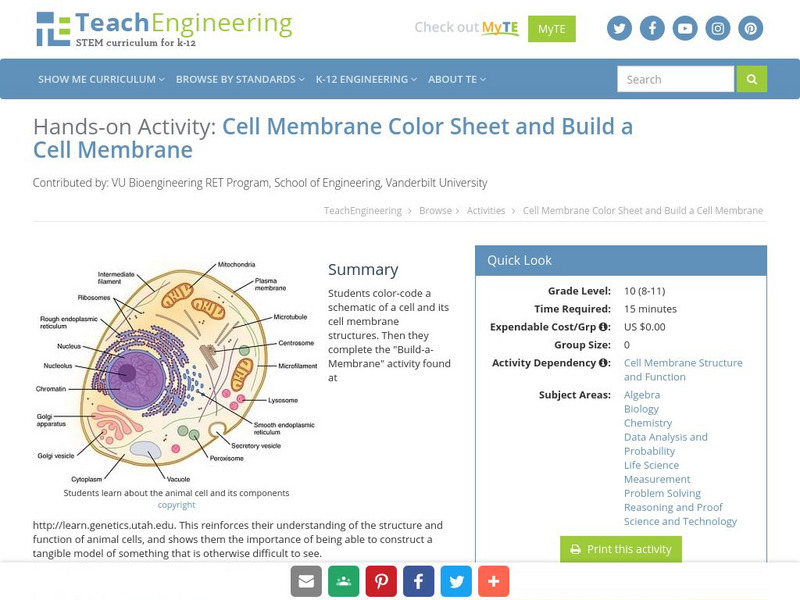
Teach Engineering: Cell Membrane Color Sheet and Build a Cell Membrane
Students color-code a schematic of a cell and its cell membrane structures. Then they complete the "Build-a-Membrane" activity found at http://learn.genetics.utah.edu. This reinforces their understanding of the structure and function of...
Science Education Resource Center at Carleton College
Serc: Animal and Plant Cell Models and Cell Tour Given to Life Science Students
A biology class is divided into two groups: one an animal cell, and the other one, a plant cell. They are given a list of cell organelles to research and construct in their 9 M X 9 M model. Students must organize and assign duties,...
TeachEngineering
Teach Engineering: Exploring Solar Power
This unit provides students the opportunity to explore methods engineers have devised for harnessing sunlight to generate power. Students will initially explore heat transfer and heat storage through the construction, testing, and...