Hi, what do you want to do?






Curated OER
The Castle
Students build a castle to Ravi's design using the cubes. Students then make an original model of a solid object from diagrams which show views from the top, front, side and back. Students describe the reflection of rotational symmetry...

Curated OER
Quadrilateral Explorations
Ninth graders identify quadrilaterals and label the vertices of quadrilaterals. they justify their identification of the quadrilaterals. Students work in groups to identify and create quadrilaterals

Curated OER
One, Two, Three...and They're Off
Students make origami frogs to race. After the race they measure the distance raced, collect the data, enter it into a chart. They then find the mean, median, and mode of the data. Next, students enter this data into Excel at which time...

Curated OER
Geoboard Area
Students explore the basic geometric shapes and geometric shape vocabulary through the use of geoboards and virtual geoboards. They create a variety of shapes with a partner, build ten different rectangles on their geoboards, and...

Curated OER
Water Conservation
Learners explore types of water reserves. In this water conservation lesson, students brainstorm ways water are used in their homes. Learners use a graduated cylinder to simulate the amount of water on Earth and the amount that humans use.

Curated OER
Introduction To Orbital Mechanics
Students use NASA drawings to build a model satellite for a specific mission. They design a set of drawings for their satellite showing its subsystems as well.

Curated OER
Surface Area with Polydrons
Students explore measurements by analyzing geometric shapes. In this surface area lesson, students identify the terms volume, weight, perimeter and area in order to find the requested measurements of specific polygons. Students utilize...

Curated OER
Pump Up the Volume
Fourth graders calculate volume. In this volume lesson, 4th graders calculate, estimate, and compare units of volume in English and metric systems.

Curated OER
Geography: Lengths, Perimeter, and Area of Similar Objects
Sixth graders explore characteristics of similar objects. Using attribute blocks, they explore the ratios of the perimeter, area and side length in similar shapes. They calculate and compare the area of shapes.

Curated OER
Using Geometric Shapes To Make Patterns
Sixth graders explore the use of shapes to create geometric patterns. they start with a simple example of dividing shapes in half to create two new ones. This can be extended to creating intricate patterns.

Curated OER
Congruent Boxes
Learners decorate the congruent faces and edges of boxes in exactly the same way. They teach the terms "congruent," "faces," and "edges" to their parents.

Curated OER
DEAD MAN'S CURVE
Ninth graders, after being given a unique scenario and a task sheet on Dead Man's Curve, calculate and explain the force needed to keep a car on a curve using a set of formulas and a geometric property of circles. They utilize and create...

Curated OER
Exploring Geometric Patterns and Relationships
Sixth graders explore different geographic relationships in like drawing lines, rays, and parallelograms. This lesson could be used for review because it covers more than one concept. The students should have prior knowledge.
Wolfram Research
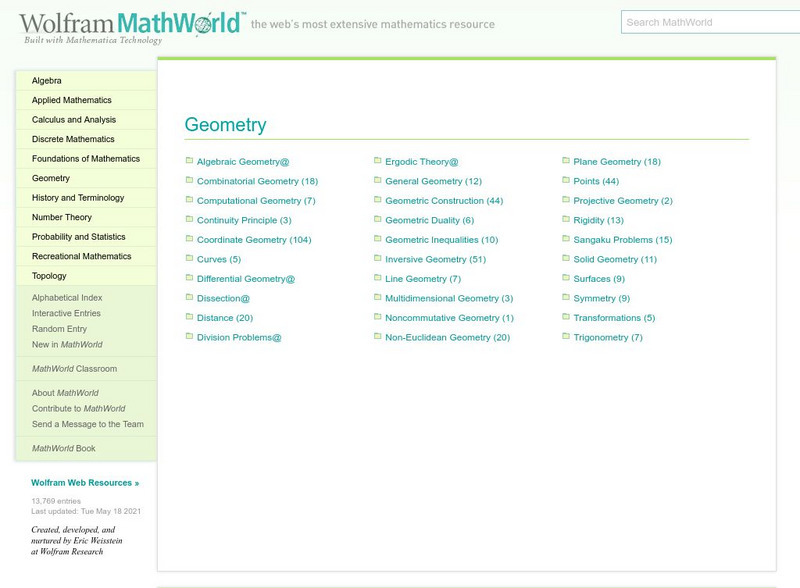
Wolfram Math World: Geometry
This MathWorld tutorial provides detailed overviews of the concepts and theorems associated with geometry. Most of the Math World sites are extensive and some require higher math knowledge to understand, links to terms and topics are...

Oswego City School District
Regents Exam Prep Center: Geometric Constructions
Learn all about the basic geometric constructions in this test prep lesson. You will explore line segments and points, and understand key terms like the terms parallel and perpendicular. Construction activities and interactive online...

Wolfram Research
Wolfram Math World: Math World: Geometric Construction
Offers an explanation of what a geometric construction is and what some of the tools are that are used for it, including the traditional straightedge and compass. The site explains how to construct various polygons inscribed within a...
Texas Instruments
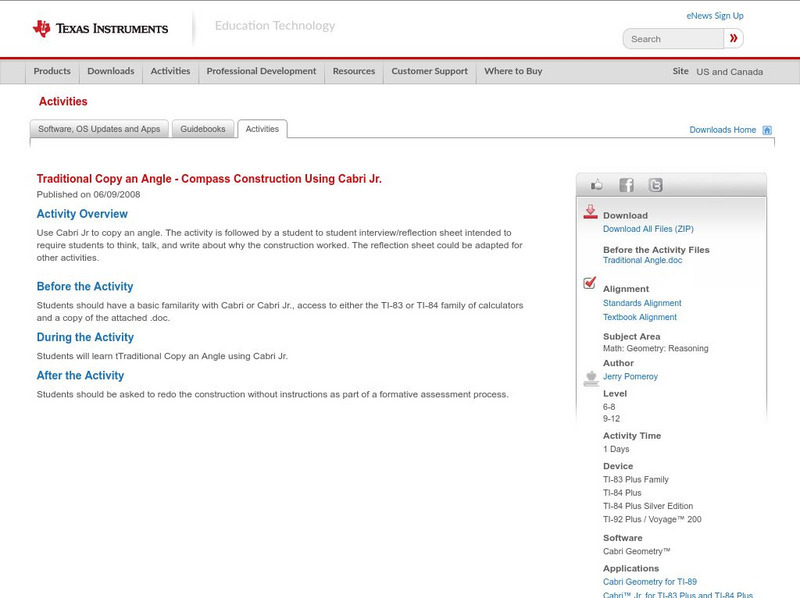
Texas Instruments: Traditional Copy an Angle: Compass Construction Using Cabri
Use Cabri Jr to copy an angle. The activity is followed by a student-to-student interview/reflection sheet intended to require learners to think, talk, and write about why the construction worked. The reflection sheet could be adapted...
Math Is Fun
Math Is Fun: Constructing a Triangle With 3 Known Sides
Students learn how to construct a triangle with three known sides using a straightedge and a compass. Includes an animated demonstration.

Khan Academy
Khan Academy: Activity: Exhibit Design Challenge
From the San Francisco 49er's Museum Education Program which promotes STEAM concepts, students construct a three dimensional (3-D) artifact stand that is the exact replica of "The Catch" which is 70 inches high. Emphasis is placed on...

Physics Classroom
The Physics Classroom: Kinematics: Graphs and Ramps Interactive
Students construct a ramp along which a ball rolls in order to match the given graph. As the ball rolls along the ramp, the motion is plotted in real time, allowing the learner to make adjustments to the ramp in order to successfully...
National Council of Teachers of Mathematics
The Math Forum: The Cylinder Problem: Middle School Lesson
This lesson offers an interesting, hands-on experience for middle school students studying cylinders. Students will create cylinders, and measure and compare their volumes.
Texas Instruments
Texas Instruments: Parallelograms: Discovering Their Properties
Students use the TI-89 with CABRI Geometry to discover properties of parallelograms. They will construct a figure and use the definition to discover the figure is a parallelogram.
Illustrative Mathematics
Illustrative Mathematics: G Co Inscribing a Square in a Circle
In this lesson, students learn how to inscribe a square in a circle. Aligns with G-CO.D.13
SEN Teacher
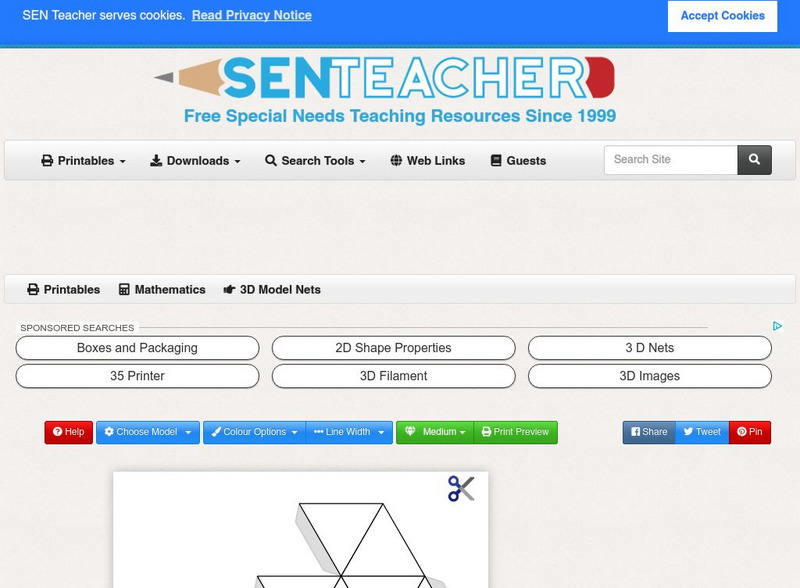
Sen Teacher: Nets
Generate different "nets" for paper construction of common three-dimensional shapes: cube, cuboid, pyramid, cone, tetrahedron, cylinder, octahedron, rhombic prism, dodecahedron, pentagonal prism, and pentagonal prism.