Hi, what do you want to do?






Council for Economic Education
Econ Ed Link: Believe It or Not?
This lesson reveals to learners how advertisers use words and images to make goods and services look their best. To protect consumers and make sure that competition among sellers is fair in the marketplace, the federal government...
Council for Economic Education
Econ Ed Link: Bringing the Market to the Farm
This printable lesson discusses producers and consumers from an agricultural perspective. It focuses on choices that the consumer has with regard to purchasing agricultural goods (e.g. fruits and vegetables). As an example, it uses...
Council for Economic Education
Econ Ed Link: Are the Best Things in Life Free?
Learners use economic reasoning to analyze the costs and consequences of choice. The idea that the best things in life are free is widely expressed as a maxim by people who know nothing of its origin. They know it's true through...
Council for Economic Education
Econ Ed Link: Clipping Coupons
In this instructional activity, students will calculate savings for different products when using coupons. They will also decide what factors will influence the choices they make when choosing products.
Council for Economic Education
Econ Ed Link: Guess Who's Coming to Dinner
This lesson introduces regulation and information as two tools used by government to promote fair competition and complete information in a market economy. Using the 1906 Pure Food and Drugs Act as a case study, students explore the...
Education Development Center
Tune in to Learning: Is Paying Over Time a Smart Move?
At T.V. 411 you can explore the concept of paying over time with situations involving credit cards, rent to own items, and more. This interactive lesson gives the learner an opportunity to make decisions about money management.
PBS
Pbs Kids: Don't Buy It: Get Media Smart!: Create a Pop Star
Follow the story line to create a pop star. You must make good financial choices to achieve success. You can also quiz yourself about commercials and other uses of music.
Other
The Mint: Take the Spending Challenge
This is an interactive game in which students are given an allowance and opportunities to spend money with friends They must make decisions on what to buy, whether to pay cash or with credit, or to save.
Scholastic
Scholastic: Study Jams! Science: Ecosystems
A video and a short multiple-choice quiz on the topic of ecosystems, covering biotic and abiotic factors, and the roles organisms play in an ecosystem.

Scholastic
Scholastic: Study Jams! Science: Ecosystems: Food Webs
A video and a short multiple-choice quiz on food webs that explains the difference between food webs and food chains, and the relationships that exist between organisms.
Soft Schools
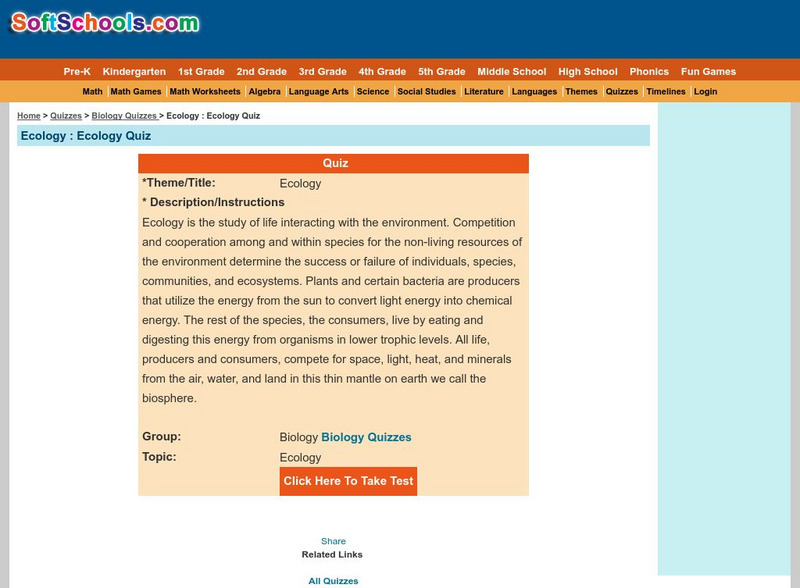
Soft Schools: Ecology Quiz
Take this interactive, multiple-choice quiz over concepts in ecology, then review your score and any missed questions at the end.
Scholastic
Scholastic: Study Jams! Science: Ecosystems: Food Chains
A video and a short multiple-choice quiz on food chains that explains how energy flows through the chain, beginning with plants.

Alabama Learning Exchange
Alex: Eat, Drink, and Be Healthy
In this lesson, learners evaluate their eating habits, focusing on the ways in which one can assess whether or not his or her diet is nutritious. Students will work in small groups to design a menu for a healthy lunch and write a...
Council for Economic Education
Econ Ed Link: Satisfaction Please! (Part I)
Even the savviest consumer has a problem with a good or service on occasion. It is a consumer's right to complain when there is a genuine problem. In some situations, it is also a consumer's responsibility. A problem can't be fixed if no...
Council for Economic Education
Econ Ed Link: To Buy or Not to Buy
While precise numbers are not known, it is believed the number of boycotts has grown markedly in the past fifty years. Consumers seem to be besieged by requests from special interest groups to refrain from buying certain goods and...
Council for Economic Education
Econ Ed Link: Marketplace: Real(ity) Estate
This lesson plan teaches young scholars about opportunity cost through some steps of buying a house. It also shows students how advertising affects consumer decision-making.
Thinkport Education
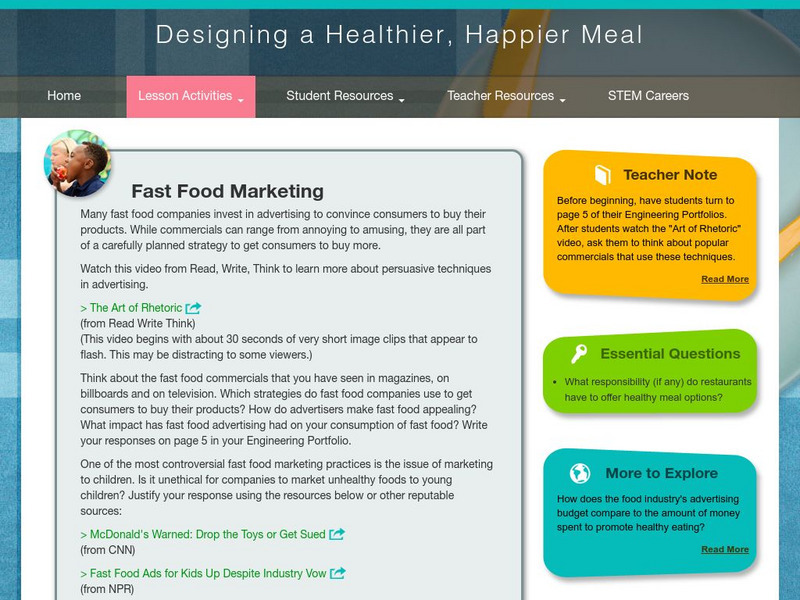
Thinkport: Designing a Healthier, Happier Meal: Fast Food Marketing
Find out how many fast food companies invest in advertising to convince consumers to buy their products.

Federal Trade Commission
Federal Trade Commission: You Are Here
In this interactive mall environment, students learn how to make smart decisions as consumers. Whether shopping for clothes, choosing the best food deal, searching for a job or buying a cellphone, students will learn how to recognize...

Khan Academy
Khan Academy: Utility Maximization
Practice applying the utility maximization rule in this exercise.
Council for Economic Education
Econ Ed Link: Buying vs. Renting
Have you given any thought to where you will live when you are "on your own" - out in the world earning a living? You will have many decisions to make as you look for a place to call home. In this lesson, your basic economic decision...
Council for Economic Education
Econ Ed Link: My Credit Rating: Why Should I Care?
Credit is a wonderful tool for the consumer. It can enhance your quality of life. It enables you to buy and enjoy a purchase before you have the money to pay for it. On the other hand, it can create serious problems for people who use it...
Council for Economic Education
Econ Ed Link: Q T Pi Fashions Learning About Credit Card Use
Credit cards are convenient, user-friendly, and at times dangerous. In this lesson, students learn the joys and dangers of using credit as they help Credit, the main character in this activity, solve her credit problems.
Consumer Financial Protection Bureau
Consumer Financial Protection Bureau: Paying for College
A website dedicated to helping students make informed financial decisions through their road to college. Website focues on filling out financial aid to choosing a loan.
Council for Economic Education
Econ Ed Link: If I Ran the Zoo Economics and Literature
Welcome to the Zoo! In this two-day lesson you will use Dr. Seuss' If I Ran The Zoo book to introduce the economic concepts to your students. You will also get the chance to use actual zoo criteria to help a zoo "choose" new animals.