Hi, what do you want to do?






Cato Institute
Atm Surcharges and the Expansion of Consumer Choice
This site is an essay that by advocates of ATM surcharges.
Consumer Financial Protection Bureau
Consumer Financial Protection Bureau: Creating a Buying Plan
Students practice creating a buying plan and apply this strategy to provide buying advice to others.
Practical Money Skills
Visa: Practical Money Skills for Life: Financial Football
Football-themed game tests your consumer-finance aptitude regarding interest, banking, credit, budgeting, saving, and spending.
Other
Wisconsin Educational Communications Board: Financial Literacy: Teach It!
Students at all grade levels learn about basic finance skills and explore ways to make informed decisions about their financial future.
Other
Smart About Money: 40 Money Management Tips Every College Student Should Know
[PDF] This downloadable brochure will help high school students prepare for the financial decisions they will need to make once high school is over.
PBS
Pbs Learning Media: Environmental Public Health: Taking Action for a Clean Environment
In this media-rich, self-paced lesson, students explore activism - taking action to bring about change - including some causes that activists espouse and the tactics that they use to end harmful practices or reshape policies. The lesson...
Council for Economic Education
Econ Ed Link: Clipping Coupons
Explore this website to find out how and why consumers make choices on what products to buy. Learn how producers entice consumers into buying their products. This is a very informative lesson plan.
Council for Economic Education
Econ Ed Link: Satisfaction Please! (Part I)
Even the savviest consumer has a problem with a good or service on occasion. It is a consumer's right to complain when there is a genuine problem. In some situations, it is also a consumer's responsibility. A problem can't be fixed if no...
Council for Economic Education
Econ Ed Link: Bringing the Market to the Farm
This printable instructional activity discusses producers and consumers from an agricultural perspective. It focuses on choices that the consumer has with regard to purchasing agricultural goods (e.g. fruits and vegetables). As an...
Council for Economic Education
Econ Ed Link: Believe It or Not?
This lesson reveals to learners how advertisers use words and images to make goods and services look their best. To protect consumers and make sure that competition among sellers is fair in the marketplace, the federal government...
Council for Economic Education
Econ Ed Link: Show Me the Money!
Young scholars will investigate unforeseen costs of car loans and/or house loans. They will then evaluate the economics of decision making, the ramifications of their choices, and options available to them. Students will compute costs...
Council for Economic Education
Econ Ed Link: Be an Energy Saver
This lesson focuses on the scarce and non-renewable nature of fossil fuels in order to stimulate student thinking about energy conservation. It emphasizes the fact that saving energy can be good for the wallet as well as the earth's...
Council for Economic Education
Econ Ed Link: Cpi the Crystal Ball
Governments and other financial organizations are constantly measuring trends in the economy to try to predict what will happen next. The ability to successfully predict economic trends has a profound effect on whether or not a business...
Council for Economic Education
Econ Ed Link: Costs and Benefits of 'The Three Little Pigs'
Find out what the definition of a cost and a benefit is in terms of the economy when using this site. "When making a decision, students should consider the costs and the benefits of that decision."
University of Nebraska Omaha
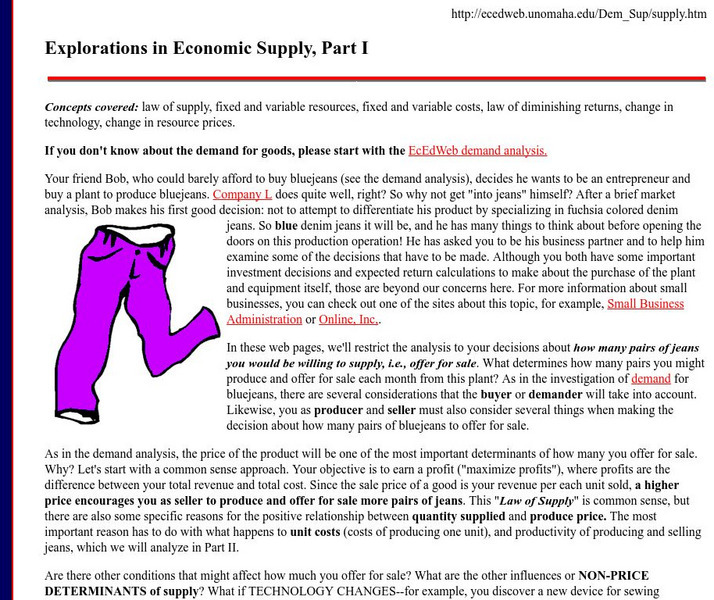
Ecedweb: Explorations in Economic Supply, Part I
Examines how supply relates to economic decision making. Using the example of purchasing blue jeans, students take the role of producer to determine how many blue jeans they would supply to the market. Includes links and discussion...
Council for Economic Education
Econ Ed Link: To Buy or Not to Buy
While precise numbers are not known, it is believed the number of boycotts has grown markedly in the past fifty years. Consumers seem to be besieged by requests from special interest groups to refrain from buying certain goods and...
Council for Economic Education
Econ Ed Link: Business Ownership: The Franchise Option
Students explore an alternative to starting a business from scratch- investing in a franchise. They begin by considering the pros and cons of a franchise and whether this form of business is an option that would fit their personality and...
Council for Economic Education
Econ Ed Link: The Best Deal
Students will learn how to determine 'price per unit' to help make decisions when comparing products.
Education Development Center
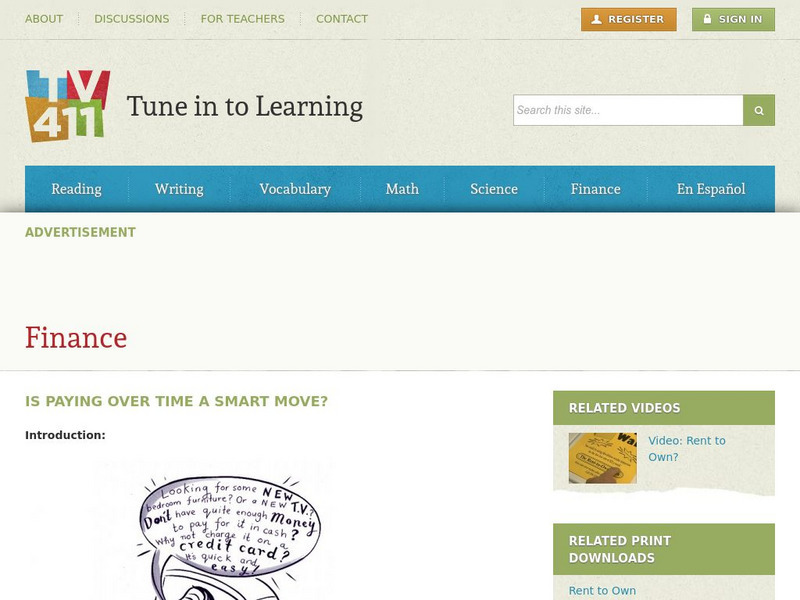
Tune in to Learning: Is Paying Over Time a Smart Move?
At T.V. 411 you can explore the concept of paying over time with situations involving credit cards, rent to own items, and more. This interactive lesson gives the learner an opportunity to make decisions about money management.
Council for Economic Education
Econ Ed Link: Clipping Coupons
In this instructional activity, students will calculate savings for different products when using coupons. They will also decide what factors will influence the choices they make when choosing products.
Council for Economic Education
Econ Ed Link: Guess Who's Coming to Dinner
This lesson introduces regulation and information as two tools used by government to promote fair competition and complete information in a market economy. Using the 1906 Pure Food and Drugs Act as a case study, students explore the...
Scholastic
Scholastic: Adventures in Math: Lesson 2: Saving Money by Finding the Better Buy
Students will be able to make economically sound purchasing decisions by using unit pricing, calculating discounts, and analyzing fixed and variable costs.
Council for Economic Education
Econ Ed Link: The Euro Makes Its Debut
On Jan. 1, 1999 11 European countries united in the European Monetary Union. The new single currency bloc includes almost 300 million consumers and creates the second-largest economy in the world. How will this new union affect the...
Other
The Mint: Take the Spending Challenge
This is an interactive game in which students are given an allowance and opportunities to spend money with friends They must make decisions on what to buy, whether to pay cash or with credit, or to save.
Other popular searches
- Making Consumer Decisions
- Consumer Decisions Math
- Health Consumer Choices
- Making Consumer Choices
- Commerce Consumer Choice
- Consumer Decisions/advertising