Hi, what do you want to do?






Center for Technology in Teaching and Learning
CSI: The Experience - Family Forensics
Forensic scientists depend on their observation skills to analyze evidence down to the molecular level. Middle and high schoolers practice making observations and predictions with a series of crime scene activities, which includes a...

Other
Crime Scene Investigator: Searching and Examining a Major Case Crime Scene
An engrossing explanation of the appropriate behavior needed at a major crime scene. What should be done with the body? How is photography handled? What about fingerprinting? How are curious onlookers dealt with? The answers to the...
Other
Crime Scene Investigator: Evidence Collection Guidelines
A list of specific types of evidence that could be collected from a crime scene. Links to methods for collecting the following kinds of evidence: blood stains, seminal stains, hair, fibers and threads, glass, paint, flammable liquids,...
Other
Crime Scene Investigation: Protecting the Crime Scene
This brief but informative site examines how a crime scene should be protected with emphasis on the role of the first officer(s) to arrive. Points are made about the arrival of additional personnel, eating and drinking at the crime...
Other
Crime Scene Investigator: Practical Methods for Processing a Vehicle
Practical methods are suggested to secure and not contaminate any evidence found in a vehicle at a crime scene.
Other
Crime Scene Investigator: Developing and Lifting Footwear Impressions
A thorough explanation of how to make a footwear impression at a crime scene. Topics include equipment needed, the technique used, documentation, personal safety, and more.
Indiana University
The Case of the Missing Computer Chip
Have your teams of students solve the simulated crime scene using clues presented in this thorough forensic lesson plan.
Georgia Department of Education
Ga Virtual Learning: Forensic Entomology
In this comprehensive interactive tutorial you will investigate the area of entomology and how it applies to forensic science. Learn what information a forensic entomologist can determine from a crime scene and a victim's body. Other...
National Institutes of Health
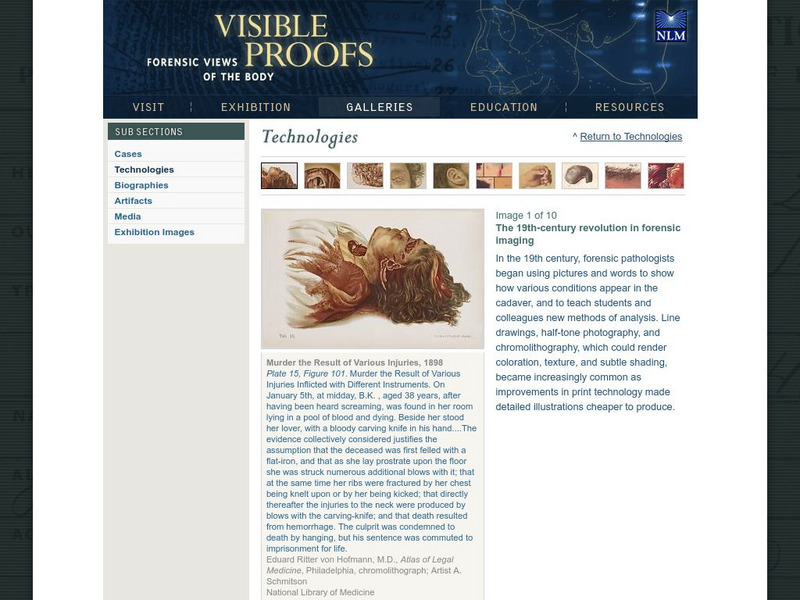
National Library of Medicine: The 19th Century Revolution in Forensic Imaging
In the 19th century, forensic pathologists began to use words and pictures to describe cadavers and to teach using cadavers in the classroom. See a number of interesting photos of various crime scenes on this interesting site.
Other
Crime Scene Investigation: Proper Tagging and Labeling of Evidence
What is the purpose of tagging and labeling items of evidence? What information belongs on the tag? These questions are answered in this concise but competent site.
Indiana University
A Crime Against Plants
Have your students delve into the evidence involving a small tree and arrive at an explanation of what happened in this thorough lesson plan site. .
National Institutes of Health
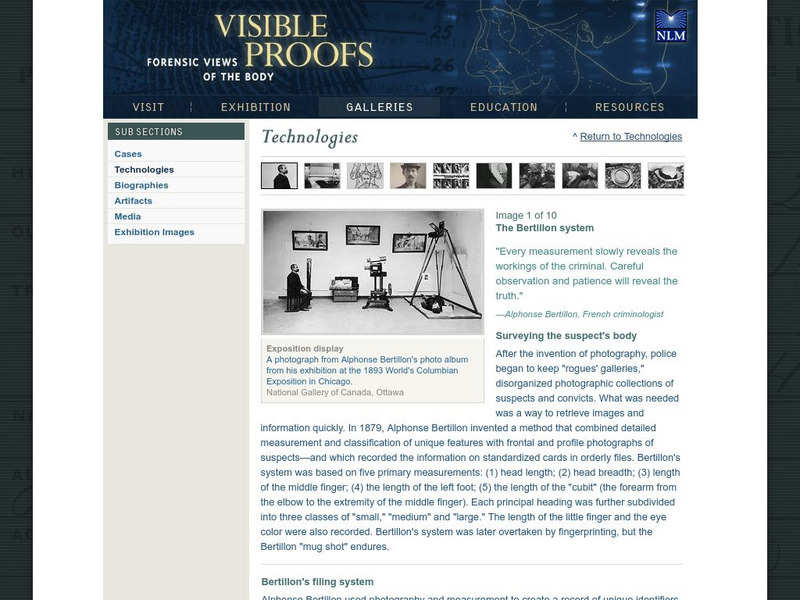
National Library of Medicine: The Bertillon System
Bertillon devised a system to make order out of the myriad of crime scene photos taken by the police. This brief site describes how that system worked and shows a number of crime scene photos taken from Bertillon's photo album.
Chem4kids
Chem4 Kids: Chemistry Careers
Chem4Kids! looks at careers available in the large field of chemistry. Here you can explore the career of a doctor, pharmacist or pharmacologist, university researcher, forensics expert, or hazardous materials expert.
National Institutes of Health
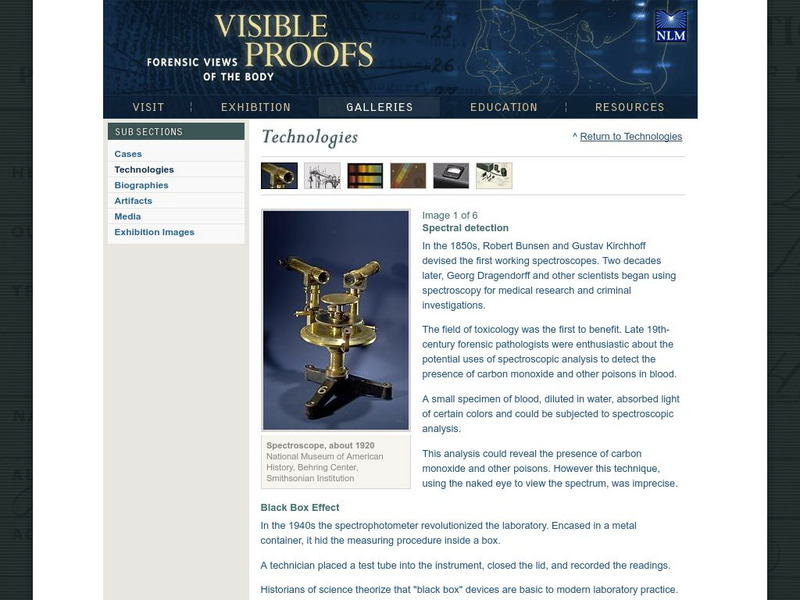
National Library of Medicine: Spectral Detection
This concise site provides a brief discussion of the invention of the first work spectroscopes and their impact on forensic science.
National Institutes of Health
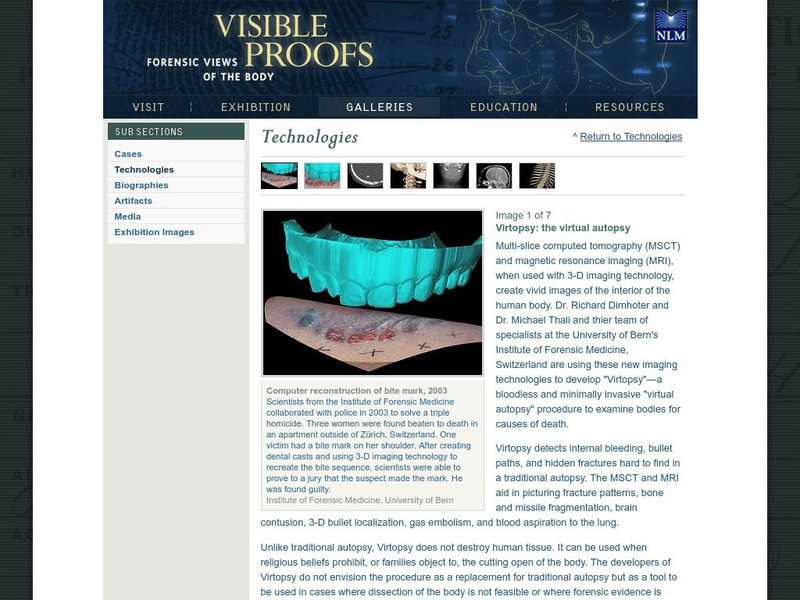
National Library of Medicine: Virtopsy, the Virtual Autopsy
An interesting site that delves into how forensic scientists perform minimally invasive autopsies using state of the art technology.
National Institutes of Health
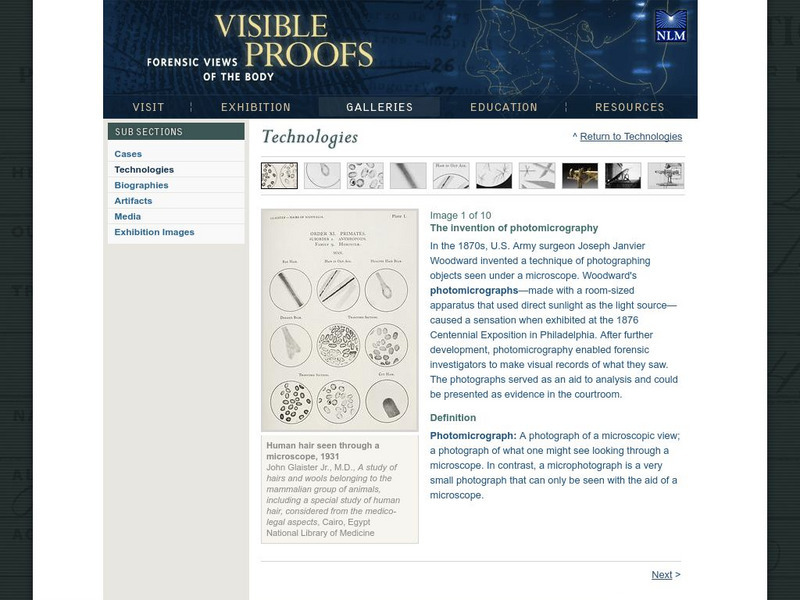
National Library of Medicine: The Invention of Photomicrography
The technique of photographing objects observed under a microscope is discussed in this succinct site. Various pictures taken under a microscope are displayed on this site as well.
National Institutes of Health
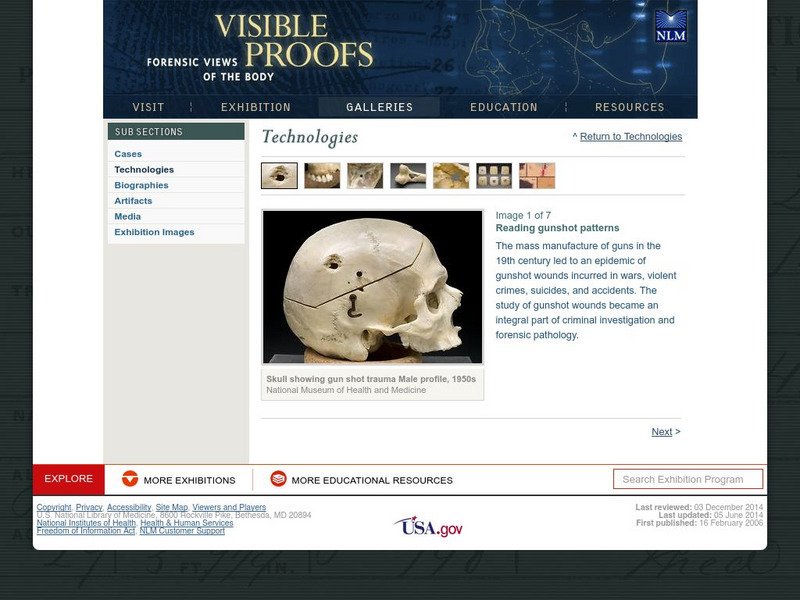
National Library of Medicine: Reading Gunshot Patterns
Various pictures of parts of the human anatomy showing gun shot trauma are found on this interesting site. .
National Institutes of Health
National Library of Medicine: Entomology in Action
Two lesson plans are found in this site. Lesson Plan 1 is geared to grades 6-9. In this plan, student's will be able to list the different stages of the blow fly's life cycle and understand how the life cycle and ADH (accumulated degree...
National Institutes of Health
National Library of Medicine: Dna a Molecular Identity
In this lesson plan site, students learn about DNA and examine three different situations where DNA was used to solve a case.
National Institutes of Health
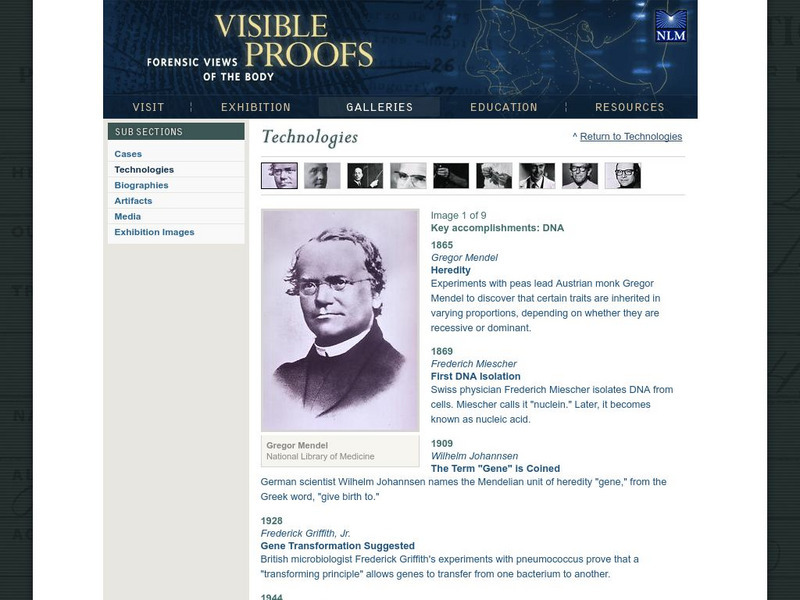
National Library of Medicine: Key Accomplishments, Dna
A brief history of the major discoveries related to DNA from 1865 until 1991. Pictures of the responsible reponsibile for these key accomplishments are included as well.
PBS
Pbs: What Jennifer Saw
How can eyewitness identification go wrong? What role can DNA play in protecting the innocent? This interesting site answers these questions and gets the opinions of several DNA experts on this fascinating subject.

PBS
Pbs: Interview With Jim Liebman, Constitutional Law Professor at Columbia Univ.
Does innocence matter in our criminal justice system? Don't the DNA cases show that we are not getting the right outcome in more cases than we previously thought?
National Institutes of Health
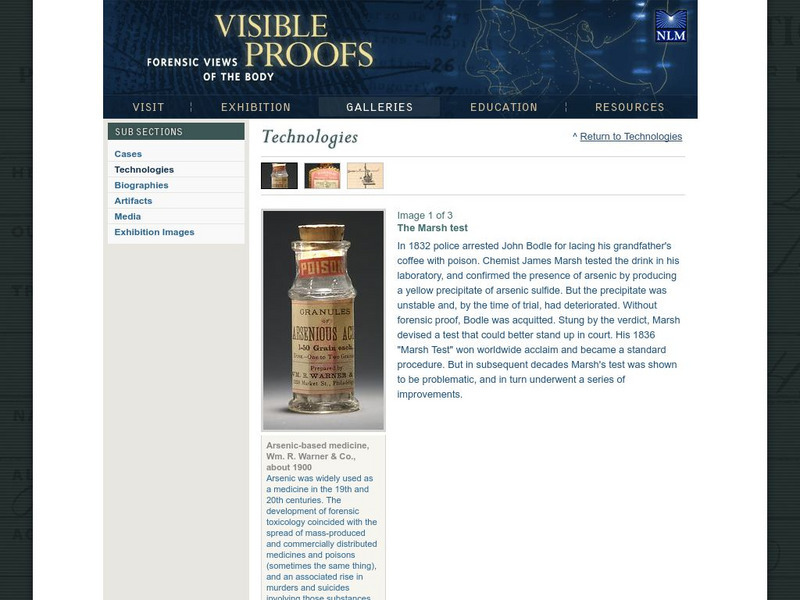
National Library of Medicine: The Marsh Test
The Marsh Test, developed in 1832, was designed to detect poison in drinks. A short history of this test is provided along with photo of the test apparatus.
National Institutes of Health
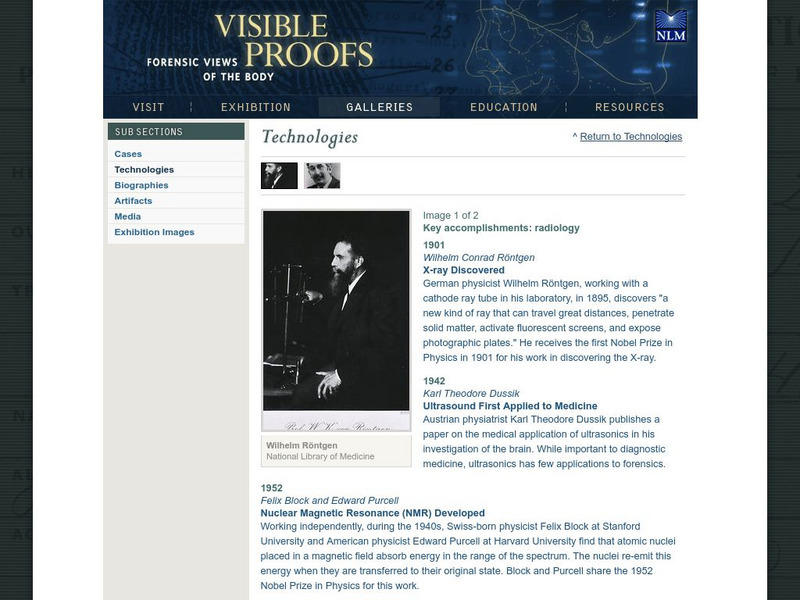
National Library of Medicine: Key Accomplishments, Radiology
A history of radiology is featured from 1901 until 2003. Succinct paragraphs cover the highlights of each discvery.