Hi, what do you want to do?





ReadWriteThink
Read Write Think: Junk Mail: Negotiating Critical Literacy at the Mailbox
Contains plans for three lessons that teach students to examine junk mail critically. In addition to objectives and standards, this instructional plan contains links to sites used in the lessons as well as assessment and reflection...
Other
Drew University: Designing Assignments to Develop Information Literacy Skills
This handy page will help teachers in the research assignment design area so critical to the development of information literacy.
Media Smarts
Media Smarts:teaching Tv: Critically Evaluating Tv Lesson
MediaSmarts provides digital and media literacy lessons for students. In this lesson, students will learn to watch and listen to a television with a critical lense
AdLit
Ad lit.org: Critical Thinking: Why Is It So Hard to Teach?
Learning critical thinking skills can only take a student so far. Critical thinking depends on knowing relevant content very well and thinking about it, repeatedly. Here are five strategies, consistent with the research, to help bring...
Other
Media Literacy Clearinghouse: Critically Viewing Photographs: Civil War
Was it possible to manipulate photographs during the Civil War? Teach your young scholars about critical viewing through this innovative lesson and engage them in discussion, analysis and research to explain their findings.
![Media Smarts: How to Recognize False Content Online: The New 5 Ws [Pdf] Handout](https://statictemp.lp.lexp.cloud/images/attachment_defaults/resource/large/FPO-knovation.png "Media Smarts: How to Recognize False Content Online: The New 5 Ws [Pdf] Handout")
Media Smarts
Media Smarts: How to Recognize False Content Online: The New 5 Ws [Pdf]
A tip sheet to help both students and adults learn how to test online content for validity.
Associated Press
Associated Press: Facebook's Fake News Problem: What's Its Responsibility?
Is it real? Is it reliable? Can it be confirmed? Always check sources of news found through social media outlets before believing it. Facebook's Mark Zuckerberg is facing criticism for the amount of fake news posted on Facebook....
Lumen Learning
Lumen: Critical Reading: Supporting Claims
This lesson focuses on supporting claims including the distinction between main ideas and supporting details, relationship between purpose and supporting details, sufficient and related support, and support and elaboration. W.9-10.1a...
ReadWriteThink
Read Write Think: Critical Media Literacy: Commercial Advertising
In this lesson, students will examine mass media critically and become aware of how much advertising is around them. They will realize the impact media has on social equality, what people buy, and on culture.
ReadWriteThink
Read Write Think: Book Sorting: Using Observation and Comprehension
Critical thinking, comprehension and analysis skills are the focus of this physical activity. Good beginning to teaching different ways of looking at things.
Other
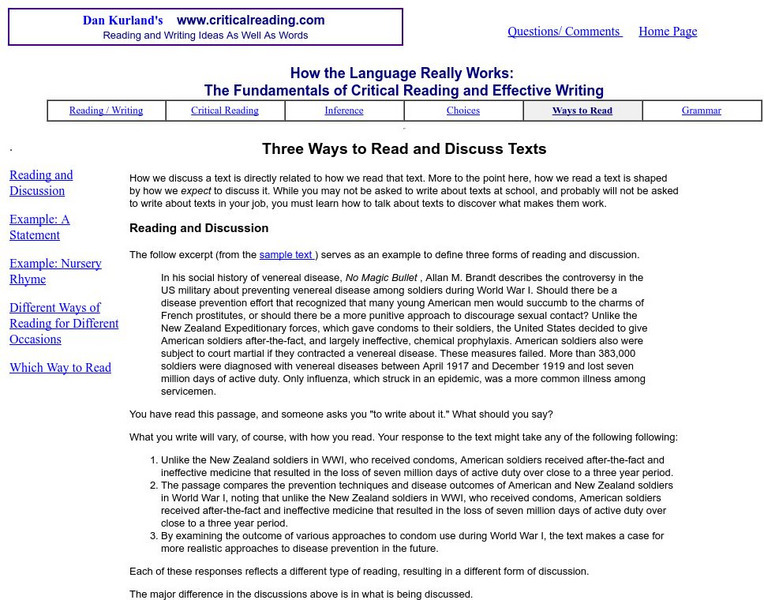
Critical Reading: Three Ways to Read and Discuss Texts
Designed to help students think about their reading and writing skills, this page offers three different ways to interpret and discuss texts.
Other
Association for Educational Communications & Technology: Learning From Tv
Research regarding what is internalized and learned from television and the responsibility parents and educators have helping students to decipher between reality and fabrication. Media literacy, or how a viewer perceives what they are...
Edutopia
Edutopia: Media Smarts: Students Evolve From Consumers to Critics and Creator
This article from Edutopia offers an overview of both the importance of media literacy and some innovative examples of teaching media literacy.
AdLit
Ad lit.org: For Teens, Phonics Isn't Enough
Schools often struggle to find appropriate materials and approaches to support adolescent literacy. Strategies that work for children can ignore teens' existing skills, knowledge, and life experience, and exclude them from the critical...

AdLit
Ad lit.org: Poor Children's Fourth Grade Slump
Teachers have often reported a fourth-grade slump in literacy development, particularly for low-income children, at the critical transition from "learning to read" to "reading to learn." This study uses Chall's stages of reading...
AdLit
Ad lit.org: What Do We Know About Who Drops Out and Why?
Students decide to drop out for many reasons. This overview classifies the reasons as either status (e.g., age, socioeconomic status, geographic region or mobility) or alterable (e.g., grades, disruptive behaviors, school climate,...
AdLit
Ad lit.org: Ensure Successful Student Transitions From the Middle to High School
The 9th grade year is critical to students' success in high school - the influence of a broader number of peers (both positive and negative); the potential of developing bad habits such as skipping class; and entry into a larger,...
Rock and Roll Hall of Fame
Rock & Roll Hall of Fame: Sti Lesson 28 the Electric Hearth
As educators, the goal of developing learners into discerning, critical viewers may enable them to negotiate with more confidence through the treacherous waters of today's multimedia. Studying the various viewpoints as expressed in...

TED Talks
Ted: Ted Ed: How False News Can Spread
In previous decades, most news with global reach came from several major newspapers and networks with the resources to gather information directly. The speed with which information spreads now, however, has created the ideal conditions...

PBS
Pbs News Hour: Column: Can Librarians Help Solve the Fake News Problem?
Was it only a matter of time that people would begin buying into any news, even when it was actually fake? This writer felt it was no surprise. Find out why and how a librarian can help educate students how to best vet resources for...
Education Development Center
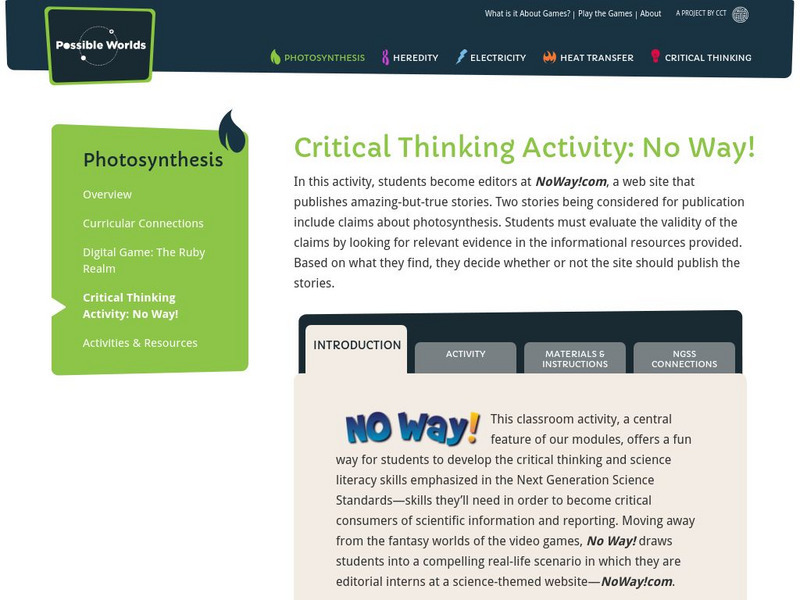
Center for Children and Technology: No Way: Photosynthesis
Students become editors at NoWay, a web site that publishes amazing-but-true stories. Two stories being considered for publication include claims about photosynthesis. Students must evaluate the validity of the claims by looking for...

TED Talks
Ted: Ted Ed: How to Choose Your News
Damon Brown gives the inside scoop on how the opinions and facts (and sometimes non-facts) make their way into the news and how the smart reader can tell them apart. [4:48]

Library of Congress
Loc: Teachers: Personal Stories and Primary Sources
Learners will explore the value of personal stories and first-hand accounts when exploring history, in this case, the events of the early twentieth century, which included World War I and the Great Depression. Through this five-unit...
FNO Press
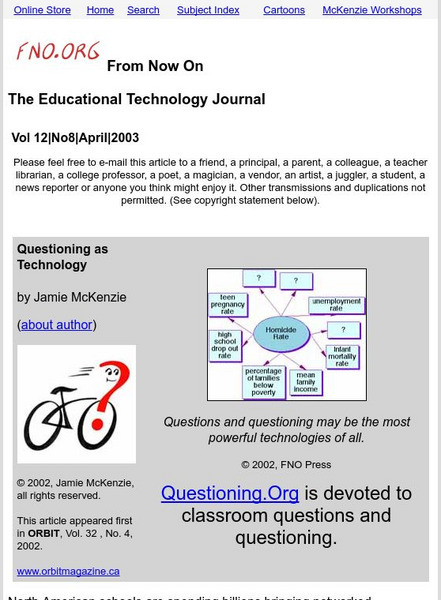
From Now On: Questioning as Technology
This article supports the concept that "Without strong questioning skills, information technologies contribute little to understanding or insight." Links provided to learn about and use the main types of questioning techniques.
Other popular searches
- Critical Media Literacy
- Critical Literacy English
- Magazines Critical Literacy
- Poetry Critical Literacy
- Critical Visual Literacy
- Identity Critical Literacy
- Critical Media Literacy Math
- Critical Pedagogy Media
- Critical Media
- Critical Literacy Lesson Plans