Hi, what do you want to do?






Curated OER
A Science Experiment With Crayfish
A crayfish can lead to a science experiment involving habitats, animal behavior, and anatomy..

US Department of Energy
Whales and Sea Ice: Investigating Insulation
Learners investigate the properties of insulation as it relates to whales and sea ice. They research whales and examine atmospheric changes that occur with sea ice variability.

Curated OER
Pond Ecosystem Field Trip
Students investigate the environment by participating in a class trip. In this pond ecosystem lesson plan, students define a list of vocabulary terms associated with ponds such as invertebrate and metamorphosis. Students attend a field...

Curated OER
Endangered Species
In this endangered species worksheet, students complete math word problems where they refer to the chart about endangered species. Students complete 7 problems.

Curated OER
Dinosaur Time Capsule
Third graders research prehistoric life using educational software. They design a prehistoric life while showing the use of appropriate scale and names for the prehistoric life. They follow an internet link to participate in a virtual...

Curated OER
Invertebrates
In this invertebrates worksheet, learners read about the characteristics of the different groups of invertebrates. Then students complete 10 multiple choice questions.

Curated OER
Stream Watch
Students discuss why it is important to take care of streams, what is non-point source and point source pollution, what are some causes of pollution in streams, and what can we do to prevent some of these causes of pollution? They steam...

Curated OER
Comparing and Contrasting
Students practice compare and contrast skills. In this science and language development lesson plan, students complete a T chart generating traits of a snail and a clam. Students complete a related worksheet.


Curated OER
Skates
Students gain understanding of structure, characteristics, and basic needs of living things and their role in world, identify parts of skate, observe details of skate's body and skate egg case, and identify unique characteristics of skates.

Curated OER
Build A "Bug"
Students brainstorm different adaptations that bug would need to live in aquatic environment, and watch presentation where classmate is dressed up in costume to represent adaptations necessary for macroinvertebrate to survive in water.

Curated OER
Stream Habitats and Biota
Pupils identify native and introduced species of fish, shellfish and insects that inhabit Hawaii's streams. They use this information to predict the impact of stream restoration projects in Hawaii.

Curated OER
Amphipod Ecology
Students count amphipods under kelp wracks of varying ages to explain how long it takes for them to find their food source. They collect and represent the data.

Curated OER
Land Use
Students examine ecosystems that covered Illinois 200 years ago, investigate some living and non-living components of ecosystems, identify components of prairie system, create food webs, and observe human effects on environment. Lessons...

Curated OER
The First Thanksgiving: Crossword
In this Thanksgiving worksheet, learners use a set of 11 clues about Thanksgiving to complete a crossword puzzle; answers are given on page 2.

Curated OER
Antarctica Food Chain
Students visit an interactive web page. In this food chain lesson, students visit an interactive web page displaying an example of the food chain in Antarctica. As students move their mouse over the images, captions appear describing the...
Unite for Literacy
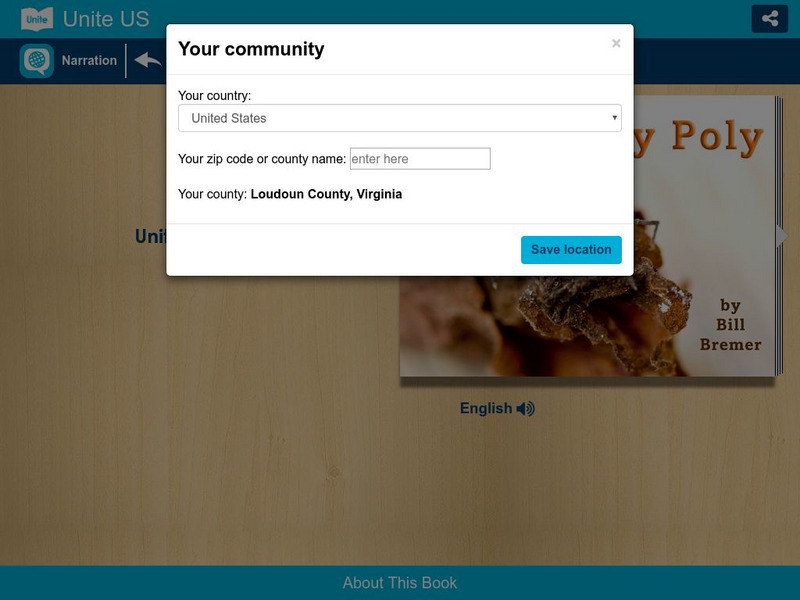
Unite for Literacy: Animals: Roly Poly
Read facts about the amazing pillbug and how this crustacean helps humans. Includes audio narration in 6 additional languages with text in English.
Other
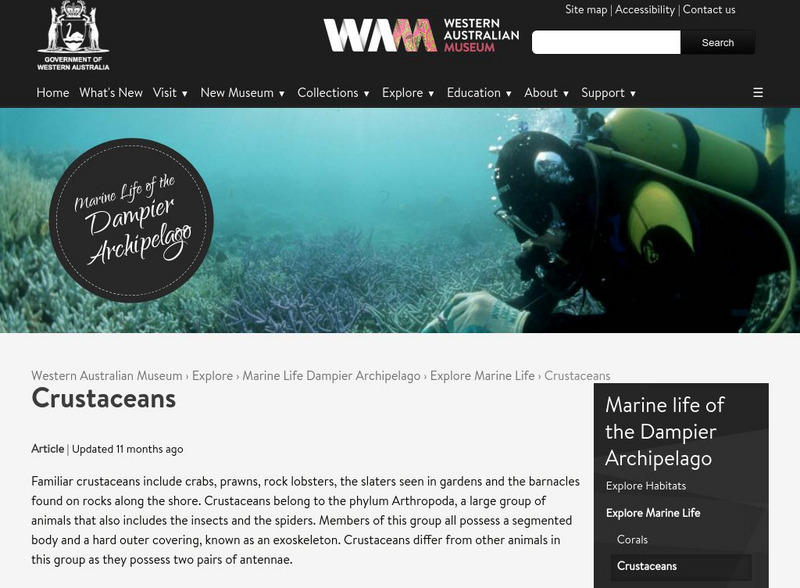
Western Australian Museum: Crustaceans: Marine Life of the Dampier Archipelago
Do you know how Crustaceans differ from other animals that belong to the Arthropod family? Find the answer to this question along with other interesting facts about this marine animal.
CK-12 Foundation
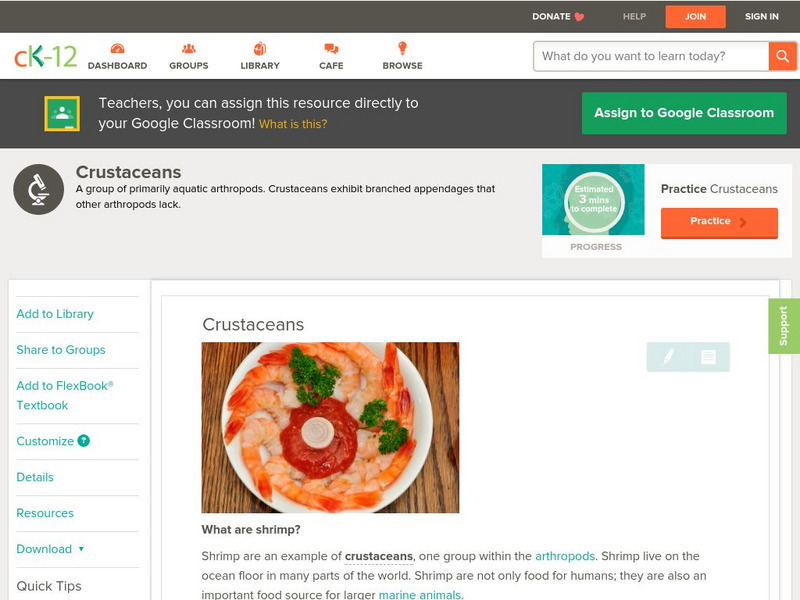
Ck 12: Life Science: Crustaceans
[Free Registration/Login may be required to access all resource tools.] Crustaceans are a large group of arthropods, consisting of almost 52,000 species. The majority of crustaceans are aquatic. A few groups have adapted to living on...
A-Z Animals
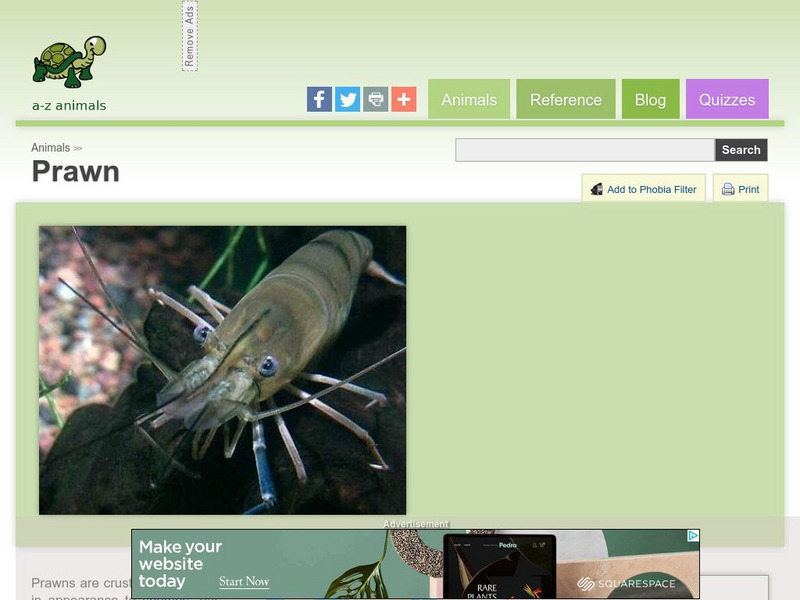
A Z Animals: Animal Facts: Prawn (Dendrobranchiata)
Provides photograph and facts about the prawn, a crustacean. Discusses physical characteristics, where they are found, diet, and how humans use them.

Saint Louis Zoo
Saint Louis Zoo: Crustaceans
Discover fun facts and learn about the habitat, diet, and appearance of crustaceans.
Ducksters
Ducksters: Animals for Kids: Invertebrates
What is an Invertebrate? Kids learn about these animals that have no backbone such as worms, mollusks, insects, and spiders.

A-Z Animals
A Z Animals: Animal Facts: Woodlouse (Oniscidea)
This entry identifies the defining characteristics of the oniscidea, otherwise known as the woodlouse.
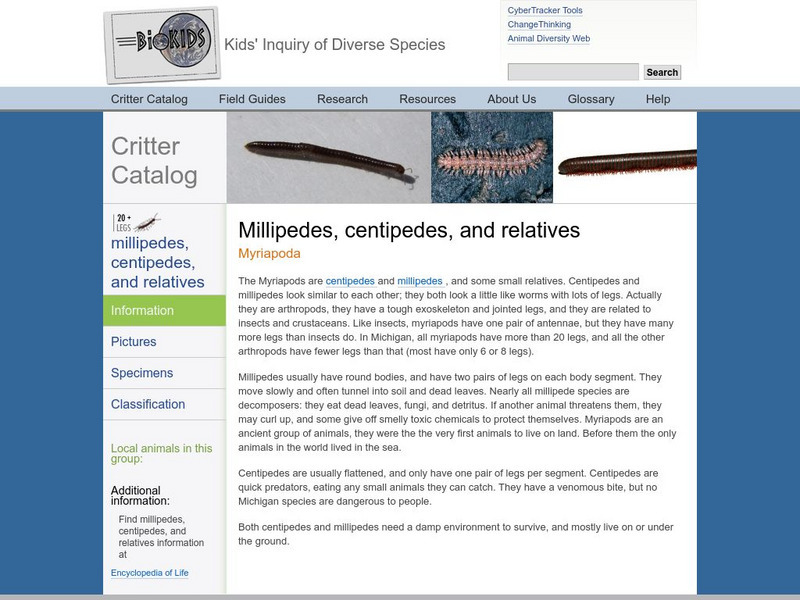
University of Michigan
Critter Catalog: Myriapods
This informative site provides a description of the characteristics of Myriapods. Local animals (southeastern Michigan) in these groups are then examined in further detail. Pictures and classification groupings are included in this site.