Hi, what do you want to do?






Other
Nearpod: 2 D Shapes
In this instructional activity on 2D shapes, 3rd graders will learn to discriminate quadrilaterals from other polygons. Additionally, they will be able to identify attributes of a square, rectangle, and rhombus.
Illustrative Mathematics
Illustrative Mathematics: 1.g 3 D Shape Sort
As a whole group, students will sort a collection of three-dimensional objects into categories by shape. There should be several that fall into each of the categories below: Aligns with 1.G.A.1.
Illustrative Mathematics
Illustrative Mathematics: 3.md Shapes and Their Insides
The purpose of this task is to help students differentiate between a polygon and the region inside of a polygon so that they understand what is being measured when the perimeter and area are being found. Aligns with 3.MD.D.
University of Regina (Canada)
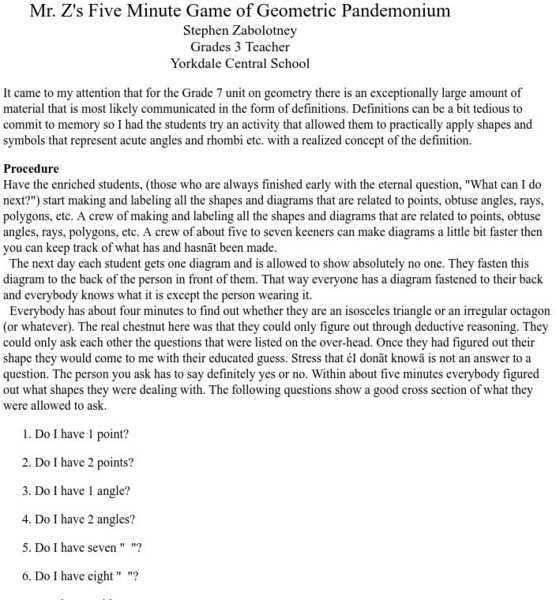
University of Regina: Math Central: Lesson: Mr. Z's 5 Minute Game of Geometric Pandemonium
Students make a series of geometric drawings of points, obtuse angles, rays, polygons, and the like. Each child is given one but not allowed to show anyone else. The drawing is then taped to the back of the child in front of them. The...
Better Lesson
Better Lesson: Tree Mapping in 2 D
Identifying 2D shapes in common objects and sorting according to shapes connects the real world to learning shape names and attributes.
Illustrative Mathematics
Illustrative Mathematics: G Co Origami Regular Octagon
After successive folds of a piece of origami paper, a student must explain why the shape made is a regular octagon. Aligns with G-CO.A.3 and G-CO.D.12.
Illustrative Mathematics
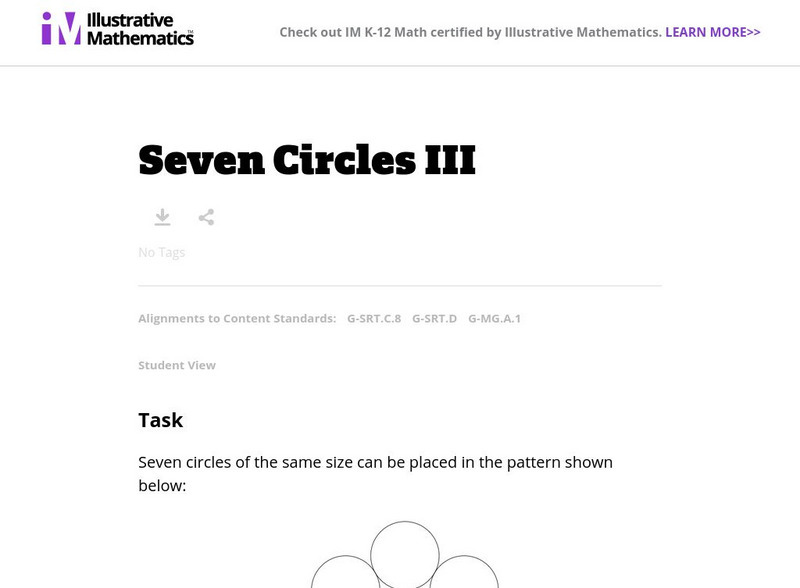
Illustrative Mathematics: G Srt, G Mg Seven Circles Iii
For this task, students are shown circle formations where an inner circle is surrounded by a set of circles and all circles are touching. In the first situation, all circles have the same diameter. In the second, the inner circle is...
Illustrative Mathematics
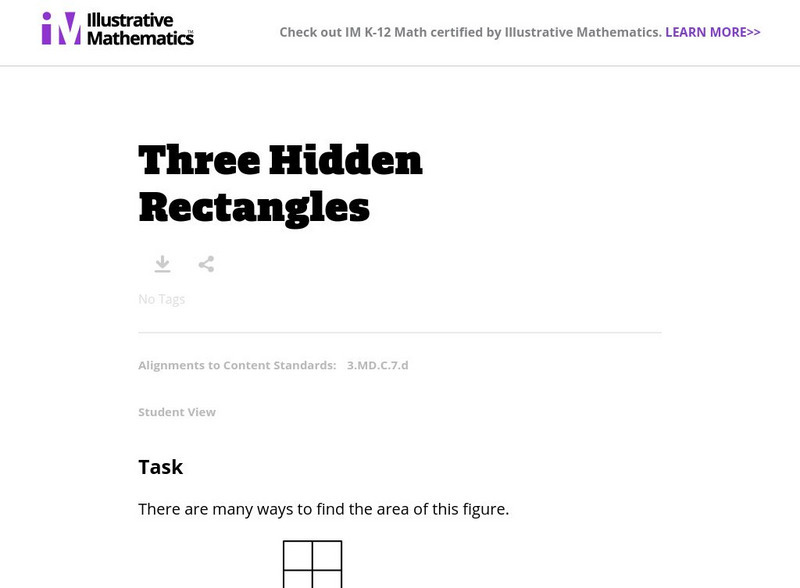
Illustrative Mathematics: 3.md Three Hidden Rectangles
The purpose of this task is for students to decompose a figure into rectangles and then find the total area by adding the area of all of its smaller, non-overlapping rectangles. Aligns with 3.MD.C.7.d.
PBS
Pbs: Mathline: Let's Face It [Pdf]
Check out this math project about polyhedra! Students will enjoy the hands-on activity while they learn about tetrahedrons, hexahedrons, octahedrons, dodecahedrons, and icosahedrons. [Requires Adobe Reader.]