Hi, what do you want to do?






Curated OER
Designing a Flotation Strategy for the Purification of Recycling
Twelfth graders work in teams to design a method of recycled plastics purification by flotation. They base their design on the concept that different kinds of plastics have different densities and keep overall costs and purification time...

Curated OER
Hitler's Lost Sub
Young scholars watch a video clip about German submarines lost during World War II. They work together to create their own submarine out of a plastic bottle. They test the buoyancy of the submarine in different activities.

Curated OER
Convection and Wind
Students use water, beakers, hot plates, paper dots, and goggles to participate in a hands on activity where they see how a convection current creates wind. In this convection current lesson plan, students participate in a hands on...

Curated OER
Emulsions
Students identify the characteristics and composition of emulsions. In this chemistry instructional activity, students classify household products according to emulsion type. They explain how to make the best emulsion.

Curated OER
Measuring Magnetic Field Strengths Using Ferrofluids
Students explore the field of nanotechnology by examining magnetic field strength in ferrofluids. They use probes attached to a computer program to determine the relationship between magnetic field strength and magnetic field lines.

Curated OER
The Solar System: Why do we Explore?
Third graders act as scientists. In this property discovery lesson, 3rd graders explore the substance "Oobleck" (cornstarch, water, food coloring). They work in groups to investigate the substance and make observations as a scientist...

Curated OER
Physical Difference and Classification
Young scholars use a microscope and observation skills to compare and contrast several physical properties and develop a classification system.
TeachEngineering
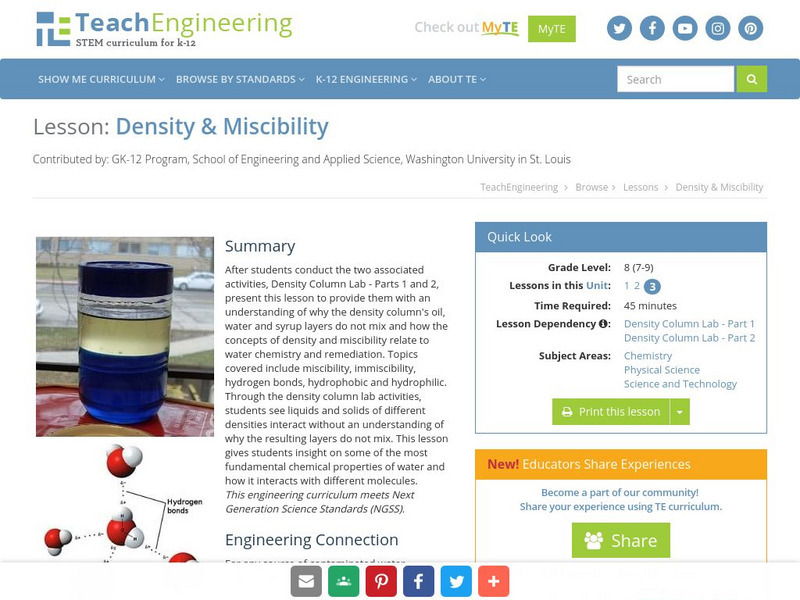
Teach Engineering: Density & Miscibility
After students conduct the two associated activities, Density Column Lab - Parts 1 and 2, present this lesson to provide them with an understanding of why the density column's oil, water and syrup layers do not mix and how the concepts...
Science Education Resource Center at Carleton College
Serc: Rainbow Challenge Lab
For this inquiry lab activity, students will attempt to layer 6 different kinds of soda pops in a large test tube using their knowledge of density and other physical properties of liquids.
Science and Mathematics Initiative for Learning Enhancement (SMILE)
Smile: Comparing Liquid Density
Because different liquids have different properties, density also differs. In this activity from the Illinois Institute of Technology, students will calculate densities of water, dish-washing detergent, cooking oil, and other liquids.
Science and Mathematics Initiative for Learning Enhancement (SMILE)
Smile: Comparing Densities of Different Liquids
This lab experiment has students observe and compare the density of five different liquids while measuring mass and volume.