Hi, what do you want to do?





Science Education Resource Center at Carleton College
Serc: Rainbow Challenge Lab
In this inquiry lab activity, students will attempt to layer 6 different kinds of soda pops in a large test tube using their knowledge of density and other physical properties of liquids.
Science and Mathematics Initiative for Learning Enhancement (SMILE)
Smile: Comparing Densities of Different Liquids
This lab experiment has students observe and compare the density of five different liquids while measuring mass and volume.
Science is Fun
Science Fun: Layered Liquids
This experiment allows you to dramatically demonstrate the different densities of five different common household liquids.
TeachEngineering
Teach Engineering: Density & Miscibility
After students conduct the two associated activities, Density Column Lab - Parts 1 and 2, present this lesson to provide them with an understanding of why the density column's oil, water and syrup layers do not mix and how the concepts...
Chemistry Collective
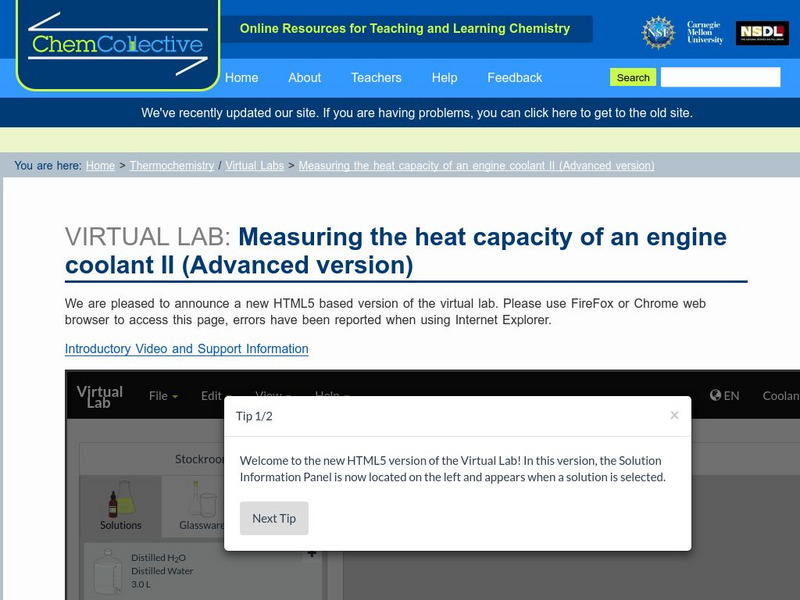
Chem Collective: Measuring the Heat Capacity of an Engine Coolant Ii
Measure and compare the heat capacity of an unknown liquid with an unknown density.
Other
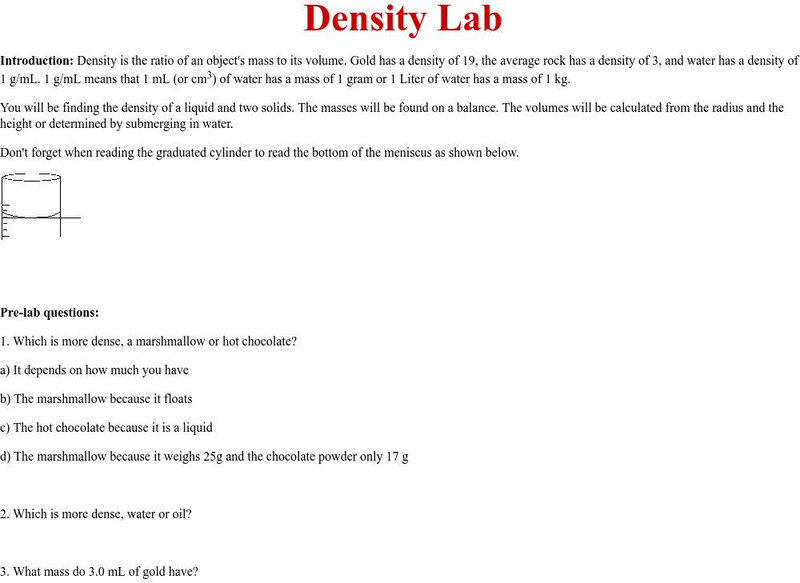
Lapeer County Schools Science Resources: Density Lab
A simple lab experiment for students to find the density of two solids and a liquid (does not use water displacement). Note that number 1d should not state "weighs" since mass is being found.
Science and Mathematics Initiative for Learning Enhancement (SMILE)
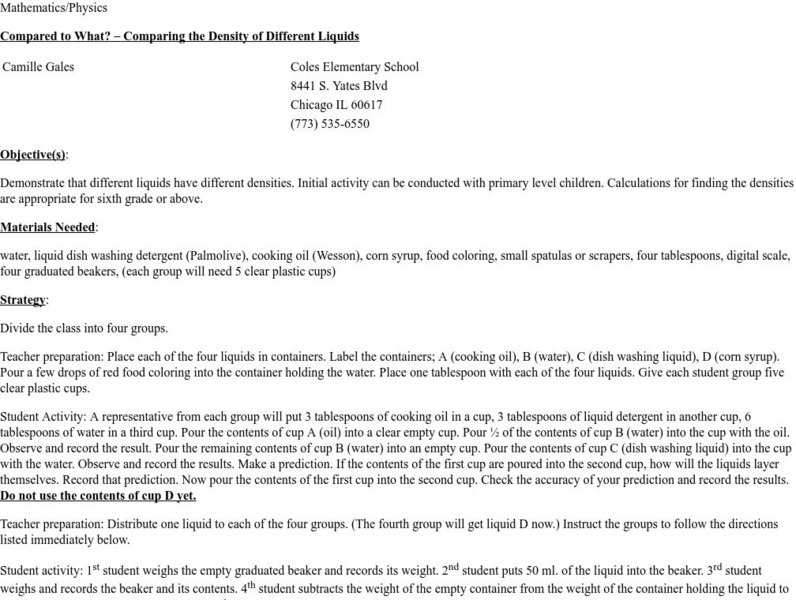
Smile: Comparing Liquid Density
Because different liquids have different properties, density also differs. In this lesson from the Illinois Institute of Technology, students will calculate densities of water, dish-washing detergent, cooking oil, and other liquids.
![Thinking Fountain: Liquid Layers [Pdf] Activity](https://statictemp.lp.lexp.cloud/images/attachment_defaults/resource/large/FPO-knovation.png "Thinking Fountain: Liquid Layers [Pdf] Activity")
My Science Site
Thinking Fountain: Liquid Layers [Pdf]
Students contrast the densities of oil and water in this lab activity. Can be done in groups or individually. This resource is in PDF form; requires Adobe Reader.
Other
The Science House: Daffy Densities
In this lab experiment, students will use 4 solids and 6 liquids to create colorful, layered rows demonstrating that less dense materials will float on top of the more dense materials.
My Science Site
Life Systems: Cells, Tissues, Organs
Extensive site for teachers provides some helpful resources that pertain to plant and animal cells. Includes a microscope diagram as well as plant, animal and pond labs. Also contains links to structures and mechanisms, matter and...