Hi, what do you want to do?






Curated OER
The Portable Niche
Third graders, in groups, research animals, plants, and conditions found in ecosystems.

Curated OER
Physical Difference and Classification
Students use a microscope and observation skills to compare and contrast several physical properties and develop a classification system.

Curated OER
Physics Post-Lab
Learners explore physics. In this science lesson, students discuss physics in their everyday lives. Learners complete a physics worksheet.


Curated OER
Working with Solutions
In this solutions worksheet, students review how molarity is calculated and how to prepare a dilute solution. This worksheet has 5 problems to solve.

Khan Academy
Khan Academy: Biology: Specific Heat, Heat of Vaporization, and Density of Water
Why does ice float? In this article answer that question by learning about the topics of Specific heat capacity, evaporative cooling, and heat of vaporization of water.

Science Struck
Science Struck: Density of Water
Explains what density is, how it is calculated, and how the density of water fluctuates depending on various conditions.
American Chemical Society
Inquiry in Action: Compare the Density of an Object to the Density of Water
In this activity, students use tea light candle holders and a student-made balance to compare the weight of equal volumes of wax, water, and clay. Students will discover that since the wax weighs less than an equal volume of water, it is...
American Chemical Society
Middle School Chemistry: Density of Water
Students discover the concept that density is a characteristic property of water by measuring the volume and mass of water and calculating its density.
Science Struck
Science Struck: Density of Water at Room Temperature
Discusses how to calculate the density of water and how density varies depending on the temperature and the salinity. Presents a chart showing the difference in the density of non-saline water for temperatures between 0 and 100 degrees...
American Chemical Society
Middle School Chemistry: Density of Water
Discover how the molecular make-up of water affects its density.
American Chemical Society
Inquiry in Action: Changing the Density of a Liquid: Heating and Cooling
In this activity, students will investigate whether the temperature of water affects its density. Students will place colored hot and cold water in a cup of room-temperature water to see that cold water sinks while hot water floats. Then...
American Chemical Society
Inquiry in Action: Comparing the Density of Different Liquids
How do the densities of vegetable oil, water, and corn syrup help them to form layers in a cup? Students will carefully pour vegetable oil, water, and corn syrup in any order into a cup and discover that regardless of the order they are...
American Chemical Society
Inquiry in Action: Changing the Density of an Object: Changing Shape
Throughout the activities in this investigation, students may have wondered how a boat made out of steel, which is more dense than water, can float. This activity addresses that question. Students will see that changing the shape of an...
American Chemical Society
Inquiry in Action: Changing the Density of a Liquid: Adding Salt
In this activity, students will see that a carrot slice sinks in fresh water and floats in saltwater. Considering the placement of the carrot slice in water and salt water, students will infer that the density of salt water must be...
American Chemical Society
Middle School Chemistry: Temperature and Density
Observe how heating and cooling affect the density of water. Combine the concepts of temperature, molecular motion, and density to learn that hot water is less dense than room temperature water and that cold water is more dense.
American Chemical Society
Middle School Chemistry: Density: Sink and Float for Liquids
Students determine whether a liquid will sink or float in water by comparing its density to the density of water.
American Chemical Society
Inquiry in Action: Changing the Density of an Object: Adding Material
In this activity, students see that a can of regular cola sinks while a can of diet cola floats. As a demonstration, bubble wrap is taped to the can of regular cola to make it float. This high-volume but light-weight material increases...
Science Education Resource Center at Carleton College
Serc: Density of Solid Objects
In this science inquiry, students investigate whether volume or density of objects determine the floating or sinking in water. Using a rock and a block of wood teachers engage students in the discussion of density, mass and volume.
American Chemical Society
Middle School Chemistry: Density: Sink and Float for Solids
Students determine whether an object will sink or float by comparing its density to the density of water.
TeachEngineering
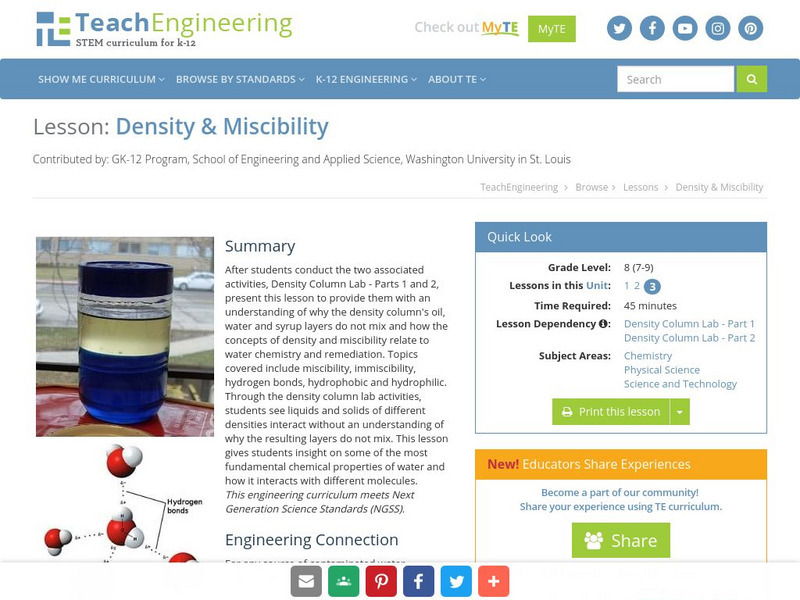
Teach Engineering: Density & Miscibility
After students conduct the two associated activities, Density Column Lab - Parts 1 and 2, present this lesson to provide them with an understanding of why the density column's oil, water and syrup layers do not mix and how the concepts...
American Museum of Natural History
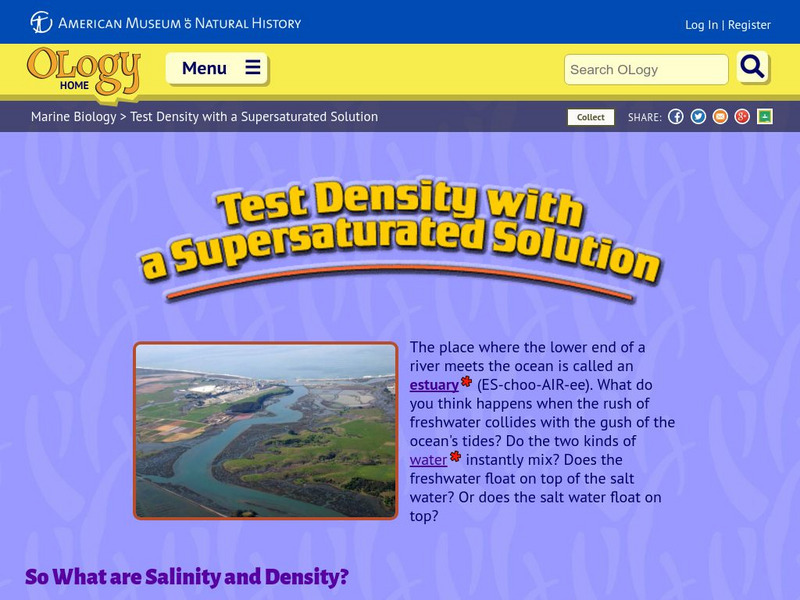
American Museum of Natural History: O Logy: Stuff to Do: Density of Salty Water
An experiment to test what happens when ocean water hits a freshwater estuary. Each step is demonstrated with photographs and the difference between salinity and density is explained.
Science Buddies
Science Buddies: Can Water Float on Water?
Of course it can, you say: ice is water and ice floats. And you're right. But we're talking about water in the liquid phase Can liquid water float on water? The goal of this project is to investigate what happens to layers of water with...
University of Hawai'i
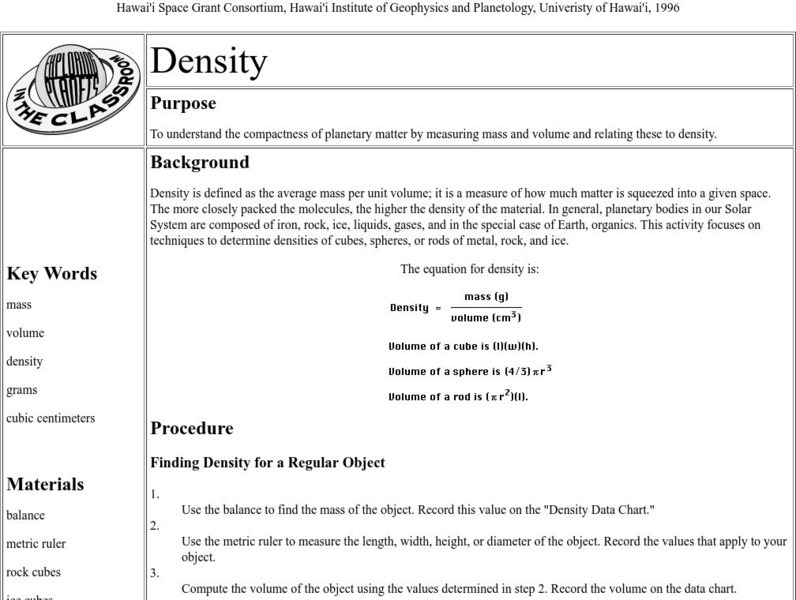
Density (Lesson Plan)
The purpose of this lesson plan is to find the density of regular (volume can be with a mathematical formula) or irregular objects through water displacement. Uses actual SI units (g/cubed cm).