Hi, what do you want to do?






Khan Academy
Khan Academy: Dependent and Independent Events
Determine if two events are dependent or independent.
Harp Week
Harp Week: The Presidential Elections: Events
Read about the domestic policies and events that occured in Grover Cleveland's first term of office. Many of these were events on which he would run as he sought his second term.
Interactive Mathematics
Interactive Mathematics: Probability and Statistics
Mini lessons are provided for learning concepts in the world of probability and statistics. Topics include counting and probability, permutations, combinations, independent and dependent events, and distributions. Links to online...
Texas Education Agency
Texas Gateway: Introduction to Probability
This activity provides the opportunity to explore the difference between finding the probability of independent events and dependent events. It also addresses how to use a tree diagram when calculating conditional probabilities.
Sophia Learning
Sophia: Combining the Rules of Probability Tree Diagrams
Tree diagrams are the focus of this learning tutorial. The lesson includes important vocabulary along with two videos and PowerPoint presentations that demonstrate how to create tree diagrams with both independent and dependent events.
Texas Instruments
Texas Instruments: Simple Probability
This set contains statistics questions regarding probability as a relative frequency. The student will recognize event pairs: complementary events, mutually exclusive events, and independent events, and use them in probability calculations.
Khan Academy
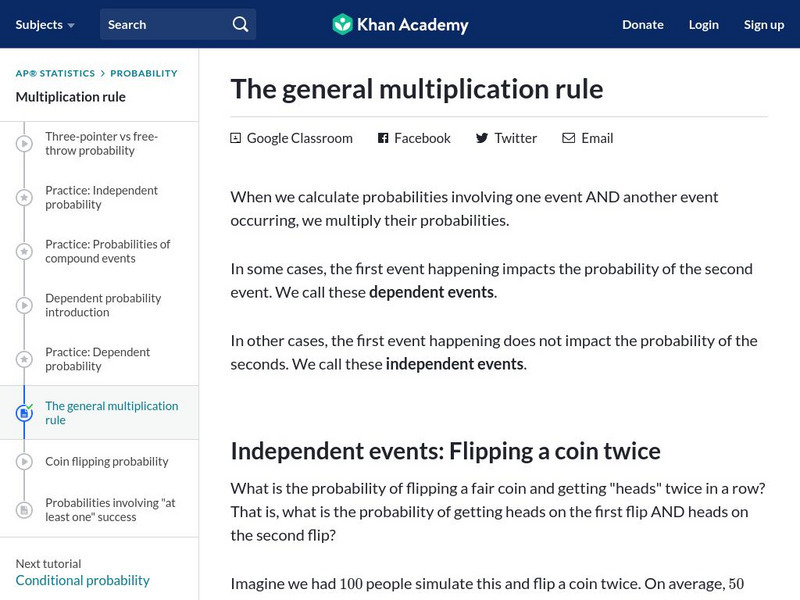
Khan Academy: The General Multiplication Rule
An explanation with examples of how to calculate probabilities of two dependent or independent events by multiplying their probabilities. Two practice problems are provided along with their explanations.

Yale University
An Introduction to Mathematical Probability
This site gives a very brief definition of independent events. It provides a few example problems for further understanding.
Other
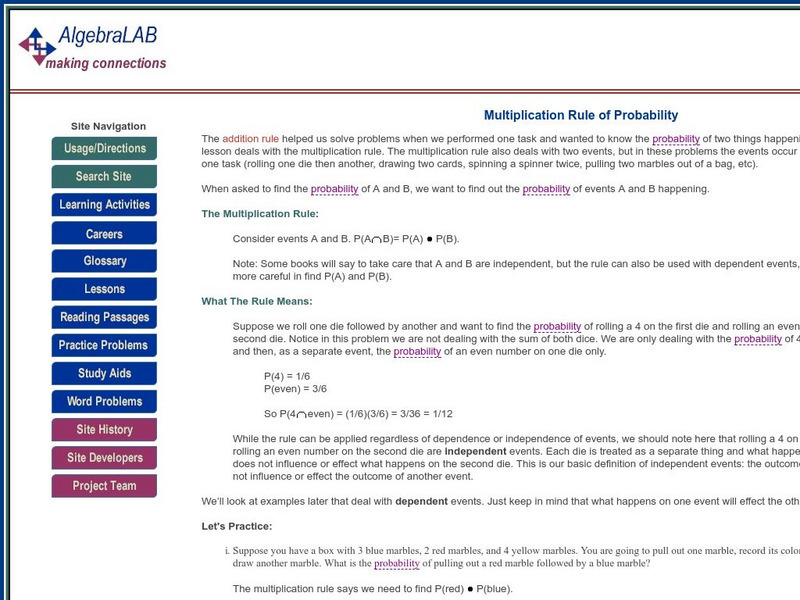
Algebra Lab: The Multiplication Rule of Probability
An explanation with examples of how to calculate probabilities of two dependent or independent events by multiplying their probabilities. Practice problems are provided along with their explanations.

Illustrative Mathematics
Illustrative Mathematics: S Cp Breakfast Before School
On school days, Janelle sometimes eats breakfast and sometimes does not. After studying probability for a few days, Janelle says, "The events 'I eat breakfast' and 'I am late for school' are independent." Explain what this means in terms...
BBC
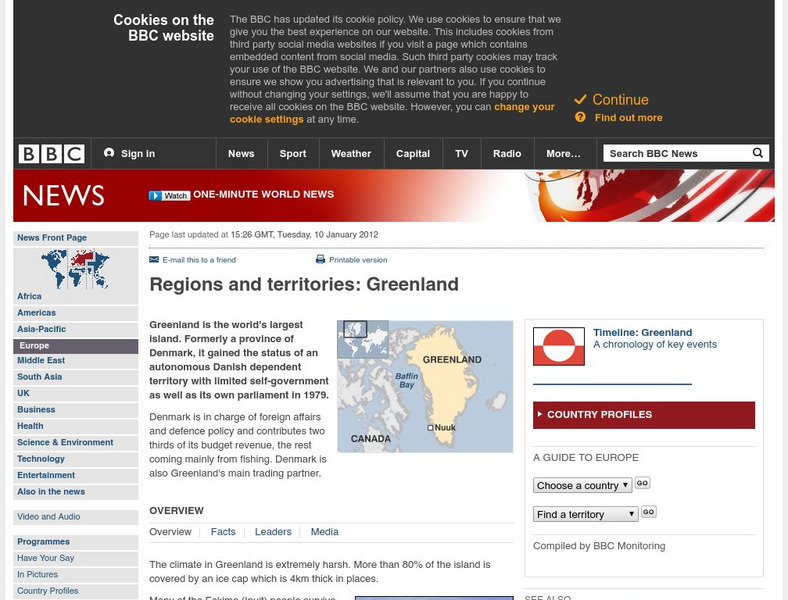
Bbc News: Regions and Territories: Greenland
Article providing a general overview of Greenland, the world's largest island, focusing on its history, country facts, political leaders, and news media. Provides links to a timeline of key events, recent news articles, and related...
Better Lesson
Better Lesson: Frog and Toad Are Friends
In this lesson plan for early readers, students will describe the major events in the plot, describe the characters, and ask and answer questions about the first chapter in Frog and Toad Are Friends---Spring.
CK-12 Foundation
Ck 12: Probability: Conditional Probability Grade 8
[Free Registration/Login may be required to access all resource tools.] Recognize and apply the definition of conditional probability to find probabilities in finite sample spaces.
CK-12 Foundation
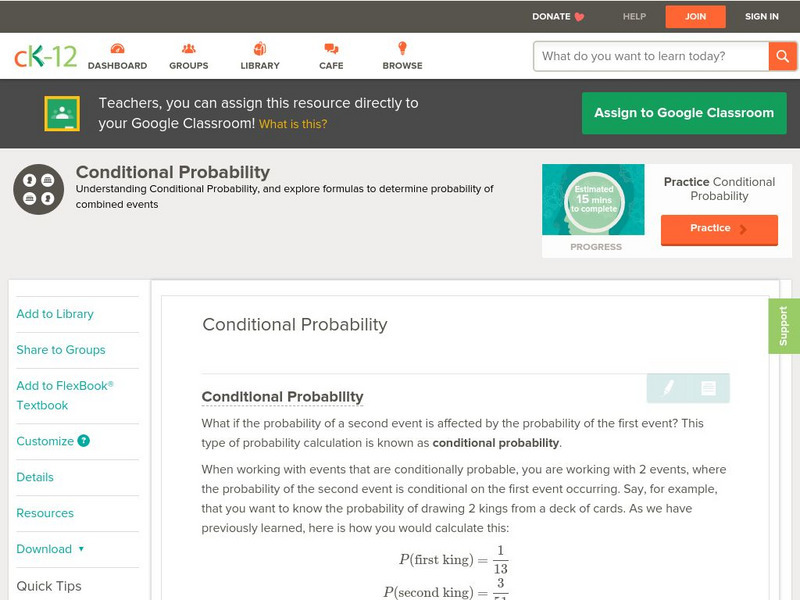
Ck 12: Probability: Conditional Probability
[Free Registration/Login may be required to access all resource tools.] Explains conditional probability. Includes videos, numerous examples, and problems for practice and review.
Other
Earth Sky: Everything You Need to Know: December Solstice 2014
Winter solstice, earliest sunset, latest sunrise. It seems that, in the Northern Hemisphere anyway, these three events should happen on the same day. Read this explanation of the changing of the seasons and learn why the winter solstice...
Better Lesson
Better Lesson: Speaking, Listening and Writing Compound Contrasting Sentences
Students will be answering text-dependent questions in which they will have to describe the differences between the different characters, settings, and major events in our stories using complex contrasting sentences. The students will...
Smithsonian Institution
National Museum of Natural History: This Dynamic Planet
Research and explore past earthquake and volcanic activity on this interactive world map. User can manipulate which notable events and other map characteristics to view depending on the type of study being done.

Stefan Warner and Steven R. Costenoble
Finite Mathematics & Applied Calculus: Markov System Simulation
The simulation investigates the Markov process. To run the simulation, learners enter probabilities in the transition matrix.

Stefan Warner and Steven R. Costenoble
Finite Mathematics & Applied Calculus: Distribution Vectors and Powers of the Transition Matrix
The utility is used for a Markov process computation.
Better Lesson
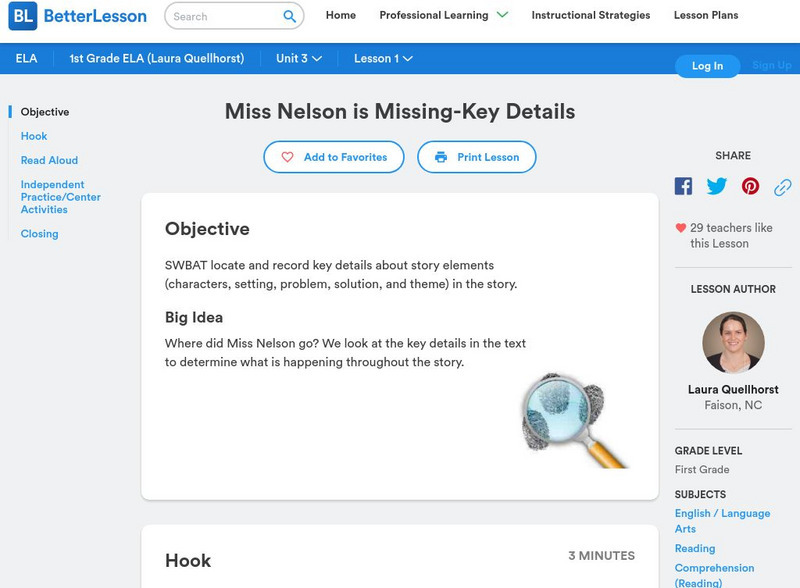
Better Lesson: Miss Nelson Is Missing Key Details
Where did Miss Nelson go? We look at the key details in the text to determine what is happening throughout the story. Students will locate and record key details about story elements (characters, setting, problem, solution, and theme) in...

Alabama Learning Exchange
Alex: America's Melting Pot
As part of the study of Civil Liberties, the students will do research on Civil Rights Supreme Court Cases and amendments that changed America. In groups, students will use various websites, books and newspaper articles to acquire...
American Museum of Natural History
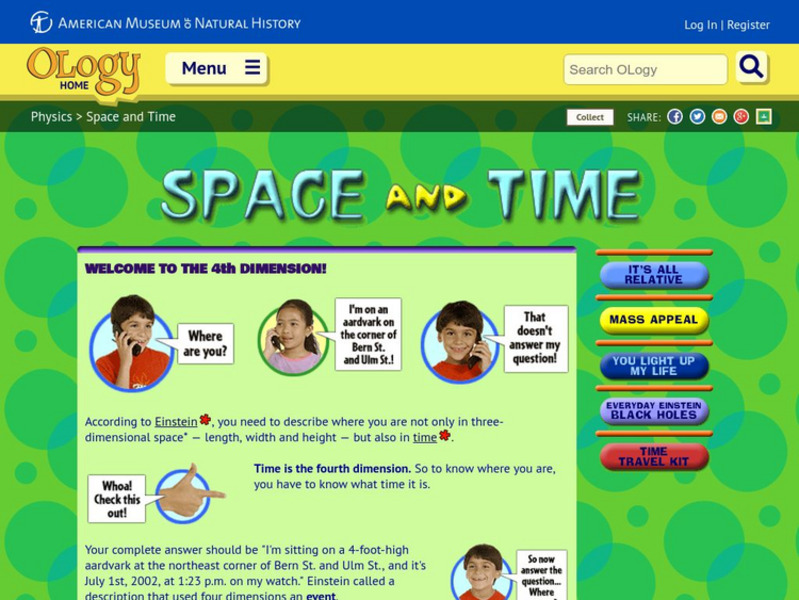
American Museum of Natural History: O Logy: It's All Relative
Learn about the 4th dimensions and the theory of relativity.There is no absolute, or "same," time and space. This means time and space are different for everyone! How you experience events in time and space depends on two important...