Hi, what do you want to do?






Curated OER
Making A Felt Pouch
Students are engaged in the making of a felt pouch. They complete the project with the aid of the teacher because the lesson is meant for the Special Education population. Students answer the following focus question to set the context,...

Curated OER
Get in Touch With Trees
In this five senses instructional activity, students complete several activities that help them improve their sense of touch and learn about their environment.

Curated OER
Capital for Cookies
Fourth graders examine the history of Utah's economy. For this Social Studies lesson, 4th graders analyze producers and consumers role in the community. Students study Utah's economy throughout history.

Curated OER
Paint Plus
Using the computer and the Paint program, Students explore the different tools available in the paint program, and then create a picture showing two sets of pictures and an equation.

Curated OER
Rationale
Students consider the rationale behind using the Internet as a research resource tool. They develop a research project, consider how to access and assess new information and format their research for presentation to the class.

Curated OER
Show and Teach
Second graders write "how to" sequences for tasks so that another person can follow the sequence to perform the action. They write a "show and teach" once a month for evaluation.

Curated OER
Geo Jammin' By DeSign - Day 3, Lesson 12: Jammin
Students review definitions of word wall words using songs, movement and sharing.

Curated OER
What's Your Expression
First graders explore facial expressions in a mirror and create drawings of people with a facial expression of their choice. They graph the facial expressions drawn.

Curated OER
Chemical Composition of Everyday Objects
Students relate chemistry to an object they use everyday. They research information related to chemistry and create their own webpage. They are to keep their page up to date as new observations are taken.

Curated OER
Galveston Island
Students discuss as a class how waves are formed. In groups, they participate in an experiment in which they can determine the effect of the moon on waves and discuss how Galveston Island formed over time. They identify the soil makeup...

Curated OER
Classifying Rocks
Students classify rocks into groups after they observe the rocks and identify properties that can be used to divide them into groups. They then identify other properties that could be used to classify other objects into groups.

Curated OER
Investigating Soil
Fourth graders swap local soil samples with another school and examine the differences. They research soil properties, identify organisms that live in soil, create and maintain a biome of soil decomposition and design a poster to present...

Curated OER
Pythagorean Triples
Students investigate the mathematical concepts related to the study of The Pythagorean Theorem. They graph and review how to use a line segment to construct a triangle. Then using the theorem students calculate the length of the hypotenuse.

Curated OER
Angles and Parallel Lines
Sixth graders draw parallel and intersecting lines to observe and examine the characteristics of alternate interior angles, vertical angles, corresponding angles, and supplementary angles. Through observation, they discover the...

Curated OER
Houses and the People They Shelter
Students examine different homes and shelters across cultures and time periods. For this Houses and the People They Shelter lesson, students draw conclusions about society and culture according to the features of their dwellings....

Math Is Fun
Math Is Fun: Regular 2 D Shapes
This tutorial provides illustrations for regular 2-D shapes as well as a definition for polygons and for regular polygons.

Other
Kindergarten Works: 10 Activities for Describing 3 D Shapes in Kindergarten
Describing 3D shapes in Pre-K and Kindergarten is now an expectation as it is a key geometry standard. This resource contains 3D shapes activities and resources for practicing this standard. Included are chants, videos, games, poetry,...

NumberNut
Number Nut: Shapes, Symbols, and Colors: 2 D Shapes
Did you know that two-dimensional shapes are also called polygons? This lesson describes the various 2-D shapes and includes two interactive games to reinforce skills.
CK-12 Foundation
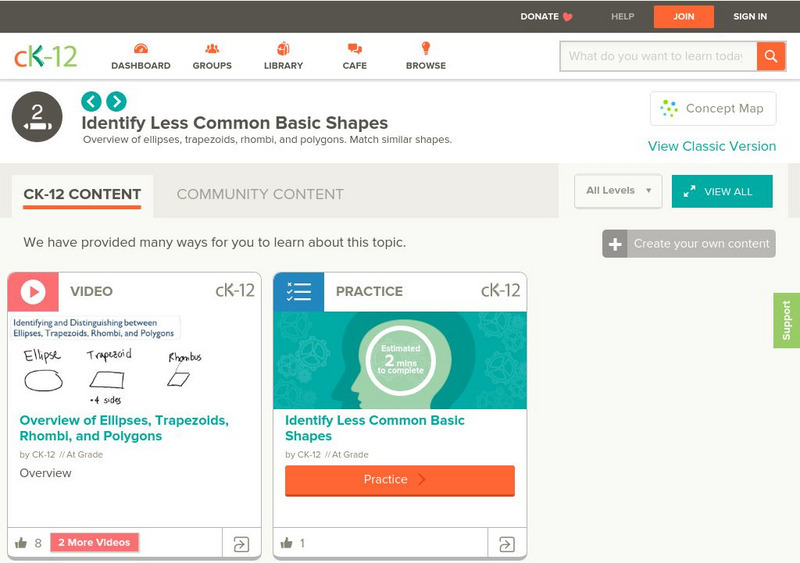
Ck 12: Elem Math: Matching Equivalent 2 D Shapes
[Free Registration/Login may be required to access all resource tools.] The video describes how to determine which shapes are similar by looking at the attributes of the given shapes. The video is followed by a series of practice...
NumberNut
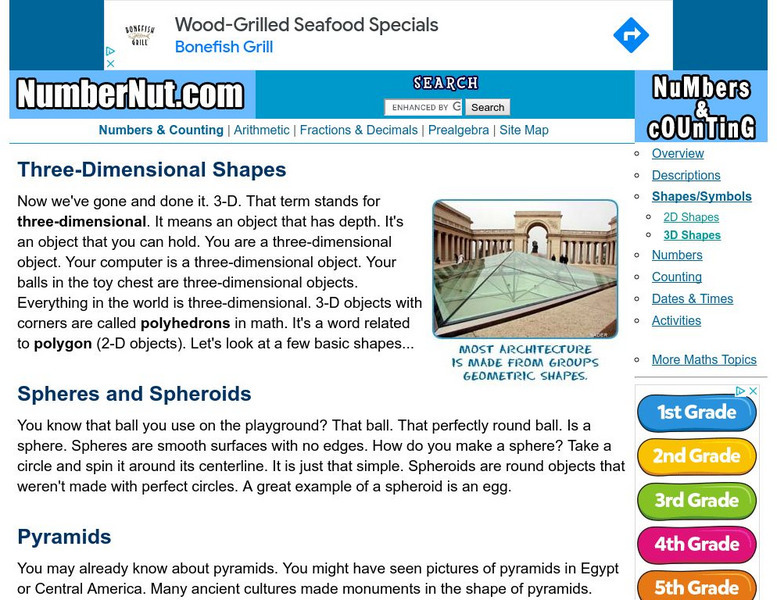
Number Nut: Shapes, Symbols, and Colors: 3 D Shapes
This lesson describes three dimensional shapes and provides two interactive practice activities.

Khan Academy
Khan Academy: Creating 3 D Shapes
Creating arrays of numbers that describe shapes in 3D shape--arrays that describe nodes and edges.
CK-12 Foundation
Ck 12: Elem Math: Counting Different 2 D Shapes Within Simple Composite Figures
[Free Registration/Login may be required to access all resource tools.] The video describes how to determine what shapes are used to create a given composite shape. The video is followed by practice problems.
CK-12 Foundation
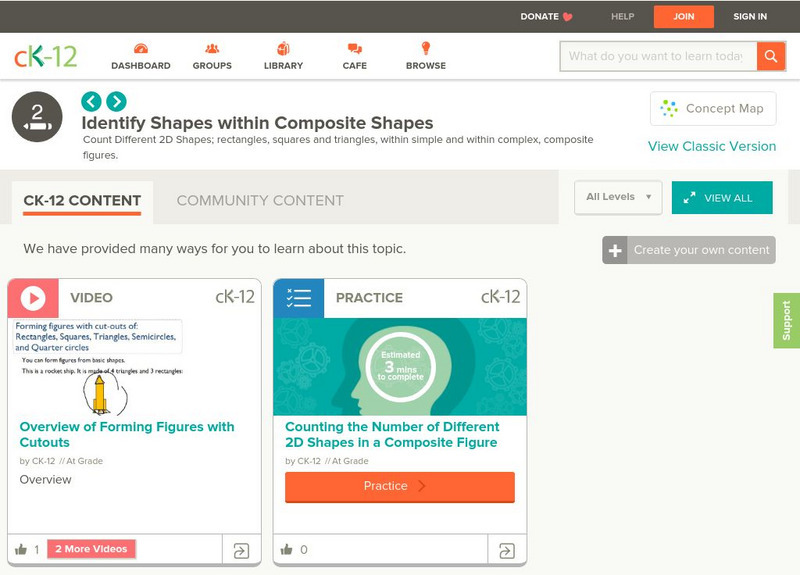
Ck 12: Elem Math: Counting Different 2 D Shapes Within Complex Composite Figures
[Free Registration/Login may be required to access all resource tools.] The video describes how to determine how many triangles are needed to create the complex composite shape.
CK-12 Foundation
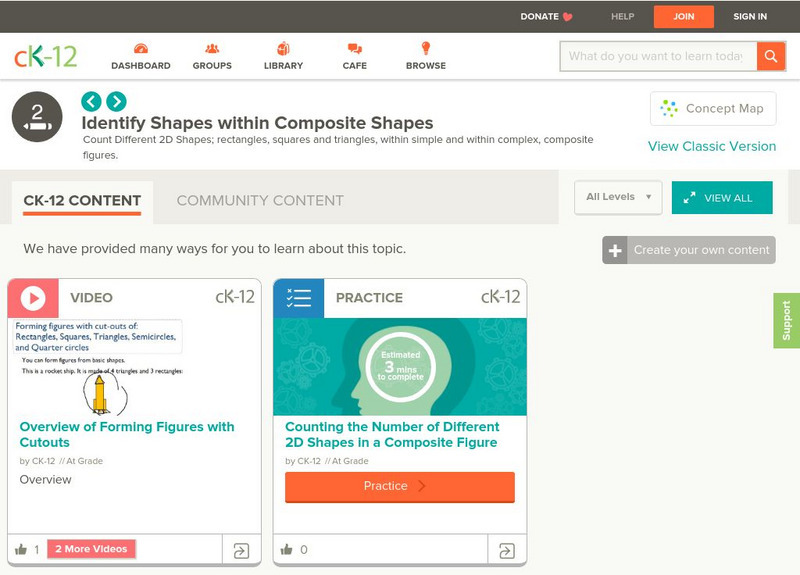
Ck 12: Elem Math: Count the Number of Different 2 D Shapes in a Composite Figure
[Free Registration/Login may be required to access all resource tools.] The video defines a composite figure and describes how to determine how many triangles are within the given composite shape. The video is followed by practice problems.