
Curated OER
Area of Polygons
Students engage in a instructional activity that is about the concept of polygons and focuses upon finding the area. They use formulas provided in the instructional activity in order to solve problems given by the teacher for independent...

Curated OER
Fractions
Students, while practicing solving equations with fractions, create their own vocabulary list to utilize through out the year that is associated with fractions. They create their own K-W-L sheet, fill it in and then locate a variety of...

Curated OER
How many isosceles triangles can you find?
Seventh graders recognize the characteristics of isosceles triangles. In this isosceles triangle lesson plan, 7th graders use geoboards to create isosceles triangles. Students record results and explain why they have an isosceles triangle.

Curated OER
Molecular Modeling Activity
Students work together to explain the VSEPR theory and how it relates to molecules. They name electron pairs that can surround the central atom of an organism. They discuss the factors that determine the polarity of a molecule as well.

Curated OER
Figure It Out - Polygons
Sixth graders explore different polygons. In this polygon lesson, 6th graders examine a rhombus, quadrilateral, parallelogram, and rectangles. Students compare and contrast polygons and research shapes on the Internet.

Curated OER
The Circle's Measure
Students explore circumference and diameter. In this math lesson plan, students apply their knowledge of circumference and diameter to solve mathematical riddles. Students apply this knowledge to find circumference and diameter of...

Curated OER
Circles, Rectangles, Squares, Triangles
Students identify, compare and classify the various shapes. In this shapes lesson, students listen to descriptions of shapes with words such as sides, angles, congruent, and parallel. Students then give the teacher examples of shapes...

Curated OER
Sizing Up Shapes
First graders explore geometric shapes. In this math lesson, 1st graders sort shapes into groups and discuss the characteristics of the shapes. Students build geometric shapes using toothpicks and marshmallows.

Curated OER
The Quadratic Formula
Students solve quadratic function by completing the square. In this algebra lesson, students use the quadratic formula to factor quadratics and find the roots. They graph the parabola and identify its properties.

Curated OER
Robots
Fourth graders devise and use problem solving strategies to explore situations mathematically (guess and check, make a drawing, use equipment). The use of logical reasoning is a focus of this lesson.

Curated OER
Geometric Shapes at the OK Corral
Students explore geometric shapes. For this math lesson, students identify geometric and non-geometric shapes using the computer. Students research geometric shapes in art and architecture.
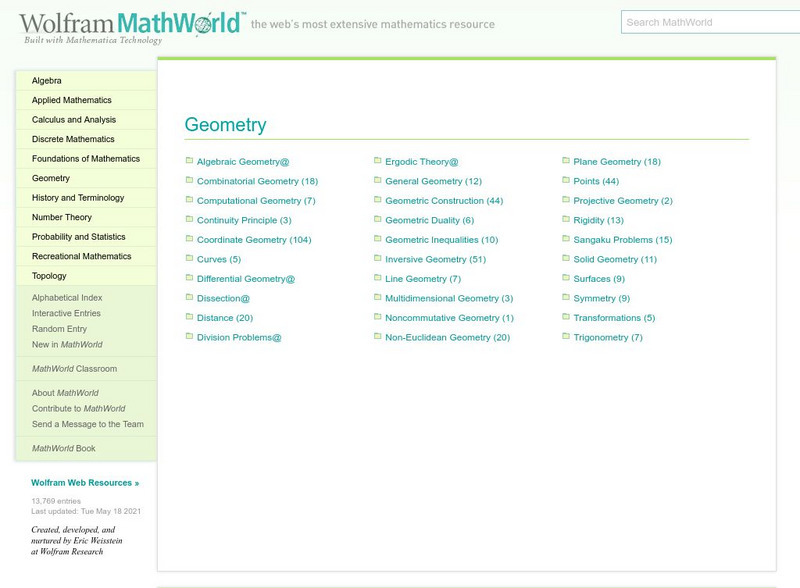
Wolfram Research
Wolfram Math World: Geometry
This MathWorld tutorial provides detailed overviews of the concepts and theorems associated with geometry. Most of the Math World sites are extensive and some require higher math knowledge to understand, links to terms and topics are...
New York Times
New York Times: Steven Strogatz on the Elements of Math Series the New York Times
[Free Registration/Login Required] On this site, Cornell University mathematics professor, Steven Strogatz, shares his 15-part series of columns on the elements of math. He investigates topics ranging from negative numbers to subtraction...

University of St. Andrews (UK)
University of St. Andrews: Luther Pfahler Eisenhart
The School of Mathematics and Statics at the University of St. Andrews, Scotland, presents this article on the life and work of Luther Eisenhart (1876-1965 CE). Eisenhart, an American mathematician who lived well into the 20th century,...
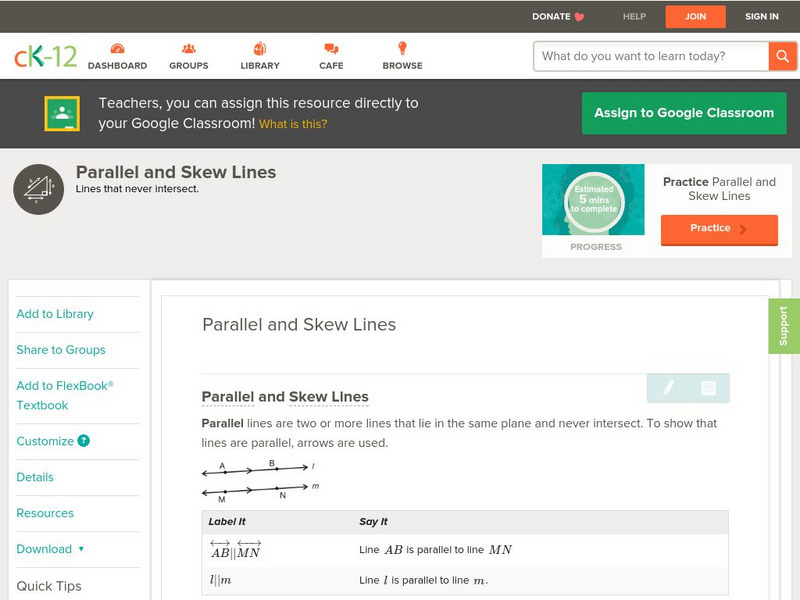
CK-12 Foundation
Ck 12: Geometry: Parallel and Skew Lines
[Free Registration/Login may be required to access all resource tools.] Differentiate between parallel and skew lines.
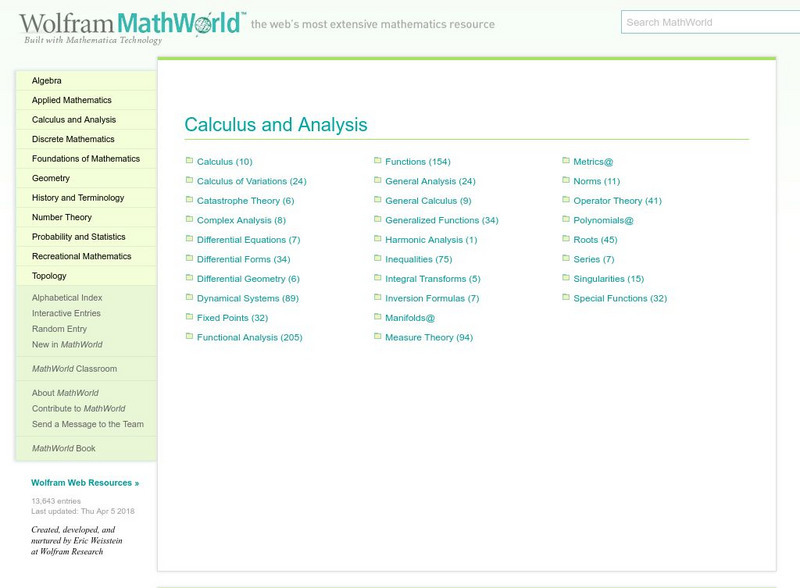
Wolfram Research
Wolfram Math World: Calculus and Analysis
Over two dozen links are provided at this MathWorld site. From Polynomials and Series to Dynamical Systems and Catastrophe Theory, each link provides in-depth explanations and relevant diagrams of the topics at hand.
Princeton University
Princeton University: Eisenhart, Luther Pfahler
This account of the work of mathematician Luther Eisenhart concentrates on his contributions to Princeton University where he taught for many years. In addition to working and publishing in mathematics, Eisenhart held various influential...

Better Lesson
Better Lesson: Designing a Restaurant
Understanding area and perimeter can help children work on solutions to very important, real world problems.
Better Lesson
Better Lesson: Using Area as an Architect (Stations Day 1)
In this multi-day activity, 3rd graders make 3 different models of an orphanage floor plan using Google Drawing, Virtual Graph paper, and a construction of rectilinear shapes, to calculate the area of each room using units square.
Stanford University
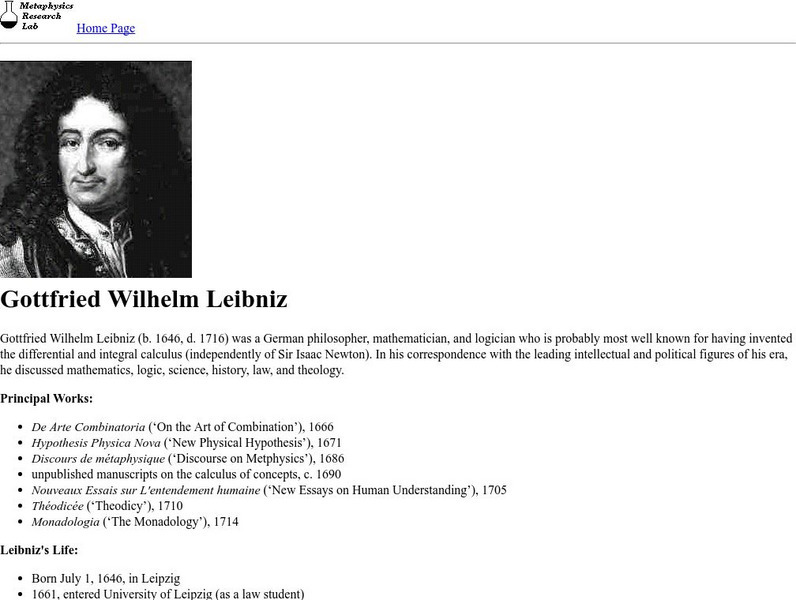
Stanford University: Overview of Leibniz
This site outlines Gottfried Wilhelm Leibniz's life. Categories include principal works, Leibniz's life, Leibniz's contributions to philosophy, and further readings.

University of St. Andrews (UK)
University of St. Andrews: George Polya
This University of St. Andrews site offers a biography of George Polya. Many links are provided.
University of Toronto (Canada)
Question Corner: Deductive and Inductive Reasoning
A simple discussion of the differences between inductive and deductive reasoning. Helpful to anyone who is having difficulty differentiating between the two.
Curated OER
University of St Andrews: Luther Pfahler Eisenhart
The School of Mathematics and Statics at the University of St. Andrews, Scotland, presents this article on the life and work of Luther Eisenhart (1876-1965 CE). Eisenhart, an American mathematician who lived well into the 20th century,...

University of St. Andrews (UK)
University of St. Andrews: Gaspard Monge
This University of St. Andrews page offers an excellent biography on Gaspard Monge, a French mathematician and diversified scientist (1746-1818.) Discusses his life and his contributions to these fields.