Hi, what do you want to do?






Curated OER
Sensational Slime
Learners predict, observe and draw conclusions while working on an experiment with "slime." Students accurately record observations and draw conclusions about the experiment.

Curated OER
Photosynthesis
In this photosynthesis worksheet, students follow the steps to complete a science investigation and then respond to 8 short answer questions regarding the photosynthesis investigation.

Curated OER
Teaching Avogadro's Number
Students design an experiment to determine Avogadro's number. Students utilize an ammeter, an electrolytic cell and internet research.

Curated OER
What's the Difference Between Concentration and Solubility?
Students discuss the difference between concentration and solubility as well as examine the difference in a hands-on activity. Using water and table salt, they experiment with solubility. They create different concentrations using water...

Curated OER
Off Base
High schoolers study La Chatelier's principle and identify how carbon dioxide may affect pH. In this coral lesson students complete a worksheet on pH and observe a lab.

CK-12 Foundation
Ck 12: Solution Concentration
[Free Registration/Login may be required to access all resource tools.] Students will calculate the concentration of solutions in units of molarity, and use molarity to calculate the dilutions of solutions.
Chemistry Collective
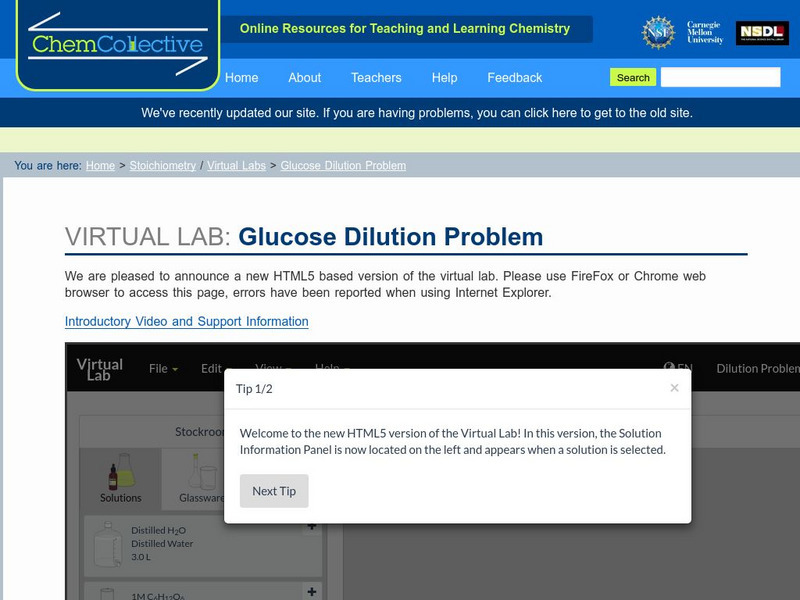
Chem Collective: Glucose Dilution Problem
In this activity, students use the virtual lab to create a 0.025M glucose solution from a standard 1M glucose solution. First, they calculate the correct volumes of 1M glucose solution and water to mix together to create the final 0.025M...
Chemistry Collective
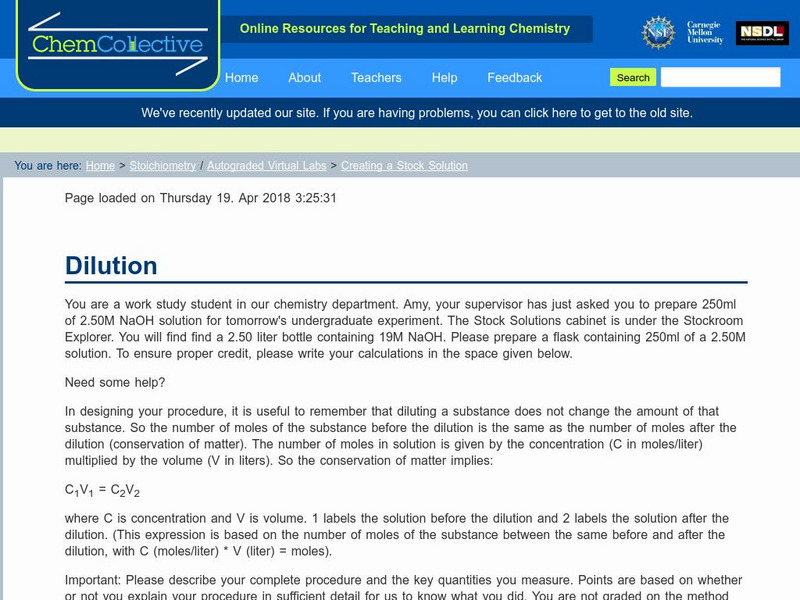
Chem Collective: Creating a Stock Solution
In this activity, students use the virtual lab to create dilute solutions from a concentrated stock solution of acids or bases. They must first calculate the correct volumes of concentrated acid solution and water to mix together to...
University of Colorado
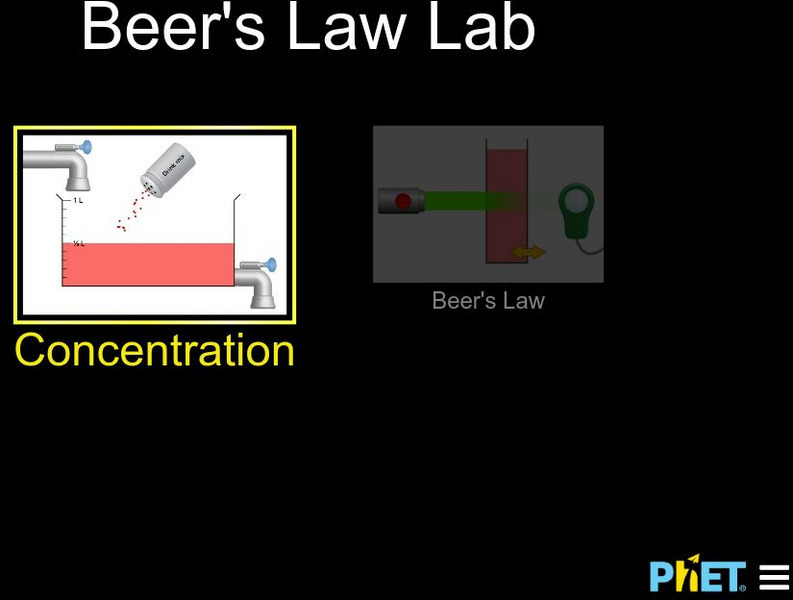
University of Colorado: Ph Et Interactive Simulations: Beer's Law Lab
"The thicker the glass, the darker the brew, the less the light that passes through." Make colorful concentrated and dilute solutions and explore how much light they absorb and transmit using a virtual spectrophotometer!
Science Education Resource Center at Carleton College
Serc: Kool Aid Chemistry
An investigation where students learn about dilutions by studying different dilutions of kool-aid with their five senses.
CK-12 Foundation
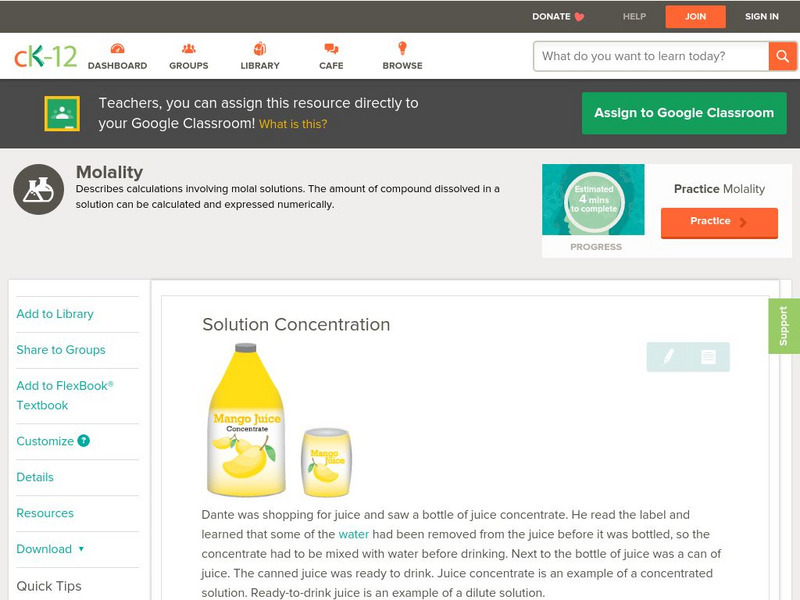
Ck 12: Physical Science: Solution Concentration
[Free Registration/Login may be required to access all resource tools.] Definition of concentration of a solution, the difference between concentrated and dilute solutions and how to calculate the concentration of a solution.
Purdue University
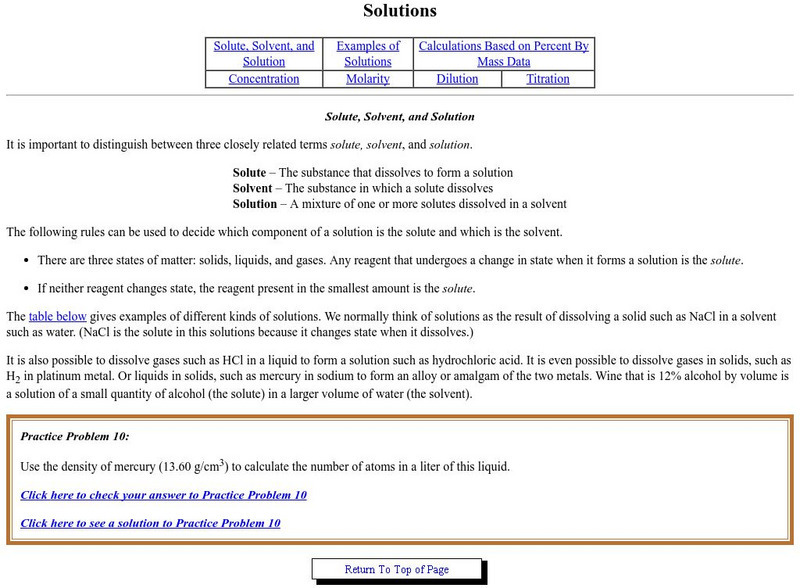
Purdue University: Solutions
This site, which is provided for by the Purdue University, gives types of solutions, concentration, dilution, and titration.
Chemistry Collective
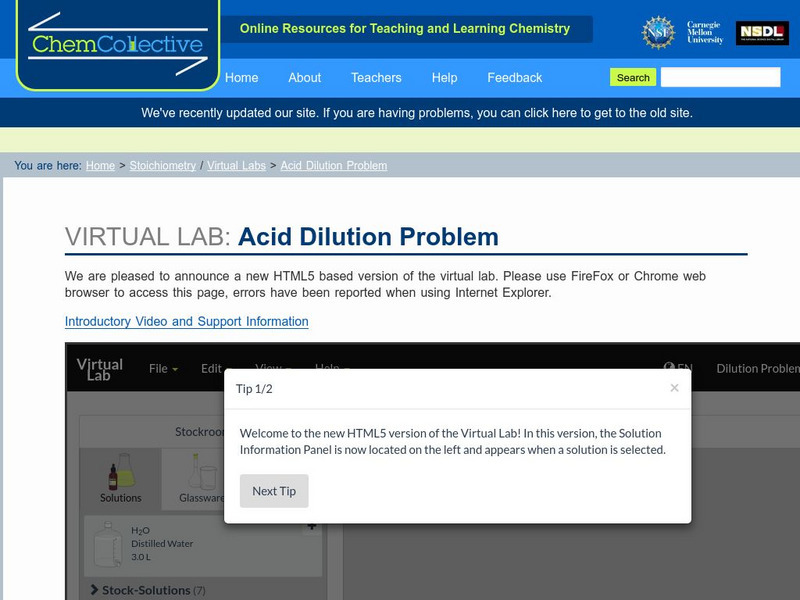
Chem Collective: Acid Dilution Problem
In this activity, students use the virtual lab to create 500mL of 3M HCl solution from a concentrated stock solution of 11.6M HCl. They must first calculate the correct volumes of 11.6M HCl solution and water to mix together to create...
Chemistry Collective
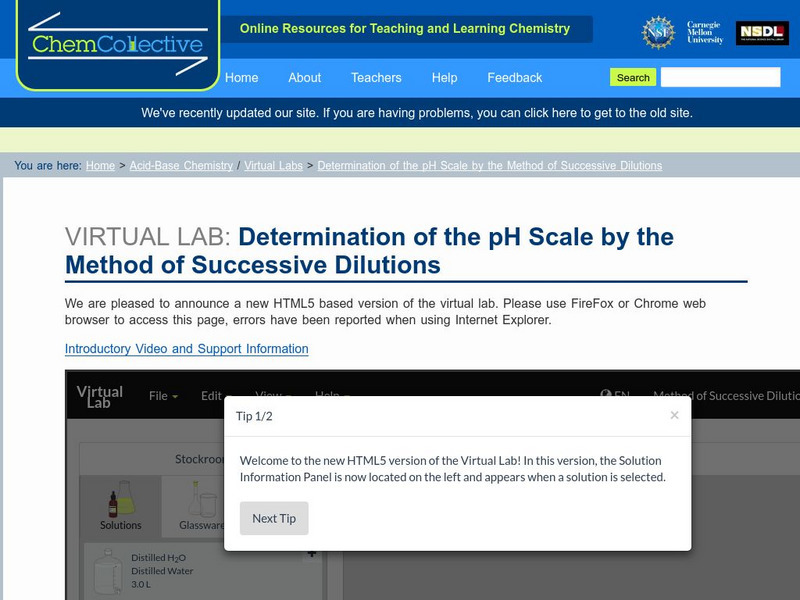
Chem Collective: Determination of the P H Scale
This virtual lab activity where students perform the method of successive dilutions using HCl, NaOH, a pH meter, and universal indicator solution to help understand the logarithmic nature of the pH scale.
American Geosciences Institute
American Geosciences Institute: Earth Science Week: Global Change: Where Land, Air and Water Meet
To develop an understanding of parts per million as a concept, teams of students create successive dilutions of a solution to reach a parts-per-million concentration.
Science Buddies
Science Buddies: How Blue Is Your Sports Drink?
Do you read the list of ingredients in foods and drinks before you buy them at the grocery store? If you do, you may have noticed that many of the items that are blue in color have the same dye, called FD&C blue 1. In this chemistry...
TeachEngineering
Teach Engineering: Yeast Cells Respire, Too (But Not Like Me and You)
Students set up a simple way to indirectly observe and quantify the amount of respiration occurring in yeast-molasses cultures. Each student adds a small amount of baking yeast to a test tube filled with diluted molasses. A second,...