Hi, what do you want to do?






CK-12 Foundation
Ck 12: Episd: Position Time Graphs
[Free Registration/Login may be required to access all resource tools.] Understand how to evaluate data presented in graphs based on speed and velocity calculations.

CK-12 Foundation
Ck 12: Plix: Motion: Position Time Graphs
[Free Registration/Login Required] Drag the red dot to draw a position-time graph for a sprinter with constant speed.
Texas Instruments
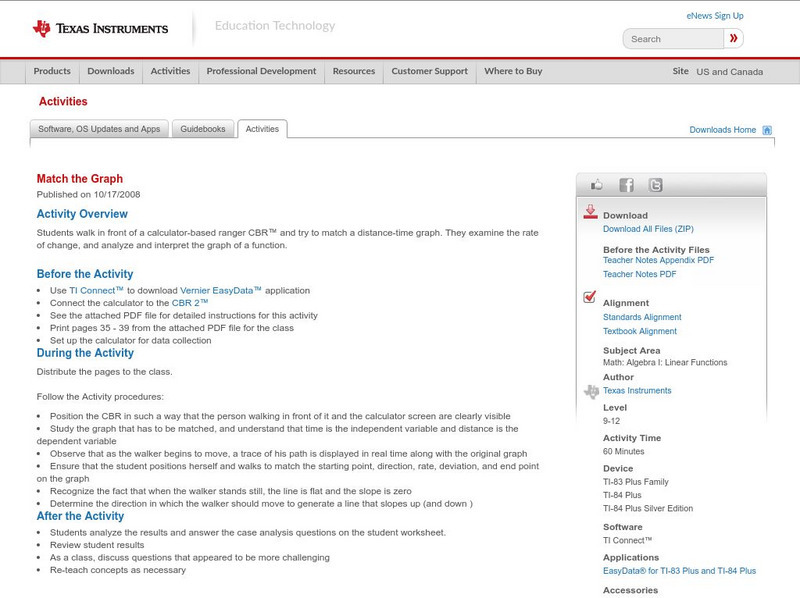
Texas Instruments: Match the Graph
In this activity, students walk in front of a calculator-based ranger CBR and try to match a distance-time graph. They examine the rate of change, and analyze and interpret the graph of a function.
Science Education Resource Center at Carleton College
Serc: Motion: Investigating Motion Graphs
In this lesson, students investigate motion graphs. Students predict what the distance-time graph and velocity time graph would look like for a student walking across the room for three different scenarios.
Concord Consortium
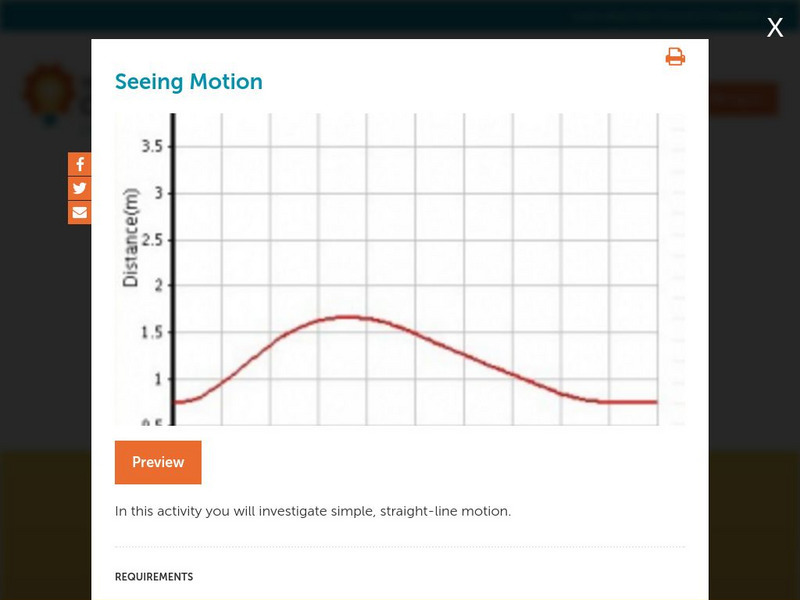
Concord Consortium: Stem Resources: Seeing Motion
With this interactive tool and the use of a motion sensor, students will track their own motion and, as they collect data in several experiments, they will plot it on a distance-time graph. After completing the three experiments, they...
BBC
Bbc: Gcse Bitesize: Describing Motion Aqa
This lesson focuses on Distance-time graphs; the gradient of a distance-time graph represents the speed of an object.
Texas Instruments
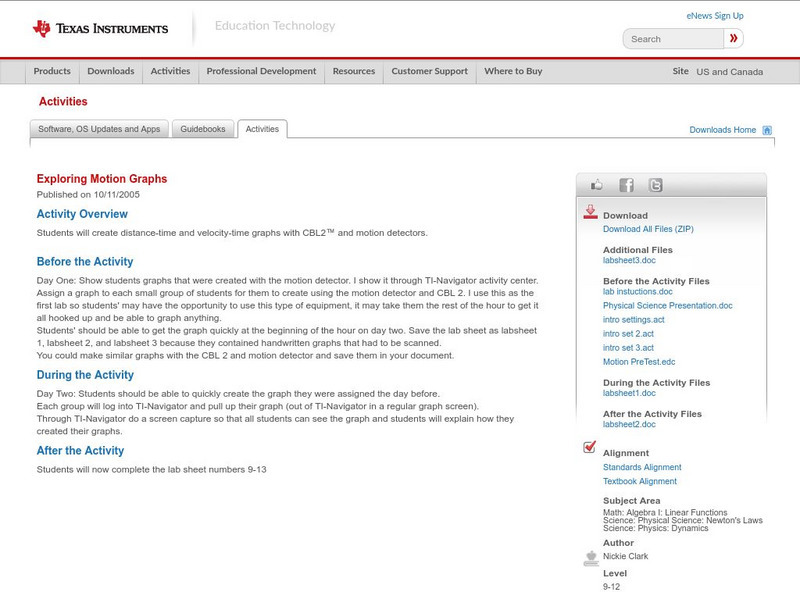
Texas Instruments: Exploring Motion Graphs
Students will create distance-time and velocity-time graphs with CBL2 and motion detectors.

Physics Aviary
Physics Aviary: Graphing Motion Problem Level 2
Find the distance traveled by an object just by looking at the velocity vs. time graph.
Texas Instruments
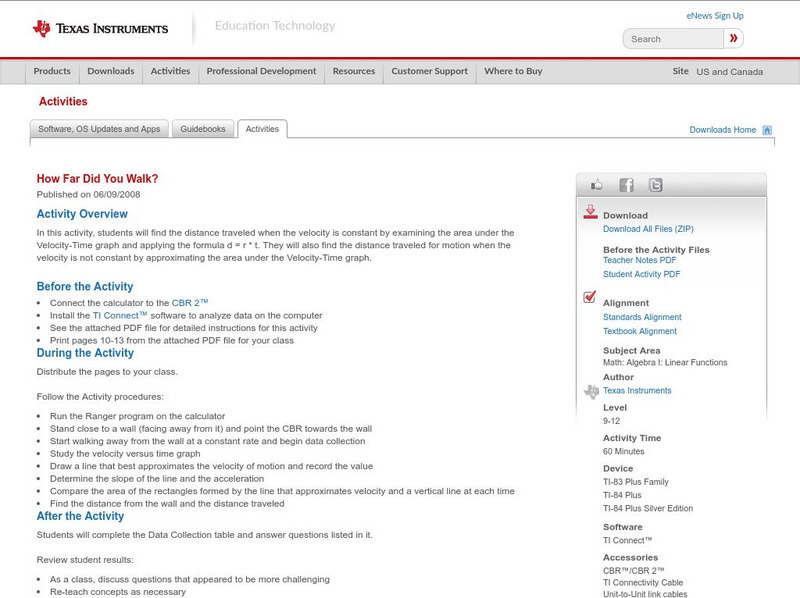
Texas Instruments: How Far Did You Walk?
In this activity, students will find the distance traveled when the velocity is constant by examining the area under the Velocity-Time graph and applying the formula d = r * t. They will also find the distance traveled for motion when...
Texas Instruments
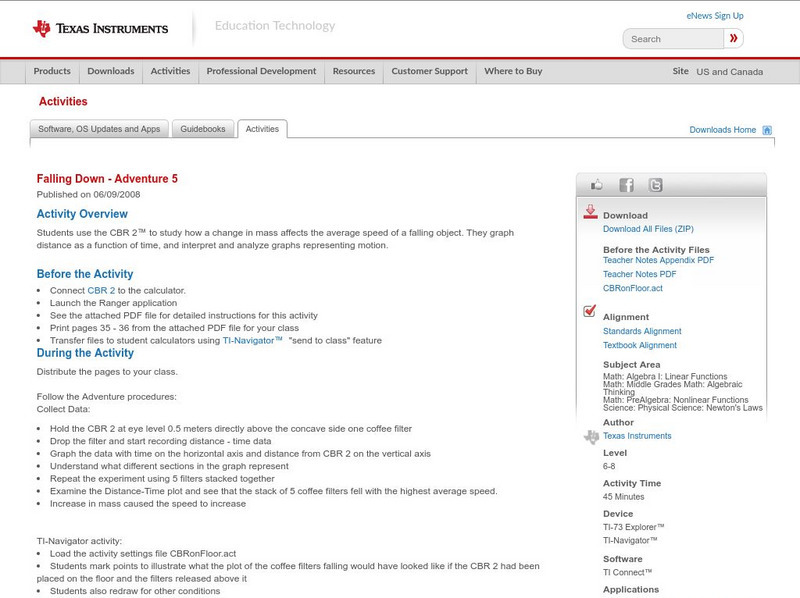
Texas Instruments: Falling Down Adventure 5
Students use the CBR 2 to study how a change in mass affects the average speed of a falling object. They graph distance as a function of time, and interpret and analyze graphs representing motion.
Texas Education Agency
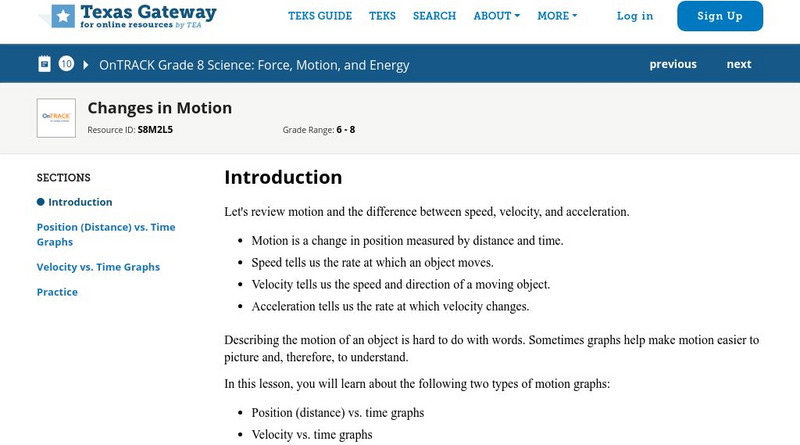
Texas Gateway: Changes in Motion
Given diagrams or scenarios, students will measure and graph changes in motion.
Physics Aviary
Physics Aviary: Graphing Motion Problem Level 1 Part 3
Find the distance traveled by an object by looking at the velocity vs. time graph. All velocities are constant.
Illustrative Mathematics
Illustrative Mathematics: 8.f Distance
Eighth graders are presented with the graphs of two cars traveling. One shows distance from home versus time and the other shows speed versus time. Students are to write a description of what might be happening during each car's...
Physics Aviary
Physics Aviary: Stopping Distance Lab
This lab is designed to have students find the relationships that affect the stopping distance and stopping time of a car on a roadway. Students will be able to modify the tires, road surface, the mass of the car, gravitational...
Texas Instruments
Texas Instruments: The Science of Racing: Time Laps
In this activity, you will create a picture of time and speed as they relate to changes in the weight of a radio controlled race car. This picture will be a graph - a mathematical model- that allows to you predict the speed of your radio...
Science Education Resource Center at Carleton College
Serc: Investigating Motion Graphing Speed
In this introduction to motion activity, students will get a personal understanding of speed and acceleration by experiencing it firsthand. Wheeled office chairs or other cart like devices are used to give one student a ride as a fellow...
Texas Instruments
Texas Instruments: Match Me!
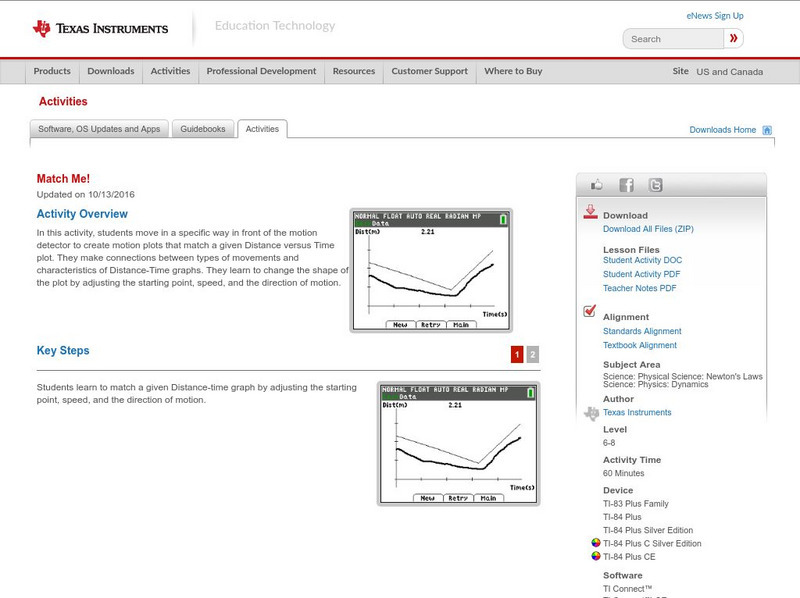
In this activity, students move in a specific way in front of the motion detector to create motion plots that match a given Distance versus Time plot. They make connections between types of movements and characteristics of Distance-Time...
Illustrative Mathematics
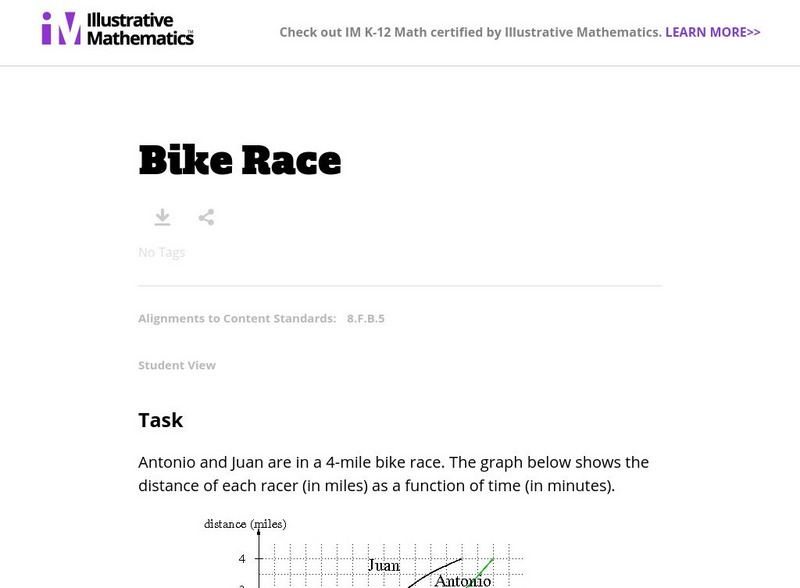
Illustrative Mathematics: 8.f Bike Race
Eighth graders are presented with the distance-time graphs of two bike riders in a race. They are to identify the winner and write a story describing what is happening during the race based on the shapes of the graphs. Aligns with 8.F.B.5.
Concord Consortium
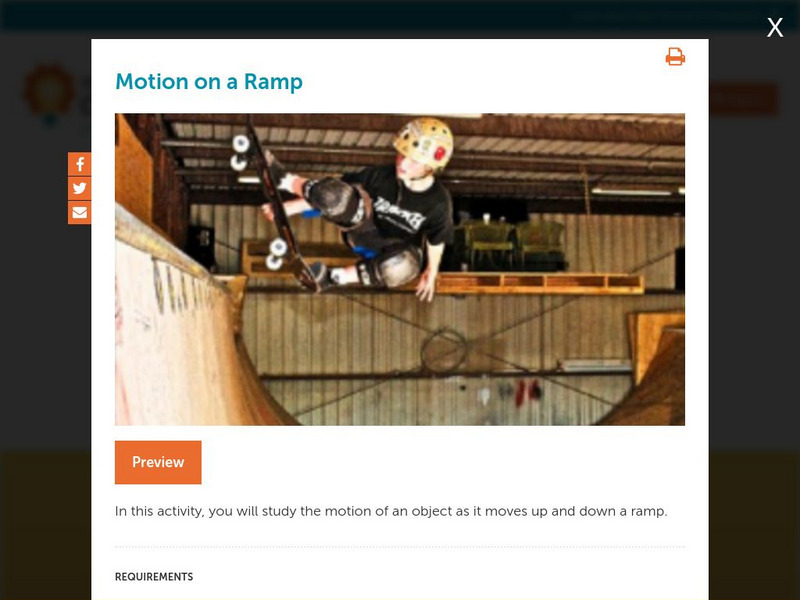
Concord Consortium: Stem Resources: Motion on a Ramp
Using a motion detector, students produce graphs that show the motion of a toy car as it moves on a ramp. Students collect distance versus time graphs and velocity versus time graphs as well as predict what the motion will look like on...
Concord Consortium
Concord Consortium: Stem Resources: Making Waves
Learn how to make waves! Using a motion sensor, students will recreate distance vs. time graphs given in the lab. Lab gives a detailed procedure as well as questions that can be saved online.
Concord Consortium
Concord Consortium: Spring and Mass Model
An interactive tool where students can explore how a spring behaves, and how changing the elasticity, mass, push/pull force, and friction affect its motion or period. As the spring moves, its motion is shown on a distance-time graph.
Texas Instruments
Texas Instruments: Walk the Line: Straight Line Distance Graphs
In this activity, students' use a motion detector to create straight-line, or constant-speed, distance versus time plots, and analyze the linear equation that describes the plots.
Texas Instruments
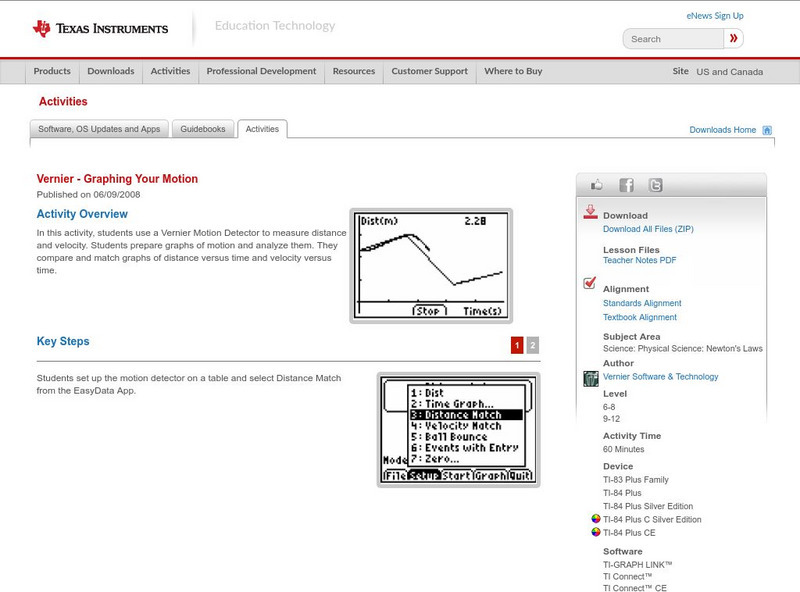
Texas Instruments: Graphing Your Motion
In this activity, students use a Motion Detector to measure distance and velocity. Students prepare graphs of motion and analyze them. They compare and match graphs of distance versus time and velocity versus time.
Texas Instruments
Texas Instruments: Graphing Your Motion With Easy Data App and Cbr 2
Students can use a CBR 2 motion detector to measure distance and velocity. Students prepare graphs of motion and analyze them. They compare and match graphs of distance versus time and velocity versus time.