Hi, what do you want to do?






Curated OER
"The Story of Miss Li" by Po Hsing-chien
Fourth graders explore a classic, well-regarded tale of traditional Chinese literature and gain a rudimentary understanding of Confucius values.

Curated OER
A Day During Colonial Times
Fifth graders participate in read aloud activities of three books about life in Colonial times. They compare their life to that of children of Colonial times using a Venn diagram. They draw a picture and write about what a day in the...

Curated OER
Landscape Confection
Students engage in a lesson about the creation of landscape paintings. This activity is meant to be done before visiting a museum. They examine the works of art in order to become familiar with the style and recreate them. Then students...

Curated OER
Sparta and Athens
Sixth graders study Ancient Greece. For this Ancient Greece lesson, 6th graders complete 16 lessons to learn about Ancient Greece. Students complete a quiz for assessment.

Curated OER
City Bound
Fifth graders identify the reasons for people migrating to cities after the Civil War. Using population data, they discover why populations in cities rose while rural populations fell during 1860 to 1900. They discuss the impact a...

Curated OER
Research as a Historian, as an Artist
Students work together to research one area of history that is of an interest to them. Using primary sources, they examine photographs and disuss what they already know about the topic. They present their images and information to the...

Curated OER
Michigan's Lumbering history: Yesterday, Today, and Tomorrow
Fourth graders explore lumbering in Michigan. For this lumbering lesson, 4th graders examine the life of a modern day lumberjack and how technology can interfere with natural ecology. Students create a list of products from...

Curated OER
Tasmanian Time Travel
Sixth graders perform research using the Internet about the Tasmanian Devil. The project can be presented in a variety of ways. The use of computer software is important for students to know, specifically Hyperstudio.

Curated OER
How Things Fly
Students conduct a series of hands-on experiments that help them explain the role of lift in fixed-wing flight. They observe the flow of air and water around several surfaces and then consider the dynamics of airflow around an aircraft...

Curated OER
Dorothea Dix: Reform in Massachusetts
Students examine the life and reform efforts of Dorothea Dix on behalf of people with disabilities. They discover how her efforts resulted in the passage of legislation. They also examine the care people with disabilities receive.

Curated OER
Cabeza de Vaca Meets the Coahuiltecans
Students examine the difference between primary and secondary sources by examining the journal of Cabeza de Vaca and creating a poster about the Coahuitecan Indian groups. They portray a scene of the groups in 16th Century south Texas.

Curated OER
What is Migration
Students conduct individual research and participate in discussion be able to identify difference between forced and voluntary migration. They identify if push and pull factors are caused by political, social, economic, or environmental...

Curated OER
The Industrial Revolution
Eighth graders examine the time period of the Industrial revolution in American history. In this American History lesson, 8th graders read the chapter on this time period. Students create a presentation on this time period to...

Curated OER
Changing Landscape at the Fort Vancouver Reserve
Students investigate the international background and consequences of The Louisiana Purchase, The War of 1812, and The Monroe Doctrine. The lesson helps to improve critical thinking skills about American History.

Palomar Community College District
Palomar College: Archaic Human Culture
Early human culture from the Paleolithic period is described. Find details about archaic tools, language, clothing, and rituals for burying the dead.
Palomar Community College District
Palomar College: Flashcards: Early Modern Human Culture
A collection of fifteen flashcards testing knowledge of the early modern human culture.
Palomar Community College District
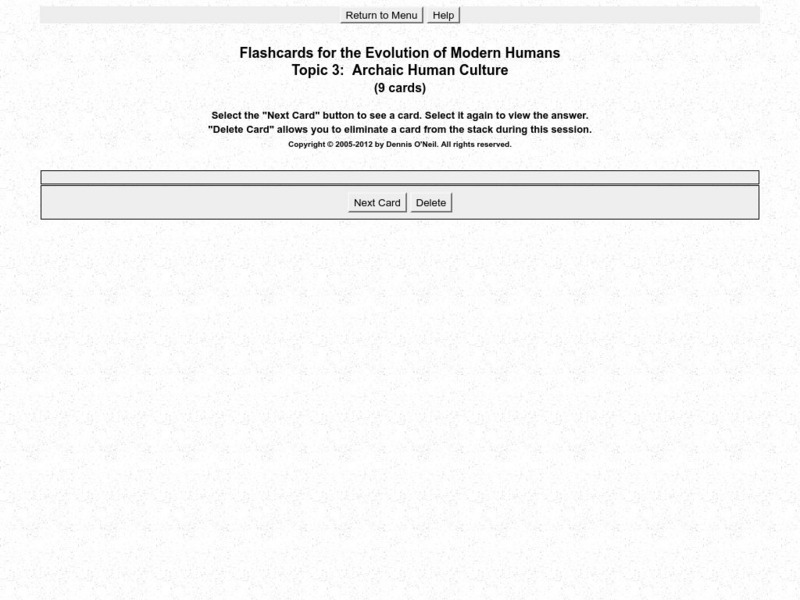
Palomar College: Early Modern Human Culture
An exclusive group of early humans are classified into the Upper Paleolithic stage because they were more evolved than others. Discover their culture - art, tools for making tools, and social changes - of this era.
Palomar Community College District
Palomar College: Flashcards: Archaic Human Culture
A set of nine flashcards to help understand the culture of early humans.
National Endowment for the Humanities
Neh: Edsit Ement: Native American Cultures Across the United States
Students explore different aspects of the cultures of the First Americans in this lesson plan. Stereotypes are often associated with Native Americans through movies and in the context of the Thanksgiving holiday. Specific information and...
Khan Academy
Khan Academy: American Indian Culture of the West
The Western Indian tribes hit the lottery with the abundant natural resources in their area. The tribes that called this area home had diverse cultures depending on the geography of their specific location. Delve into these cultures and...
Khan Academy
Khan Academy: American Indian Culture of the Southwest
We can thank the Indian tribes from the Southwest for introducing us to corn. Corn was seen as a spiritual gift in Pueblo societies. Study more of the cultural characteristics of these tribes such as their irrigation system which allowed...
Other
Institute of Human Origins: Becoming Human
Multimedia-rich guide for anyone making their way through a study of human origin. Find information and analysis about the fossil record, comparative anatomy, theories, and the cultural adaptations of humans and their ancestors. With an...

Khan Academy
Khan Academy: Moche Culture, an Introduction
Moche architects and artists raised spectacular adobe platforms and pyramids and created exquisite ceramics and jewelry. View pictures and read descriptions of Moche artwork and culture in this essay.

Khan Academy
Khan Academy: A Brief History of Western Culture
History is divided into time periods in order to better understand the culture and characteristics of that time. Read a brief description of the art and culture of historical time periods in this introductory article.