Hi, what do you want to do?





Extreme Science
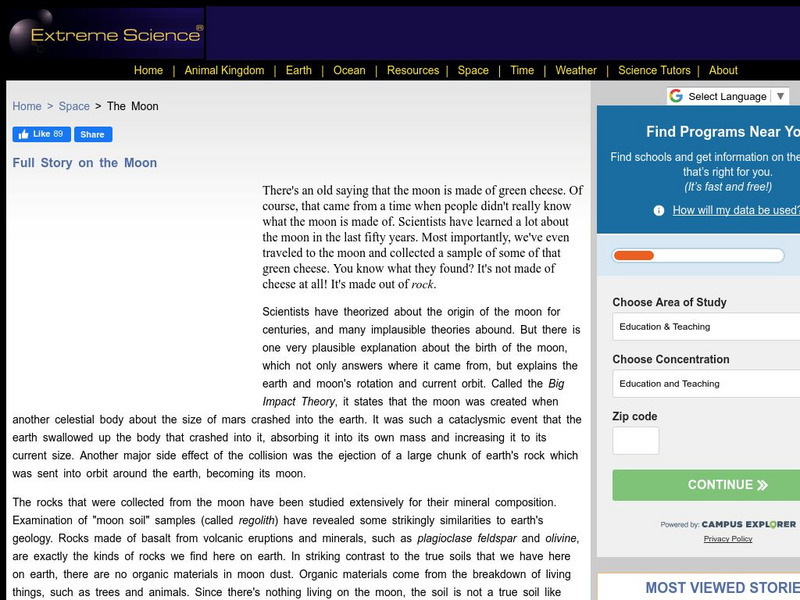
Extreme Science: The Moon
Read about the birth of Earth's moon, its composition, orbit, visible phases, and other interesting facts. Link to a virtual moon phase interactive which shows the current lunar phase and the phase on any date in the past or future.

Alabama Learning Exchange
Alex: Our Restless Planet
This unit will use demonstrations and student examples to help students gain an understanding of rotation, revolution, and orbit. Through hands-on activities students will explore the concepts of day and night. Technology will be...

PBS
Pbs Learning Media: Satellite Motion
Explore the motion of a satellite as it orbits the earth in this interactive simulation.
NOAA
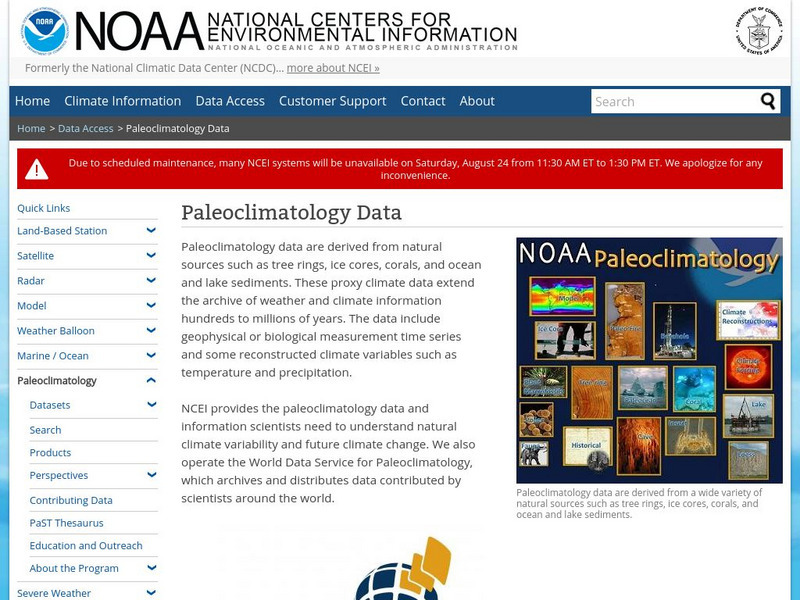
Noaa: Paleoclimatology Program: Astronomical Theory of Climate Change
Use this site to learn how the Earth's not-so-circular orbit around the sun has affected our climate over thousands of years, and continues to affect our climate now.

National High Magnetic Field Laboratory
Magnet Academy: Oersted Satellite, 1999
Named in honor of Danish physicist Hans Christian Oersted, Denmark's first satellite has been observing and mapping the magnetic field of the Earth.
Science Buddies
Science Buddies: Kinesthetic Astronomy: Longer Days, Shorter Nights
This kinesthetic activity demonstrates to students that the Earth's tilt is what is responsible for shifting light patterns and the change in seasons.
Science U
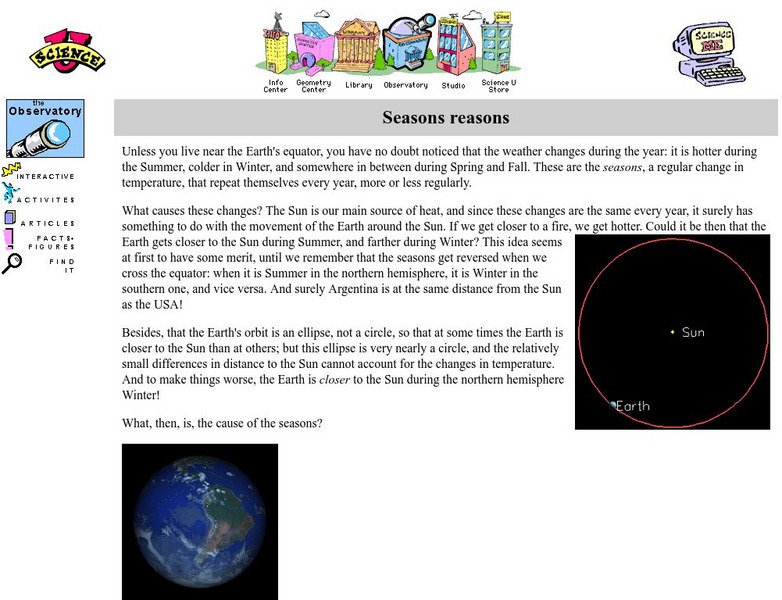
Science U: Reasons for the Seasons
This webpage uses diagrams and video to explain the causes of the seasons.
Nine Planets
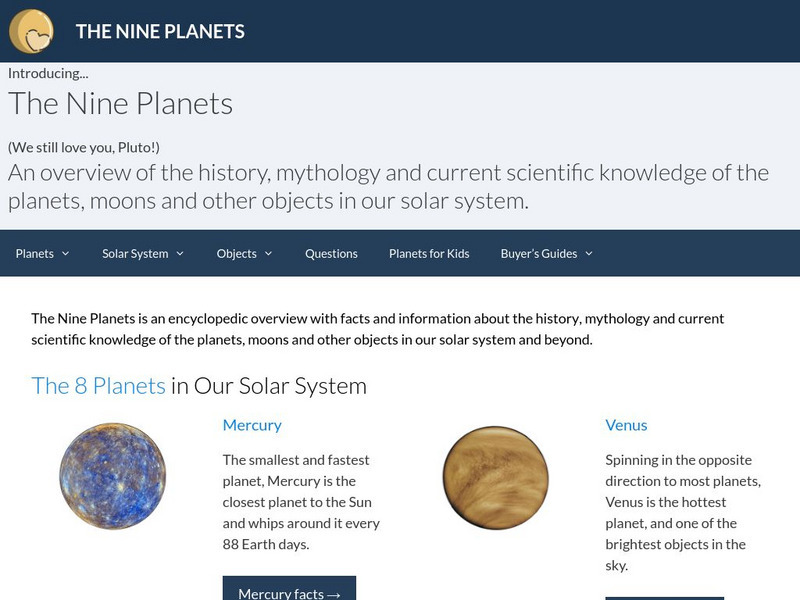
The Eight Planets: Just for Kids
Here is a clear, simple picture of the solar system. Click on the names of the planets to learn more about each. Clicking on underlined terms takes you to more and more detailed scientific information.
Texas Instruments
Texas Instruments: Seasons
This activity is designed to assess a student's comprehension of a basic meteorological phenomenon.

TED Talks
Ted: Ted Ed: The Leap Year Explained
Every four years, we gain an extra calendar day. Neil deGrasse Tyson explains the science behind the leap year. [3:22]
Mocomi & Anibrain Digital Technologies
Mocomi: John Herschel Glenn Jr Biography
Interesting biographical information, fun facts, and famous quotes about John Glenn, the first American to orbit the earth.
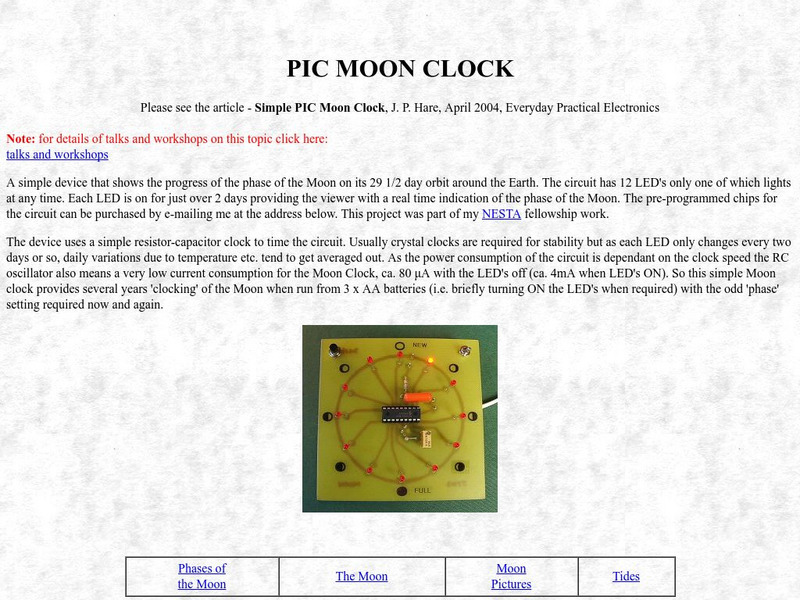
Creative Science Centre
Creative Science Centre: Pic Moon Clock
Explains the design of a simple device that shows the progress of the phases of the Moon on its 29 1/2 day orbit around the Earth.
NASA
Nasa: Heliophysics: New Science of the Sun Solar System Connection
This site from NASA lists common and uncommon misconceptions about Sun-Earth Science. Site also provides links to activities and lesson plans as well as background reading.
MadSci Network
Mad Scientist: Why High Tide Away From the Moon or Sun?
An excellent and thorough answer to the often asked question about high tide "bulges" on the side of Earth facing away from the Moon or Sun.
Curated OER
Moon's Orbit
This site provides a moving diagram of a Lunar eclipse, showing Earth's umbra and penumbra and the appearance of the Moon as it passes through these shadow regions.
Curated OER
Eyes on the Sky, Feet on the Ground: The Earth's Moon
In this online textbook produced by the Smithsonian, students explore the phases of the moon, the moon's orbit, the origin of the moon, and the tides. Includes numerous inquiry-based activities.
Curated OER
Earth Rotates Toward the East
This site from the National Aeronautics and Space Administration provides a fun project on rockets. "Nothing in space stands still. Everything either orbits around something else, or moves toward or away from something else. So how do...
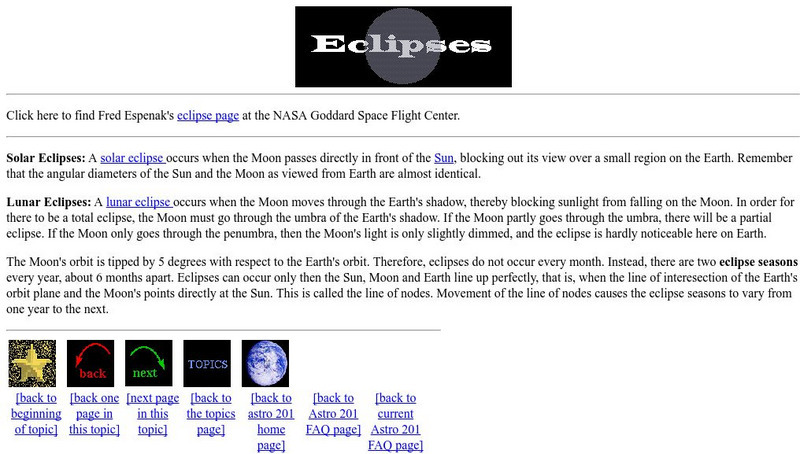
Cornell University
Cornell University: Astronomy: Eclipses
This site from the Astronomy Department of Cornell University provides brief introduction to both solar and lunar eclipses. Links are provided for pictures and charts of the eclipses, and this is a good site to check out on the subject.
Wonderville Media
Wonderville: Planets
There are eight planets in orbit around our Sun. These planets form our solar system. The eight planets are Mercury, Venus, Earth, Mars, Jupiter, Saturn, Uranus, and Neptune. There are also rocks, moons, comets, and other objects going...
Kidport
Kidport: The Moon Landing
Travel back in history and see the first men on the moon. See photos of the crew, the launch, the landing and more.
TeachEngineering
Teach Engineering: Solar System!
An introduction to our solar system: the planets, our Sun and our Moon. Students begin by learning the history and engineering of space travel. They make simple rockets to acquire a basic understanding Newton's third law of motion. They...
Digital History
Digital History: The Space Race
In October 1957, the Soviet Union launched Sputnik 1, the world's first artificial satellite. The 184-pound, 22.5-inch sphere orbited the earth once every 96 minutes. Sputnik transmitted radio signals for 21 days and later burned up in...
TeachEngineering
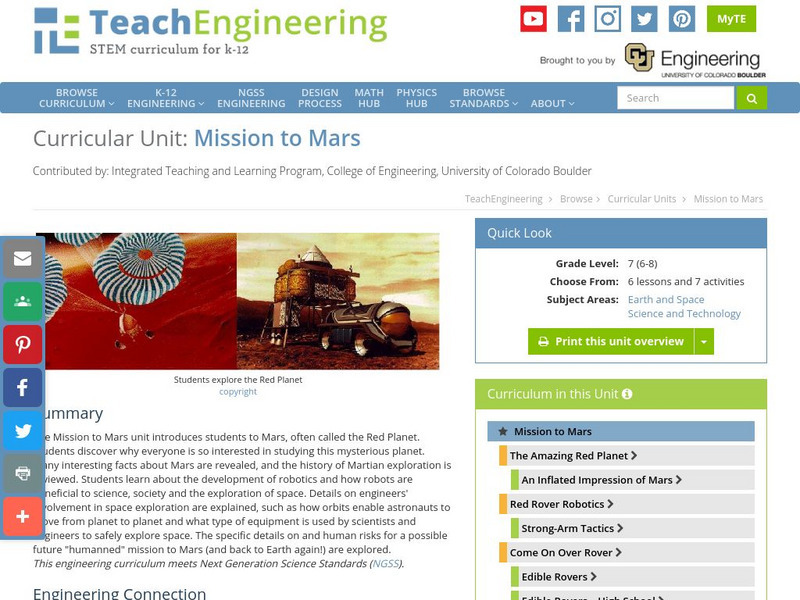
Teach Engineering: Mission to Mars
The Mission to Mars curricular unit introduces students to Mars-the Red Planet. Students discover why scientists are so interested in studying this mysterious planet. Many interesting facts about Mars are revealed, and the history of...
University of Texas at Austin
Ut Austin Center for Space Research
The homepage of the Center for Space Research at the University of Texas whose mission is "to conduct research in orbit determination, space geodesy, the Earth and its environment, exporation of the solar system, as well as expanding the...
Other popular searches
- Earths Orbit Around Sun
- Earth's Orbit Seasons
- Earth's Orbit Around Sun
- Earth's Orbit Shape
- Seasons Earths Orbit
- Shape of Earth's Orbit
- Earth's Orbit Projects
- Earth's Orbit Circle
- Seasons, Earths Orbit
- Earths Orbit of Sun
- Earth's Orbit Around the Sun