Hi, what do you want to do?






PBS
Pbs Learning Media: The Lowdown: Brief History of the First Earth Day and What We Can Learn From Its Success Lesson Plan
Earth Day grew out of the environmental movement in the late 1960s in response to a series of environmental disasters that took lives, marred natural beauty and threatened animal species. An estimated 20 million Americans participated in...
Other
Mother Nature Network: Earth Day: An Animated Tribute
Animated review of environmental legislation and events, produced as a commemoration, in 2010, on the forty-year anniversary of the first Earth Day. Includes a timeline of events. [4:40]
Utah Education Network
Uen: Earth and Moon Observations
Earth's revolution, rotation, tilt, day and night cycle, and the sun's apparent movement across the earth are explored.

E-learning for Kids
E Learning for Kids: Science: Atlantic Ocean: Day and Night
This module explores day and night. Learn about what we see during the day and night and why we see what we see.
NASA
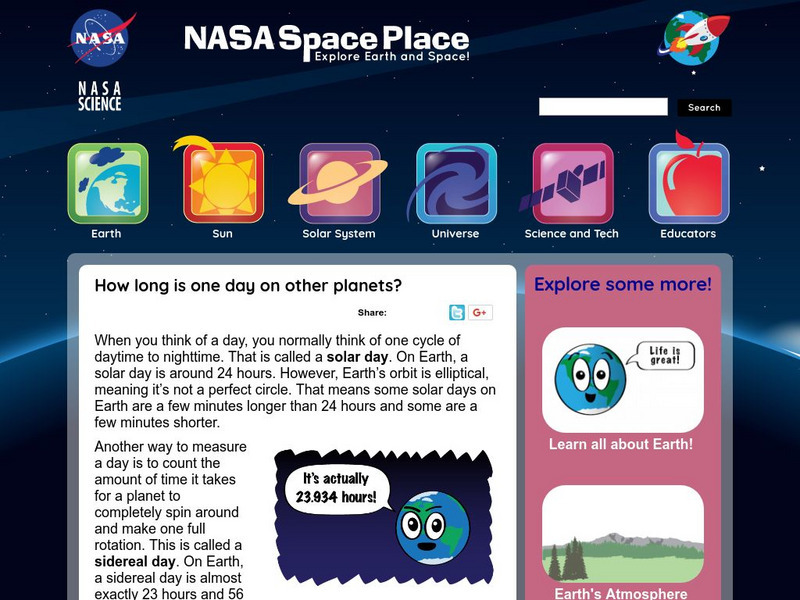
Nasa: Space Place: How Long Is One Day on Other Planets?
Here on Earth a day takes 24 hours. How long are days on other planets in our solar system? Find out here in three different ways, whichever meets your learning style the best.

Alabama Learning Exchange
Alex: Take Pride in America Auntie Litter Needs You!
In this lesson plan from "The Friends of Auntie Litter", (www.auntielitter.org), Earth Day will be explored. This lesson plan is one from the "Take Pride Statewide" series. *This lesson plan is provided by Julie Danley, Pam Walston, and...

E-learning for Kids
E Learning for Kids: Science: France: What Makes Day and Night?
Papa and his son Pierre work at a grape farm. Pierre loves to go out and play as soon as the sun comes up. What do you know about the sun and the Earth?

Other
Center for Science Education: Eye on the Sky: What Makes Day and Night?
This activity will allow you to model day and night cycles. A rotating student holding a map (provided) models the earth. A lamp is used to model the sun. Numerous worksheets (pdf) and additional website resources are also provided.
Science Struck
Science Struck: A Scientific Explanation to What Causes Day and Night
Explains how the rotation and the axial tilt of the Earth are responsible for the phenomenon of day and night. Provides information about the Sun, the solar system, and the Earth, and how the circumference of the Earth was first measured...
Utah Education Network
Uen: Trb 3:1: Investigation 4: Day and Night
A instructional activity for third graders in which they learn about the rotation of the Earth on its axis and how this movement creates day and night. They also examine the orbit of the moon about the Earth and the Earth's orbit around...

Geography 4 kids
Geography4 kids.com: Earth Around the Sun
Find out what all results from Earth revolving around the sun every 365 days as well as the rotation of the Earth every 24 hours.
American Chemical Society
American Chemical Society: Explore Chemistry: Water and Chemistry
Explore water's unique properties in the activities here. Includes ideas for starting a chemistry club, ideas for Earth Day, articles, and videos.
Utah STEM Foundation
Utah Stem Action Center: Air Masses
An air mass forms when the air over a large region of Earth sits in one place for many days. The air gradually takes on the characteristics of the land or water below it. Where Earth's surface is cold, the air becomes cold. Where Earth's...
Other popular searches
- Earth Day Activities
- Earth Day Writing Activities
- Earth Day Art
- Earth Day Art Project
- Earth Day Writing
- Earth Day Lesson Plans
- Earth Day Lessons
- Earth Day Games
- Earth Day Unit Plan
- Earth Day Participation
- Earth Day Word Search
- Letters for Earth Day