Hi, what do you want to do?





Sophia Learning
Sophia: The Sun and Moon: Lesson 3
This lesson will analyze the role of the sun and moon relative to the earth's orbit. It is 3 of 4 in the series titled "The Sun and Moon."
Sophia Learning
Sophia: The Sun and Moon: Lesson 4
This lesson will analyze the role of the sun and moon relative to the earth's orbit. It is 4 of 4 in the series titled "The Sun and Moon."
Creative Science Centre
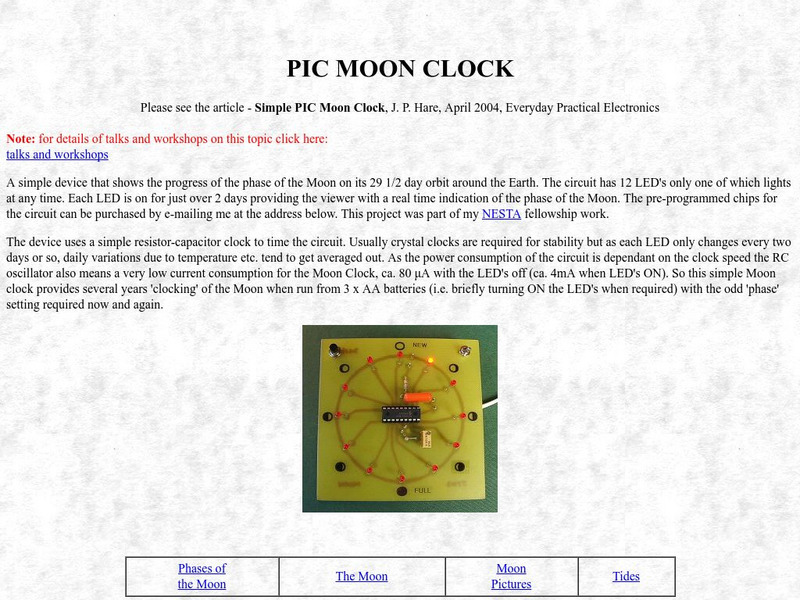
Creative Science Centre: Pic Moon Clock
Explains the design of a simple device that shows the progress of the phases of the Moon on its 29 1/2 day orbit around the Earth.
MadSci Network
Mad Scientist: Why High Tide Away From the Moon or Sun?
An excellent and thorough answer to the often asked question about high tide "bulges" on the side of Earth facing away from the Moon or Sun.

NASA
Nasa: Io: Overview: Volcanic Moon
Find out about most volcanically active world in the Solar System, Jupiter's moon named Io.

E-learning for Kids
E Learning for Kids: Egypt: How Do the Sun, Moon and Earth Revolve Around Each Other?
Omar helps his parents sell things at the market. Join him while he learns about the relationship of the Sun, Moon, and Earth.
Harvard University
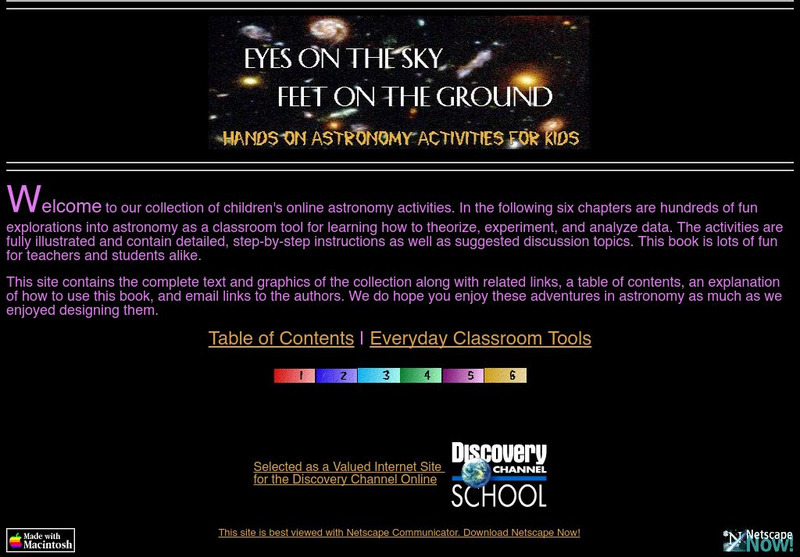
Harvard University: Eye on the Sky, Feet on the Ground
An ebook filled with information and classroom activities covering several astrological topics such as the Earth's rotation and the solar system. Many tips and teaching tools are available to aid in discovering what the sky has to offer.
Science and Mathematics Initiative for Learning Enhancement (SMILE)
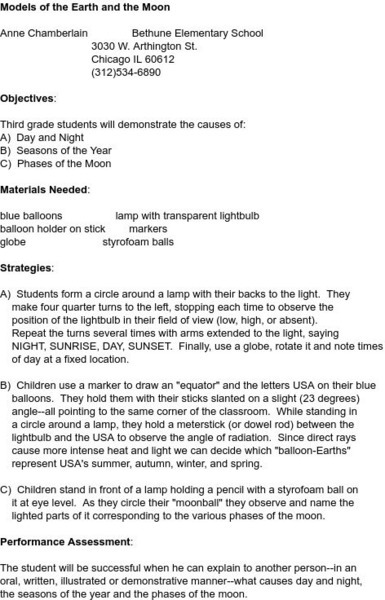
Smile: Models of the Earth and Moon
This lesson plan from the Illinois Institute of Technology demonstrates the causes of; day and night, seasons, and phases of the moon.With a few items, you help the elementary student discover why these phenomena occur.
Kidport
Kidport: The Moon Landing
Travel back in history and see the first men on the moon. See photos of the crew, the launch, the landing and more.
Curated OER
Moon's Orbit
This site provides a moving diagram of a Lunar eclipse, showing Earth's umbra and penumbra and the appearance of the Moon as it passes through these shadow regions.
Physics Classroom
The Physics Classroom: The Apple, the Moon, and the Inverse Square Law
Describes the logic behind the development of Newton's law of universal gravitation. Beginning with Johannes Kepler and his three laws of planetary motion, content walks the reader through Newton's thought process and development of this...
American Geosciences Institute
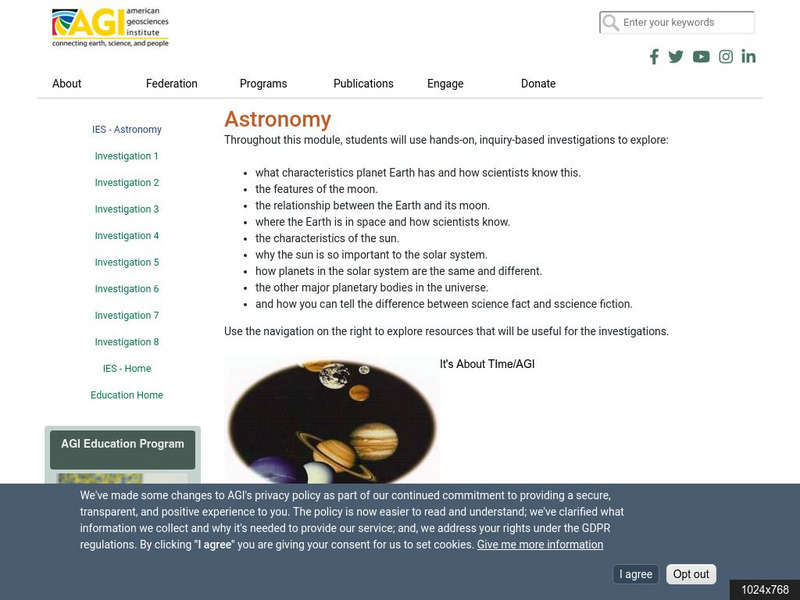
American Geosciences Institute: Astronomy
Eight hands-on lessons module in which students explore the characteristics of planet Earth, its moons, the sun, the solar system, planets, and the difference between science fact and science fiction.
Science Museum, London
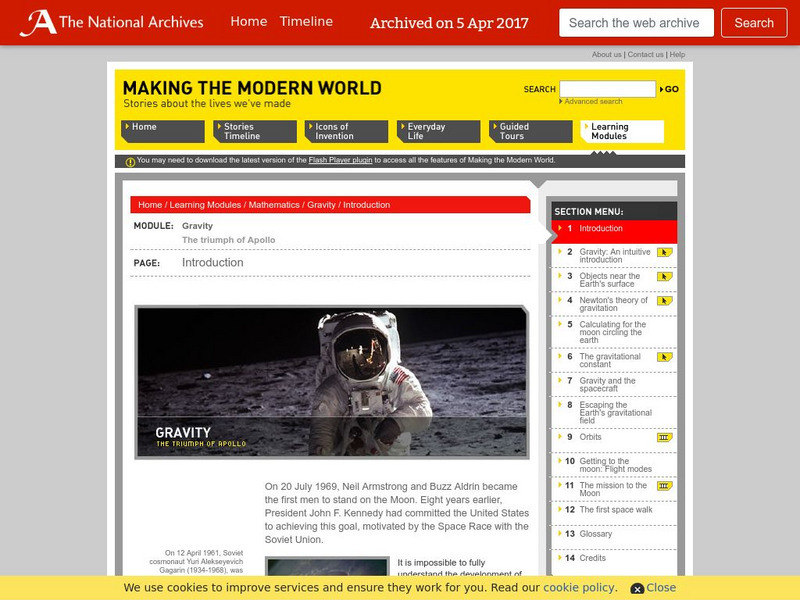
Making the Modern World: Gravity
The learning module helps students gain a deeper understanding of gravity. Some topics explored are orbits, the mission to the Moon, and the first space walk. Activities and videos are included.
Other
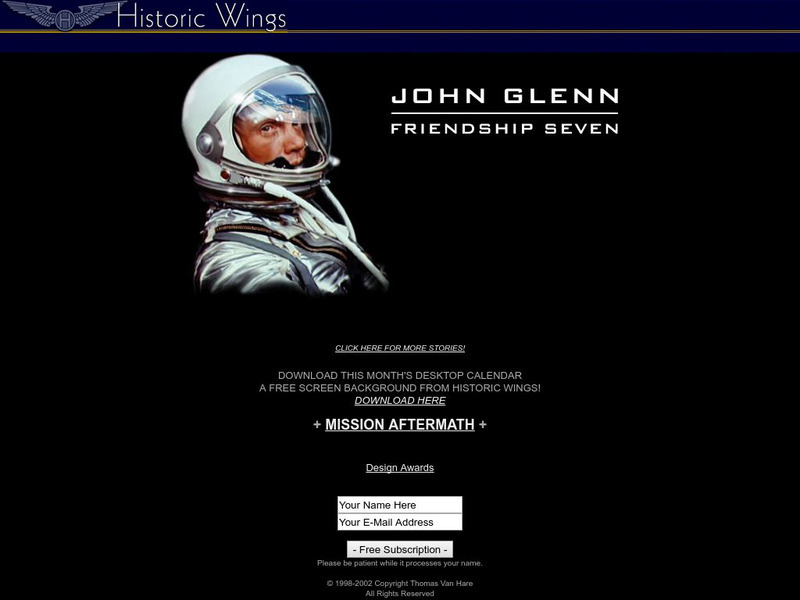
Historic Wings: John Glenn Friendship 7
The story of America's first astronaut to orbit the earth during the Mercury Space program. After launching the program click on continue or on the numbers to learn about the story of the Mercury program and the first American to orbit...
Utah Education Network
Uen: Trb 3:1: Investigation 4: Day and Night
A lesson for third graders in which they learn about the rotation of the Earth on its axis and how this movement creates day and night. They also examine the orbit of the moon about the Earth and the Earth's orbit around the sun.

American Association of Physics Teachers
Com Padre Digital Library: Open Source Physics: Newton's Mountain Model
A science simulation launches a projectile from the top of a mountain testing Newton's theory introduced in Principia.
Kidport
Kidport: The Space Shuttle
Students can see actual photos of a space shuttle launching from earth as well as the people who now could go because of technology. Learn about some of the equipment and vehicles used to make it happen.
NASA
Nasa: From Stargazers to Starships: The Calendar
A lesson plan that gives an overview of solar and lunar calendars, their history and lore. Also, of the day and the month, and their relations to the rotational period of the Earth and the orbital period of the Moon.For versions in...
NASA
Nasa: The Galileo Mission
This site from NASA has information on the Galileo space mission, which launched in October 1989. In spite of technical problems, Galileo transmitted enormous amounts of new data, especially about Jupiter and its satellites and rings,...
Physics Classroom
The Physics Classroom: Circular and Satellite Motion: The Inverse Square Law
Through illustrated examples and interactive practice, students explore Newton's ability to relate the cause for heavenly motion (the orbit of the moon about the earth) to the cause for Earthly motion (the falling of an apple to the...
Wonderville Media
Wonderville: Planets
There are eight planets in orbit around our Sun. These planets form our solar system. The eight planets are Mercury, Venus, Earth, Mars, Jupiter, Saturn, Uranus, and Neptune. There are also rocks, moons, comets, and other objects going...
TeachEngineering
Teach Engineering: Solar System!
An introduction to our solar system: the planets, our Sun and our Moon. Students begin by learning the history and engineering of space travel. They make simple rockets to acquire a basic understanding Newton's third law of motion. They...
NASA
Nasa Space Science Data Archive: Apollo Program
This is an extensive online review of the 17 Apollo missions. Resources are organized by mission number and include descriptions, mission details, photographs, and scientific data sets.
Other
Bad Astronomy/phil Plait: Tides and Why Our Days Are Getting Longer
Why does the Moon always shows the same face to the Earth? Why is the Moon's rotation period the same as the length of time it takes to orbit the Earth? Why are there two tides a day? These questions and more are answered here.