Hi, what do you want to do?






American Museum of Natural History
One-on-One With The Sun
Follow along as Stella Stardust interviews the sun. A fun and informative interview provides scholars with information about the sun.

American Museum of Natural History
Journey to the Stars
Fifteen detailed pictures and informative captions delve deep into the exploration of stars—their life cycle and importance in the universe.

American Museum of Natural History
What is Astronomy?
Go study the universe. Pupils learn seven aspects about astronomy and astronomers. They begin to learn about constellations; distance and motion between objects; gravity; the electromagnetic spectrum; dark matter and energy; and teams of...

American Museum of Natural History
A Closer Look at Mars
A website looks at how we know so much about Mars—telescopes, robots, and spacecraft—and the search for martian life. Following the informational text are three questions that quiz pupils about possible life on Mars.
NASA
Nasa: The Space Place: Orbits 'R' Us
Learn about how Earth orbits the sun and how satellites orbit the Earth. Discover the different types of satellites such as GOES and POES and what they are used to monitor.

PBS
Pbs News Hour Extra: Satellites Orbit the Sun to Better Predict Solar Storms
For the first time, NASA scientists have generated a full image of the sun, front and back, using twin orbiting satellites. The new view of Earth's star will allow for the study of solar weather events like coronal mass ejections that...
NASA
Nasa: The Space Place: What's a Barycenter?
This site from NASA helps in explaining a barycenter. "In the case of the Earth and the Sun, both bodies actually revolve, or spin, around the center of the mass between them. This point is called the barycenter."
American Geosciences Institute
American Geosciences Institute: Astronomy
Eight hands-on lessons module in which students explore the characteristics of planet Earth, its moons, the sun, the solar system, planets, and the difference between science fact and science fiction.
NASA
Nasa: Heliophysics: New Science of the Sun Solar System Connection
This site from NASA lists common and uncommon misconceptions about Sun-Earth Science. Site also provides links to activities and lesson plans as well as background reading.

Ducksters
Ducksters: Astronomy for Kids: The Planet Earth
This site is astronomy for kids and teachers! Here students can learn about the planet Earth of the Solar System including fun facts, mass, day, year, and distance from the Sun.
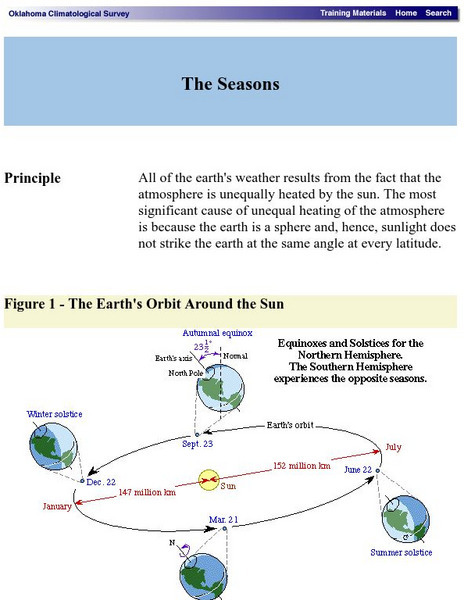
Oklahoma Mesonet
Oklahoma Climatological Survey: The Seasons
Find out what the seasons are and how they change. Through the use of excellent graphics, content explores the Earth's orbit around the sun and how sunlight reaches the earth at equinox and the winter solstice.
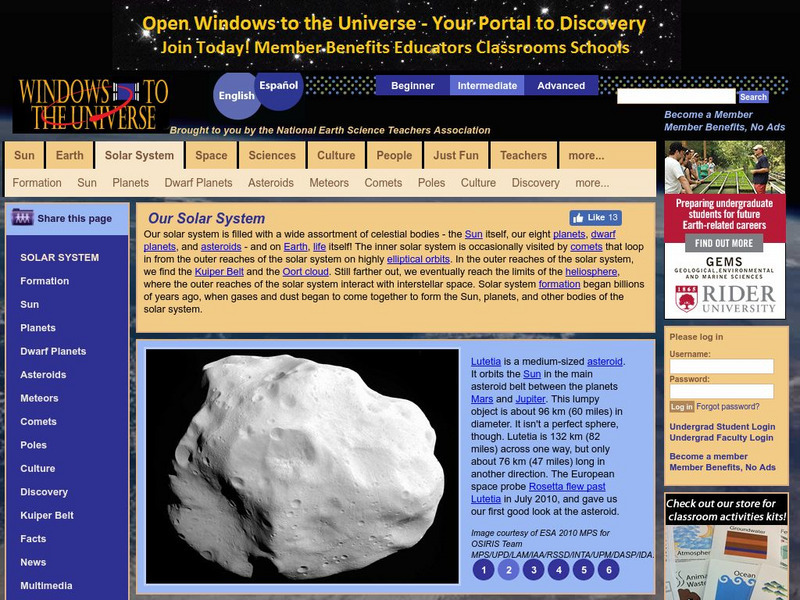
National Earth Science Teachers Association
Windows to the Universe: Our Solar System
Our solar system is filled with a wide assortment of celestial bodies - the Sun itself, our eight planets, dwarf planets, and asteroids - and on Earth, life itself! The inner solar system is occasionally visited by comets that loop in...
Nine Planets
The Eight Planets: Just for Kids
Here is a clear, simple picture of the solar system. Click on the names of the planets to learn more about each. Clicking on underlined terms takes you to more and more detailed scientific information.
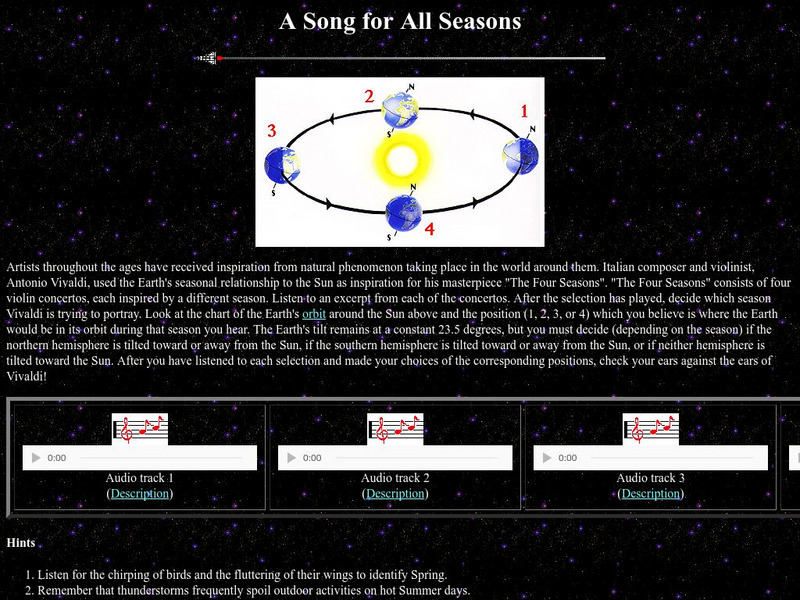
NASA
Nasa Star Child: A Song for All Seasons
After listening to excerpts from four of the violin concertos from "The Four Seasons" by Italian composer and violinist, Antonio Vivaldi, decide which excerpt was meant to go with which season, and also decide where the earth would be in...
PBS
Pbs Learning Media: All Planet Sizes
This illustration from the Lunar and Planetary Laboratory shows the approximate sizes of the planets relative to each other. Note that the planets are not shown at appropriate distances from the Sun.
Rice University
Galileo Project: The Copernican System
This site from The Galileo Project of Rice University contains information relating to Copernicus's sun-centered solar system theory. Pictures are provided throughout this article along with links to additional information.
NOAA
Noaa: Paleoclimatology Program: Astronomical Theory of Climate Change
Use this site to learn how the Earth's not-so-circular orbit around the sun has affected our climate over thousands of years, and continues to affect our climate now.

Enchanted Learning
Enchanted Learning: Zoom Astronomy
Where is our Solar System? How far away is the sun? What makes up the sun? Find out all you want to know about our solar system. This is a comprehensive on-line site about space and astronomy. Check out all of the excitement!
Cornell University
Cornell University: Astronomy: Eclipses
This site from the Astronomy Department of Cornell University provides brief introduction to both solar and lunar eclipses. Links are provided for pictures and charts of the eclipses, and this is a good site to check out on the subject.