Hi, what do you want to do?






Utah Education Network
Uen: How Big Are Earth, Sun, and Moon?
Understand where the sun is in the solar system and how big the earth, moon, and sun are.
The Wonder of Science
The Wonder of Science: Ms Ess1 1: Earth Sun Moon System
Develop and use a model of the earth-sun-moon system to describe the cyclic patterns of lunar phases, eclipses of the sun and moon, and seasons.
Utah Education Network
Uen: Earth and Moon Observations
Earth's revolution, rotation, tilt, day and night cycle, and the sun's apparent movement across the earth are explored.
TeachEngineering
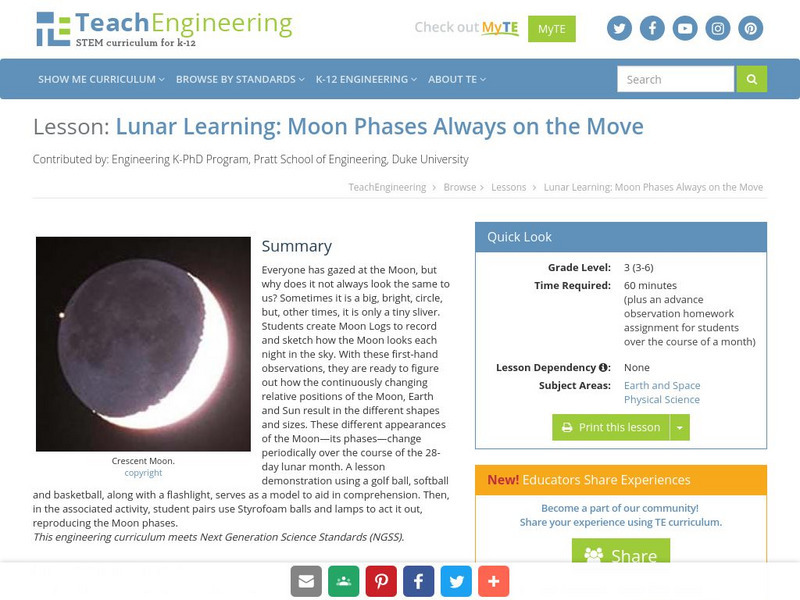
Teach Engineering: Lunar Learning
Why does the Moon not always look the same to us? Sometimes it is a big, bright, circle, but, other times, it is only a tiny sliver, if we can see it at all. The different shapes and sizes of the slivers of the Moon are referred to as...

CK-12 Foundation
Ck 12: Earth Science: Tides
[Free Registration/Login may be required to access all resource tools.] Reveals tidal patterns and that tides are caused by the gravitational attraction of the Sun and Moon to Earth.

Alabama Learning Exchange
Alex: Sun, Earth, and Moon: Calendar of Events
During this lesson plan students are going to take a look at moon phases and sunrise-sunset times in order to learn about daylight hours. Students discover that we do not always have the same amount of daylight each day. This lesson plan...
Other
Buzzle.com: Univer Savvy: Which Is Bigger the Earth or Sun?
Find out what the diameter and volume of the Earth and the Sun are and learn just how much bigger the Sun is. Also explains how the Sun compares to the Moon.

Enchanted Learning
Enchanted Learning: Earth's Oceans Tides
This site explains what tides are and the difference between Proxigean Spring Tides, spring tides, and neap tides, and how these are formed. Graphic illustrations are provided.

Ducksters
Ducksters: Earth Science for Kids: Ocean Tides
Did you know the rising and falling of the sea level is caused by the gravity of the Moon and the Sun? Kids learn about ocean tides including tidal currents and types of tides on this site.
National Earth Science Teachers Association
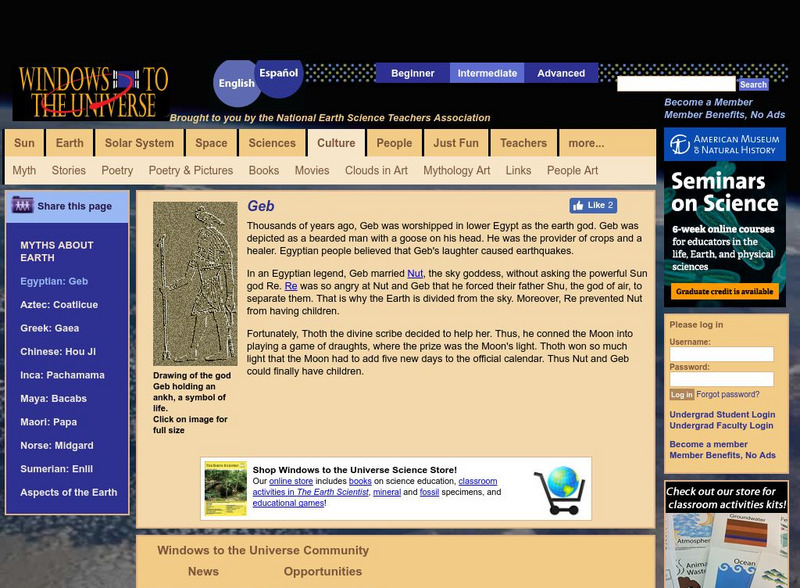
Windows to the Universe: Geb
This article outlines the ancient Egyptian myth in which Geb, the Earth god, and Nut, the sky goddess, marry without the approval of the powerful Sun god, Re.
Utah Education Network
Uen: The Night Sky
Learn about the rotation of the earth, the movement of the moon, and the position of the sun.
Better Lesson
Better Lesson: Our Sky
What objects are in the day sky and the night sky? How do they seem to move? Come and explore with us as we discover the sun, moon, planets and stars! This detailed lesson plan includes pictures and videos of the lesson in action,...
Better Lesson
Better Lesson: Our Stars
For this lesson, students will observe and communicate how the stars are in the sky both day and night. The extremely detailed lesson includes photos and videos of the lesson in actions, examples of student's work, materials, parent...
Utah Education Network
Uen: Patterned Paragraphs
Students will learn about the importance of including specific details when writing. Students will watch the teacher model "How to Make a Peanut Butter Sandwich." Then student will replicate the process for writing with specificity as...
Cornell University
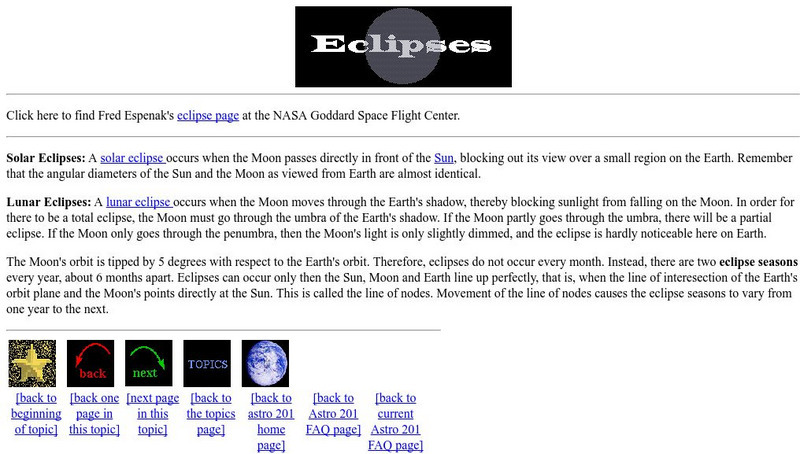
Cornell University: Astronomy: Eclipses
This site from the Astronomy Department of Cornell University provides brief introduction to both solar and lunar eclipses. Links are provided for pictures and charts of the eclipses, and this is a good site to check out on the subject.
Other popular searches
- Sun Earth and Moon
- Earth and Moon and Sun
- Earth, Moon and Sun
- Sun, Earth and Moon
- Earth, Moon, and Sun
- Moon Earth and Sun Rotations
- Moon, Sun and Earth