Hi, what do you want to do?





Other
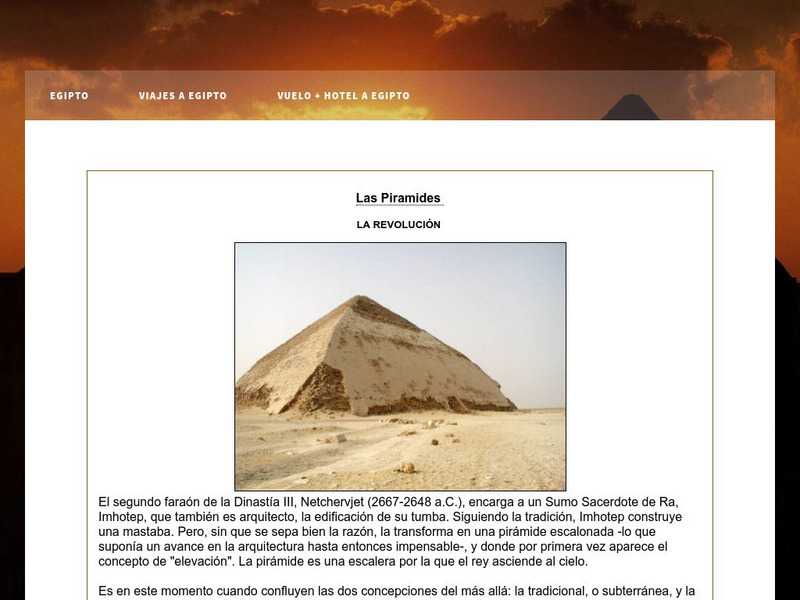
Egipto.com: La Revolucion De Las Piramides
In Spanish, learn about improvements and changes to building pyramids as new pharaohs direct the empire. Pyramids now have stairs to carry those entombed to the heavens.
Museum of Science
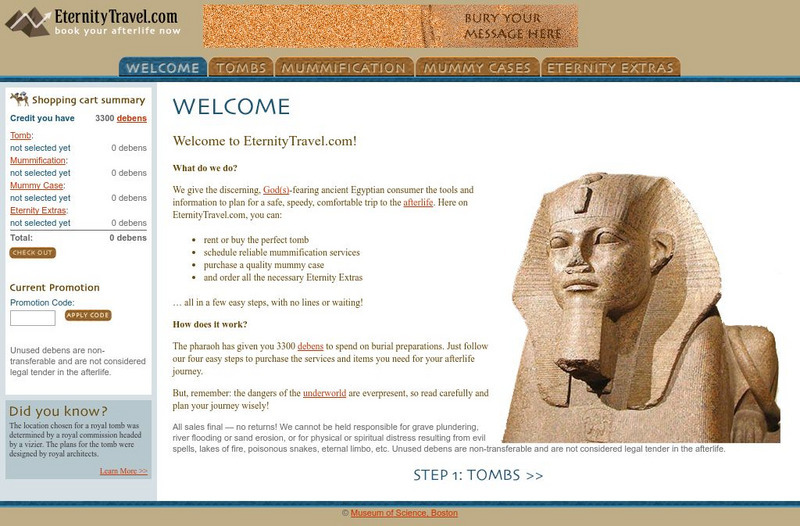
Boston Museum: Eternity Travel: Book Your Afterlife
Plan a safe, speedy trip to the afterlife with this interactive resource. Choose your tomb type, mummification method, and case and also select a number of eternity extras. See if you can plan a safe trip to the afterlife on the money...
Steven Kreis, PhD
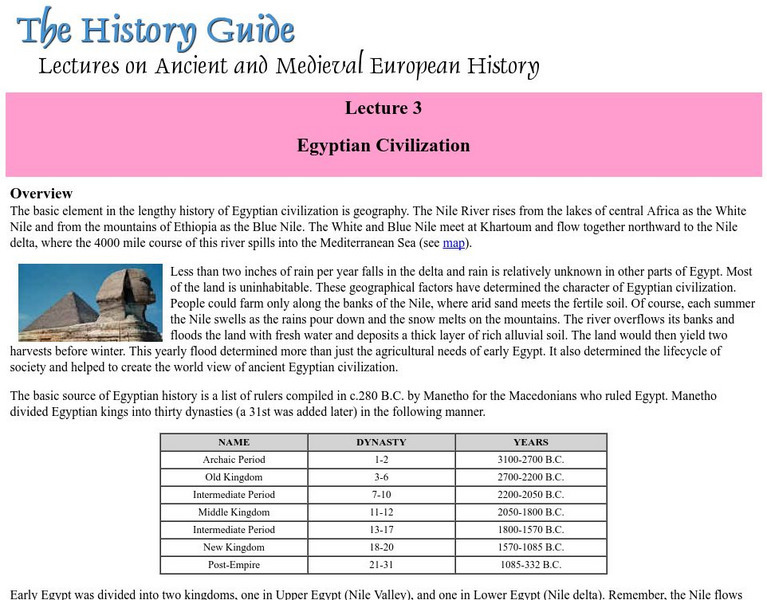
The History Guide: Egyptian Civilizations
This site from The History Guide provides a general overview of the Egyptian civilization, focusing mainly on its geography, dynasties, and religion.
Other
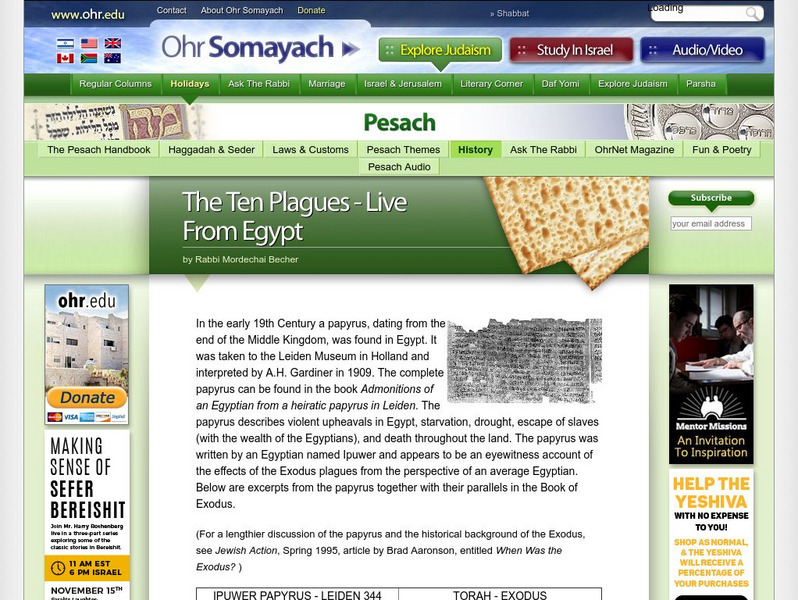
Ohr Somayach International: The Ten Plagues
Ohr Somayach International provides an introduction to the Ten Plagues. Recently an artifact was found that parallels the Bible's account of the Ten Plagues. Scroll down the site and you can read the similiarities.
Topmarks Online
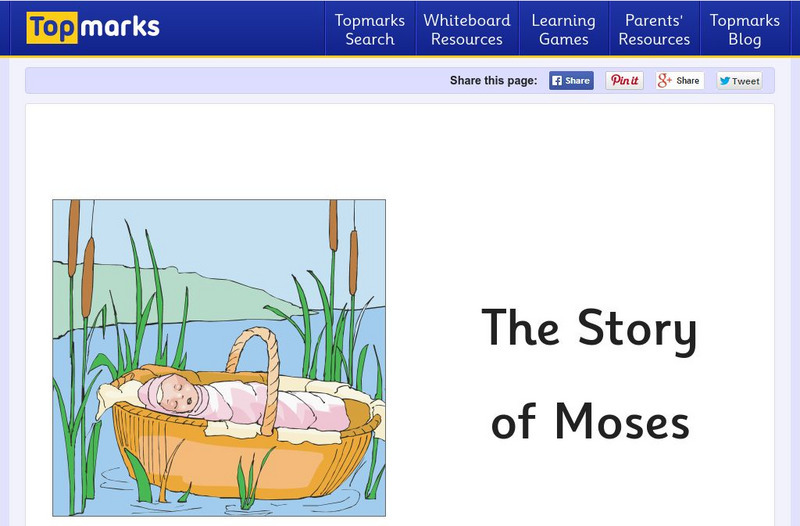
Topmarks: The Story of Moses
Provides an illustrated story of Moses from his birth to the Ten Commandments.

World History Encyclopedia
World History Encyclopedia: Akhenaten
Thorough overview of Akhenaten and early Egyptian civilization.
Stephen Byrne
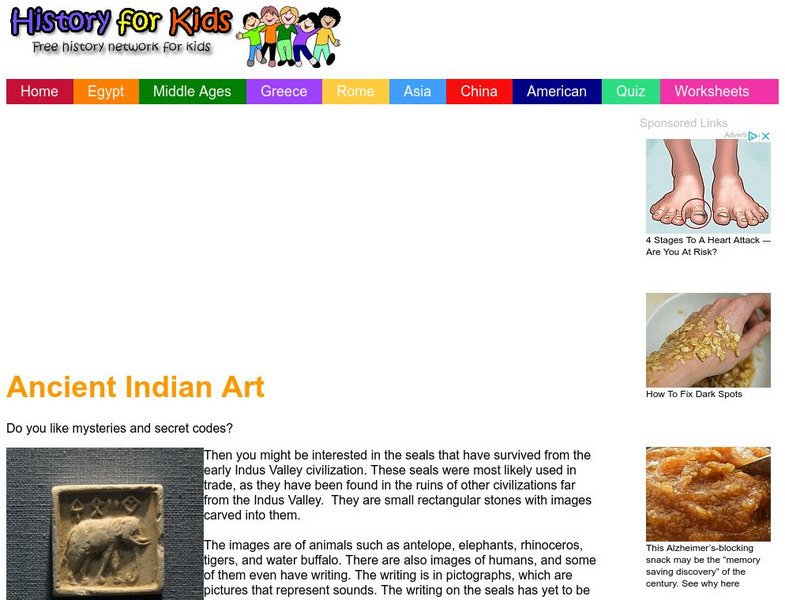
History for Kids: Hatshepsut
Kid-friendly articel with photos about Hashepsut and female pharaohs in ancient Egypt. Includes links to activities, worksheets and quizzes.
Other
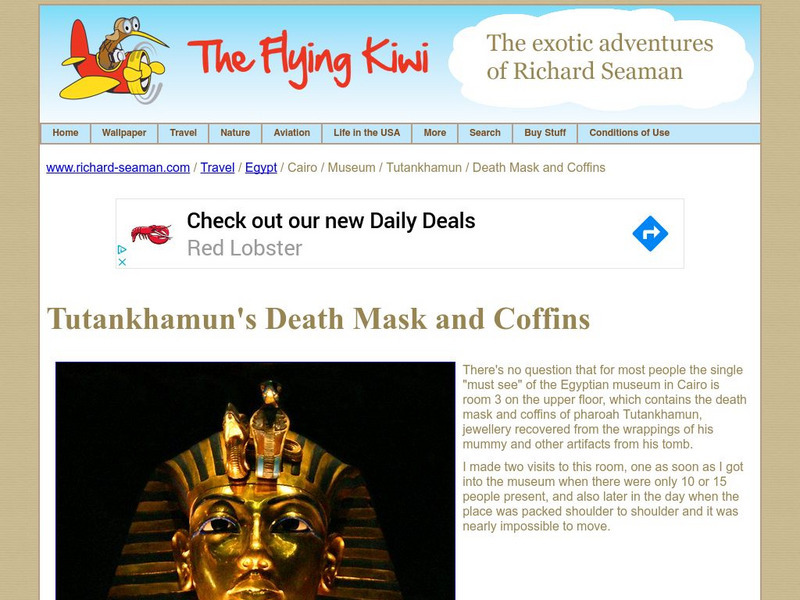
Tutankhamun's Death Mask and Coffins
This site is developed by a amateur photographer who's traveled to quite a few exotic destinations. A comprehensive description of King Tut's Sarcophagus as well as some great photographs are offered here.
![Field Museum: Exhibits: Tutankhamun: Exploring an Ancient [Mastaba] Tomb Website](https://content.lessonplanet.com/knovation/original/33232-9d506d2e7e753fe5dfe10cf333e42db3.jpg?1661366220 "Field Museum: Exhibits: Tutankhamun: Exploring an Ancient [Mastaba] Tomb Website")
The Field Museum
Field Museum: Exhibits: Tutankhamun: Exploring an Ancient [Mastaba] Tomb
Part of a larger exhibit about Tutankhamun, this resource lets you view details of the reconstructed mastaba of Unis-Ankh, the son of an early pharaoh.

Curated OER
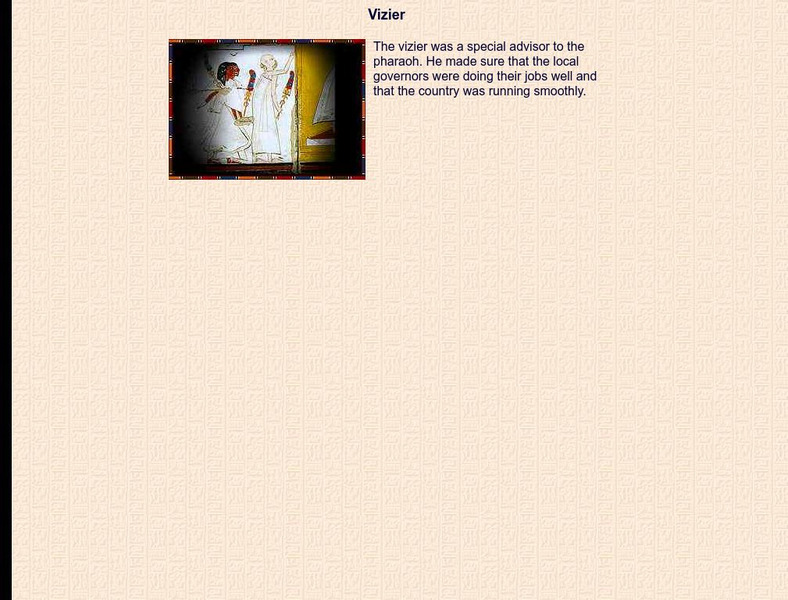
Eternal Egypt: Khasekhem
Khasekhem was the last pharaoh of the second dynasty, he ruled from 2734 to 2707 B.C. His reign is particularly important because he was the last ruler from Abydos, in Upper Egypt. His successor king Djoser who was perhaps his son,...
Curated OER
Eternal Egypt: Step Pyramid Complex
The Step Pyramid Complex was built for King Djoser of the Third Dynasty by his Vizier, Imhotep, at Saqqara. It was copied after the existing structures of Egypt's capital in order for the pharaoh to repeat his earthly experience in the...
Curated OER
Eternal Egypt: Head of Queen Hatshepsut
This head is part of a statue that shows Queen Hatshepsut wearing the White Crown of Upper Egypt, which was originally adorned, as with all her statues, with the royal cobra (uraeus); it is now missing. She wears the false beard, because...
Curated OER
Eternal Egypt: Mut
Mut was the consort of Amun and the mother of Khonsu in the Theban Triad. Mut is one of the symbolic mothers of the pharaoh.
Curated OER
Eternal Egypt: Statue of Caracalla
The upper part of a statue of the emperor Caracalla, who ruled from AD. 211-217. In this statue he is shown as an Egyptian pharaoh wearing the Nemes headdress, which is adorned with the uraeus or royal cobra.
Curated OER
Eternal Egypt: Pyramid of Unas
The pyramid of Unas, who was the last pharaoh of the Fifth Dynasty, is nowadays rather dilapidated. All of its outer covering has vanished except for that on the southern face, where a few of the limestone blocks were restored in ancient...
Curated OER
Eternal Egypt: Senusert the Third
Senusert the Third ruled the country after his father, Senusert the Second, for about 19 years as the fifth pharaoh of the Twelfth Dynasty. He had his pyramid built at Dahshur.
Curated OER
Eternal Egypt: Head of Tutankhamun
An unusual and appealing small head that is a masterpiece; it was found by Howard Carter at the entrance to King Tutankhamun's tomb. The head is that of the boy pharaoh with very beautiful features, modeled in the Amarna style.
Curated OER
Eternal Egypt: Ichneumon Statuette
The statuette depicts an ichneumon, a type of mongoose, which is also referred to as the "Pharaoh's mouse". Many bronze statues of this animal have been found dating from the Late Period and the Ptolemaic Period.
Curated OER
Eternal Egypt: Statue of Ramesses the Second
The statue depicts the great pharaoh Ramesses the Second sitting on a low-backed throne. He is wearing the Double Crown and the pleated royal kilt.
Curated OER
Eternal Egypt: Head of Amenhotep the Third
The pharaoh Amenhotep the Third is portrayed with the features of a young boy; he has a round full face, almond-shaped eyes, curved eyebrows, a small nose and a fleshy mouth.
Curated OER
Eternal Egypt: Mummy of Ramesses the Third
The pharaoh Ramesses the Third is considered to have been the last great king of the New Kingdom. He was not the son of Ramesses the Second; his father was Seth-nakhte, the founder of the Twentieth Dynasty. He was a great admirer of his...
Curated OER
Eternal Egypt: Mask of Sheshonq the Second
The funeral mask of King Sheshonq the Second was found on the pharaoh's mummy but was seriously damaged. It is made from a thick sheet of gold with hollow spaces for the eyes and the eyebrows where glass paste was to be inserted.
Curated OER
Eternal Egypt: Papyrus of Setne Kha Em Was
This papyrus belongs to the best period of demotic writing when the script was at once full and expressive. It tells a story of Kha-em-was, the son of the Pharaoh Ramesses the Second.