Hi, what do you want to do?





TeachEngineering
Teach Engineering: Electrifying the World
This lesson introduces students to the fundamental concepts of electricity. This is accomplished by addressing questions such as "How is electricity generated," and "How is it used in every-day life?" The lesson also includes...
TeachEngineering
Teach Engineering: Get Charged!
Students are introduced to the idea of electrical energy. They learn about the relationships between charge, voltage, current and resistance. They discover that electrical energy is the form of energy that powers most of their household...

Technovation
Curiosity Machine: Challenges: Engineer an Electric Switch
Using your knowledge of the flow of electricity, do you think you could build a switch that can complete a circuit to turn on an LED? This site contains the challenge, tips, a lesson plan, and a place for students to document their...
TeachEngineering
Teach Engineering: The Strongest Pump of All
In this lesson the students will learn how the heart functions. Students will be introduced to the concept of action potential generation. The lesson will explain how action potential generation causes the electrical current that causes...
TeachEngineering
Teach Engineering: Rolling Blackouts & Environmental Impact
The goal is for the students to understand the environmental design considerations required when generating electricity. The electric power that we use every day at home and work is generated by a variety of power plants. Power plants...
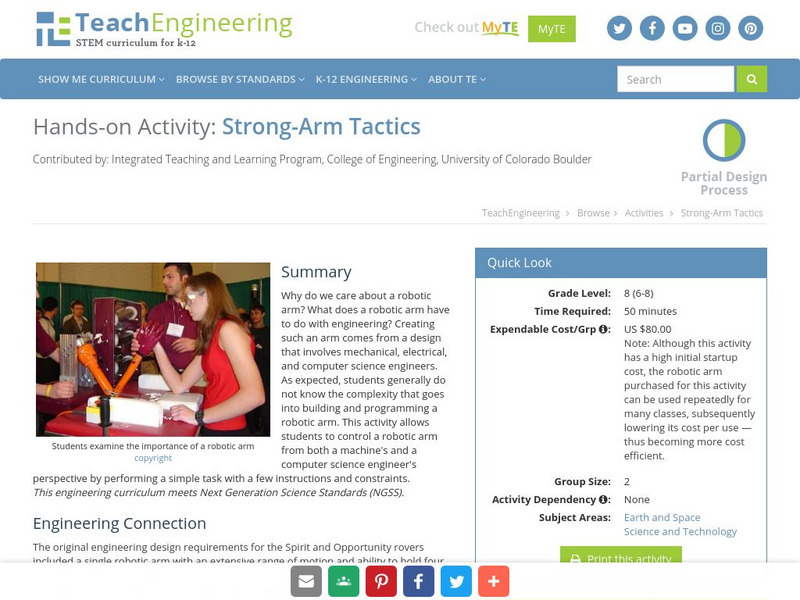
TeachEngineering
Teach Engineering: Strong Arm Tactics
Students generally do not know the complexity that goes into building and programming a robotic arm. In actuality, creating such an arm comes from a design that involves mechanical, electrical, and computer science engineers. This...
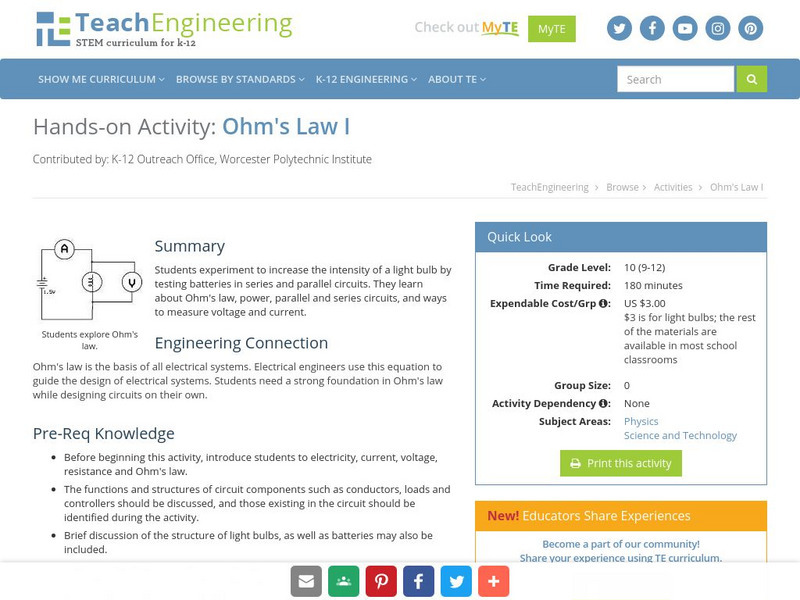
TeachEngineering
Teach Engineering: Ohm's Law I
Students will work to increase the intensity of a light bulb by testing batteries in series and parallel circuits. It analyzes Ohm's Law, power, parallel and series circuits, and ways to measure voltage and current.
Science Buddies
Science Buddies: Go, Gadget, Go! Building Robots With Lego Mindstorms
In the mid-20th century, people thought of robots as futuristic tools. But in the 21st century, robots are not a figment of our imaginations, but are a part of our reality. Robots even perform tasks that humans can't do. In this...
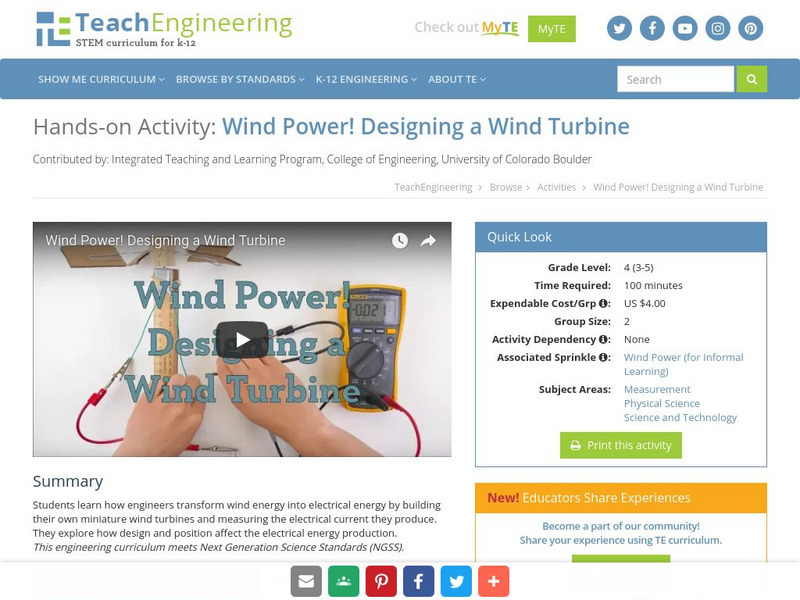
TeachEngineering
Teach Engineering: Wind Power!
Students learn how engineers transform wind energy into electrical energy by building their own miniature wind turbines and measuring the electrical current it produces. They explore how design and position affect the electrical energy...
TeachEngineering
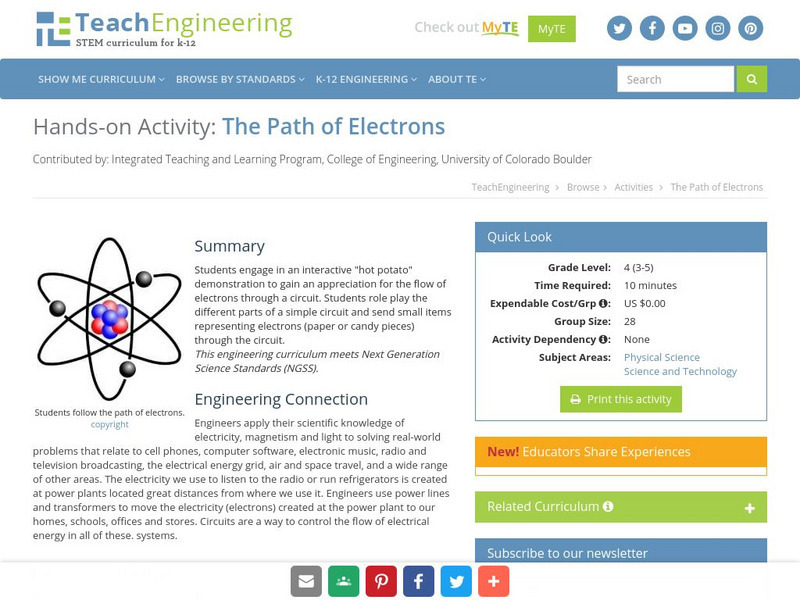
Teach Engineering: The Path of Electrons
Students engage in an interactive "hot potato" demonstration to gain an appreciation for the flow of electrons through a circuit. Students role play the different parts of a simple circuit and send small items representing electrons...

Khan Academy
Khan Academy: Application of the Fundamental Laws
We solve a circuit by direct application of the fundamental laws: Apply element laws (Ohm's Law and the like) plus Kirchhoff's Laws to solve for the currents and voltages of a circuit.
Science Buddies
Science Buddies: Cold Room? Heat It Up With a Homemade Solar Air Heater
Humans need food, water, and warm shelter to survive. But a lot of humans depend on fossil fuels to supply gas and electricity to heat our homes. But burning fossil fuels to create energy is harmful to the environment. In this science...
NC State University
The Engineering Place: Battery Making
Using simple materials, students will learn how to create batteries, and about the relationship between voltage and current.

Science Buddies
Science Buddies: Waste Not, Want Not: Use the Microbial Fuel Cell to Create Elec
Gross. What is that in the toilet? But maybe it's not just gross. Did you know there are bacteria that digest organic waste and create electrons? What if there was a way to collect those electrons to power a circuit? In this science fair...
TeachEngineering
Teach Engineering: What Is Energy?
With an introduction to the ideas of energy, learners discuss specific types of energy and the practical sources of energy. Hands-on activities help them identify types of energy in their surroundings and enhance their understanding of...
Technovation
Curiosity Machine: Challenges: Build a Hydroelectric Waterwheel
Can you generate electricity from the flow of water by designing a waterwheel? In this challenge, students will be using everyday objects to create their waterwheel. This site contains a lesson plan, tips, and a place for students to...