Hi, what do you want to do?





National High Magnetic Field Laboratory
Magnet Academy: Heike Kamerlingh Onnes
Heike Kamerlingh Onnes was a Dutch physicist who first observed the phenomenon of superconductivity while carrying out pioneering work in the field of cryogenics. An important step on the way to this discovery was his success in...
National High Magnetic Field Laboratory
Magnet Academy: Karl Alexander Muller
In their search for new superconductors, Swiss theoretical physicist Karl Alexander Muller and his young colleague, J. Georg Bednorz, abandoned the metal alloys typically used in superconductivity research in favor of a class of oxides...
National High Magnetic Field Laboratory
Magnet Academy: James Clerk Maxwell
James Clerk Maxwell was one of the most influential scientists of the nineteenth century. His theoretical work on electromagnetism and light largely determined the direction that physics would take in the early twentieth century. Indeed,...
National High Magnetic Field Laboratory
Magnet Academy: Theodore Maiman
Theodore Maiman built the world's first operable laser. Ironically, Maiman's first paper announcing this momentous achievement, which many other scientists had been racing to complete themselves, was rejected. Since then, however, lasers...
National High Magnetic Field Laboratory
Magnet Academy: Max Planck
In a career that lasted seven decades, Max Planck achieved an enduring legacy with groundbreaking discoveries involving the relationship between heat and energy, but he is most remembered as the founder of the "quantum theory."
National High Magnetic Field Laboratory
Magnet Academy: Julian Schwinger
Theoretical physicist Julian Schwinger used the mathematical process of renormalization to rid the quantum field theory developed by Paul Dirac of serious incongruities with experimental observations that had nearly prompted the...
National High Magnetic Field Laboratory
Magnet Academy: John Robert Schrieffer
While still in graduate school, John Robert Schrieffer developed with John Bardeen and Leon Cooper a theoretical explanation of superconductivity that garnered the trio the Nobel Prize in Physics in 1972. The BCS theory (the acronym...
National High Magnetic Field Laboratory
Magnet Academy: Heinrich Rohrer
Swiss physicist Heinrich Rohrer co-invented the scanning tunneling microscope (STM), a non-optical instrument that allows the observation of individual atoms in three dimensions, with Gerd Binnig. The achievement garnered the pair half...
National High Magnetic Field Laboratory
Magnet Academy: Carl Edwin Wieman
Carl Edwin Wieman is one of three physicists credited with the discovery of a fifth phase of matter, for which he was awarded a share of the prestigious Nobel Prize in 2001. The recognition capped a distinguished career that began deep...
National High Magnetic Field Laboratory
Magnet Academy: Sin Itiro Tomonaga
Japanese theoretical physicist Sin-Itiro Tomonaga resolved key problems with the theory of quantum electrodynamics (QED) developed by Paul Dirac in the late 1920s through the use of a mathematical technique he referred to as...

National High Magnetic Field Laboratory
Magnet Academy: Jean Charles Athanase Peltier (1785 1845)
Although he didn't start studying physics until he retired from the clock-making business at age 30, French native Jean Peltier made immense contributions to science that still reverberate today. Even with the primitive tools available...
National High Magnetic Field Laboratory
Magnet Academy: Charles Augustin De Coulomb
Charles-Augustin de Coulomb invented a device, dubbed the torsion balance, that allowed him to measure very small charges and experimentally estimate the force of attraction or repulsion between two charged bodies. The data he obtained...
National High Magnetic Field Laboratory
Magnet Academy: Crookes Tube 1870
English chemist Sir William Crookes (1832 - 1919) invented the Crookes tube to study gases, which fascinated him. His work also paved the way for the revolutionary discovery of the electron and the invention of X-ray machines.
National High Magnetic Field Laboratory
Magnet Academy: Paul Dirac
Paul Adrien Maurice Dirac was an outstanding twentieth century theoretical physicist whose work was fundamental to the development of quantum mechanics and quantum electrodynamics. He was awarded the Nobel Prize for Physics jointly with...
National High Magnetic Field Laboratory
Magnet Academy: John Bardeen
John Bardeen was one of a handful of individuals awarded the Nobel Prize twice and the first scientist to win dual awards in physics. Both times, he shared the prize with others. The first time his co-recipients were Walter Brattain and...

Science Struck
Science Struck: The Relationship Between Magnetism and Electricity
Provides a short explanation of the similarities between magnetism and electricity, the properties of their fields, and the effect they each have on a charged particle.
Orpheus Books
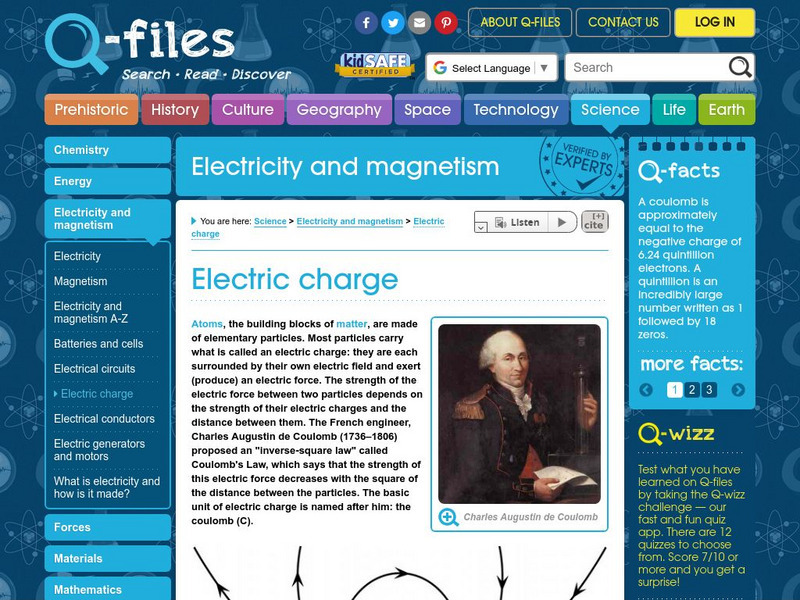
Q Files: Electricity and Magnetism: Electric Charge
Learn how electric charges work and about Coulomb's Law, which is used to calculate the strength of an electric force.
National High Magnetic Field Laboratory
Magnet Academy: Heat Resistance
Heating a metal conductor makes it more difficult for electricity to flow through it. See why in this tutorial. (Java tutorial)
Sophia Learning
Sophia: Electric Circuits: Lesson 2
This lesson will explain how to calculate voltage, current, and resistance in simple electric circuits. It is 2 of 4 in the series titled "Electric Circuits."
Sophia Learning
Sophia: Electric Circuits: Lesson 4
This lesson will explain how to calculate voltage, current, and resistance in simple electric circuits. It is 4 of 4 in the series titled "Electric Circuits."
Science4Fun
Science4 Fun: How Electricity Is Made
Read this brief article to gain an understanding of the principle of electromagnetism, how electricity is generated, and the problem with fossil fuels.
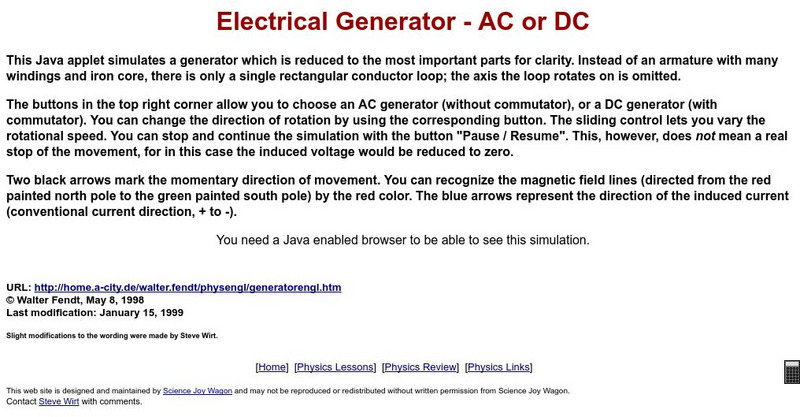
Other
Ithaca Hs Ny/electrical Generator Ac or Dc/applet
What a lovely little applet! You can speed/slow it, change it from AC to DC, plot the voltage as it rotates, change direction, control other information. Real neat.
Science Bob Pflugfelder
Science Bob: Build an Electromagnet!
This site presents a procedure for creating your own electromagnet using an iron nail, some wire, and a battery. The site illustrates a connection between electricity and magnetism.
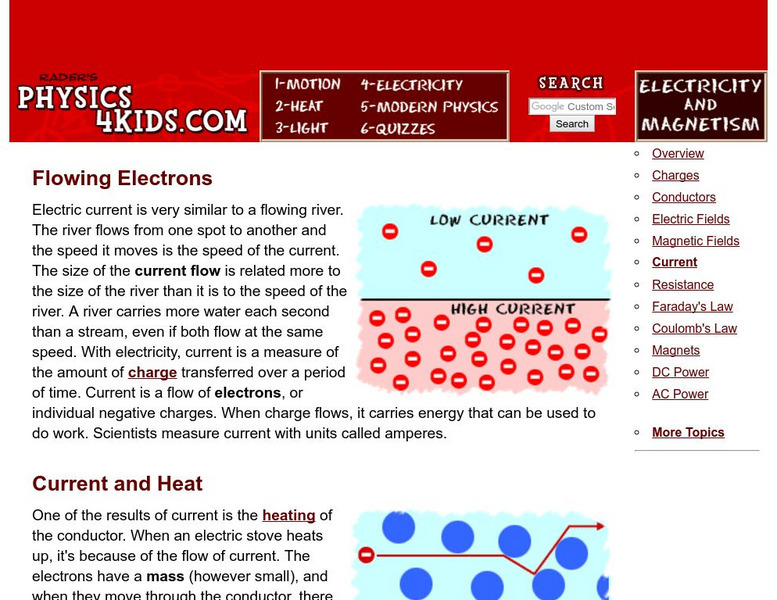
Physics4kids
Physics4 Kids: Electricity and Magnetism: Current
Explains electric current, how it produces heat, and the difference between a direct current and an alternating current.