Hi, what do you want to do?





Science Buddies
Science Buddies: Batteries: The Shocking Truth
Here you can find what you need to scientifically assess battery performance. In this exercise (that should take about one week) learn how batteries work, how they wear out and most importantly, how to make valid measurements to assess...
Science Buddies
Science Buddies: A Battery That Makes Cents
Batteries are expensive to purchase in a store, but you can make one your self for exactly 24 cents. In this experiment, you will make your own voltaic pile using pennies and nickels and determine how many coins in a pile will make the...
Science Buddies
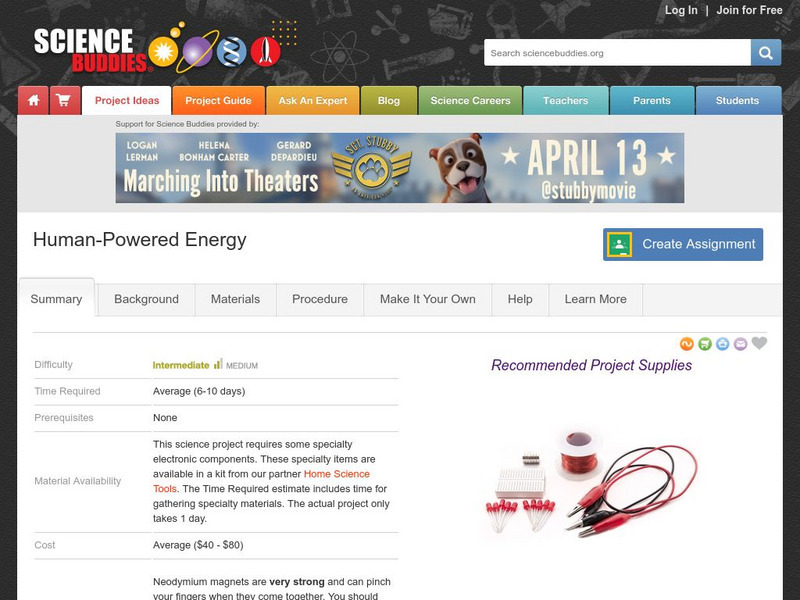
Science Buddies: Shaking Up Some Energy
Shake N' Light flashlights have been advertised on televisions across the nation in the recent year. But many do not understand just how they get energy to light up the bulb without using batteries. Do this experiment to make your own...
Khan Academy
Khan Academy: Electromagnetic Waves: The Electromagnetic Spectrum and Photons
An article that discusses the coupling of an electric field with a magnetic field to create electromagnetic waves. Article also discusses how different types of electromagnetic waves have different wavelengths which forms the...

World Health Organization
World Health Organization: International Emf Project
The World Health Organization probes into the feared associations between electromagnetic fields (EMFs) and cancer. Check out "What is EMF?" for detailed summaries on what electromagnetic fields are and the possible health effects, or...
National High Magnetic Field Laboratory
Magnet Academy: Wimshurst Machine 1880
In the modern world, virtually everyone is familiar with electricity as an accessible, essential form of energy. In electricity's earlier days, scientists used the buildup and release of static electricity.

National High Magnetic Field Laboratory
Magnet Academy: Carl Friedrich Gauss
Although he is best known as one of the greatest mathematicians of all time, Carl Friedrich Gauss was also a pioneer in the study of magnetism and electricity. To facilitate an extensive survey of terrestrial magnetism, he invented an...
National High Magnetic Field Laboratory
Magnet Academy: James Watt
The Scottish instrument maker and inventor James Watt had a tremendous impact on the shape of modern society. His improvements to the steam engine were a significant factor in the Industrial Revolution, and when the Watt engine was...

National High Magnetic Field Laboratory
Magnet Academy: William Thomson, Lord Kelvin
William Thomson, known as Lord Kelvin, was one of the most eminent scientists of the nineteenth century and is best known today for inventing the international system of absolute temperature that bears his name. He made contributions to...
National High Magnetic Field Laboratory
Magnet Academy: Nikola Tesla
Awarded more than 100 patents over the course of his lifetime, Nikola Tesla was a man of considerable genius and vision. He was reportedly born at exactly midnight during an electrical storm, an intriguing beginning for a man who would...
National High Magnetic Field Laboratory
Magnet Academy: Sulfur Globe 1660
In the 17th century, German scientist Otto von Guericke built and carried out experiments with a sulfur globe that produced static electricity.
National High Magnetic Field Laboratory
Magnet Academy: Claude Shannon
Claude Shannon was a mathematician and electrical engineer whose work underlies modern information theory and helped instigate the digital revolution. He was the first person to recognize how Boolean algebra could be used to great...
National High Magnetic Field Laboratory
Magnet Academy: Felix Bloch (1905 1983)
Physicist Felix Bloch developed a non-destructive technique for precisely observing and measuring the magnetic properties of nuclear particles. He called his technique "nuclear induction," but nuclear magnetic resonance (NMR) soon became...
National High Magnetic Field Laboratory
Magnet Academy: Paul Lauterbur
Chemist Paul Lauterbur pioneered the use of nuclear magnetic resonance (NMR) for medical imaging. He developed a technique, now known as magnetic resonance imaging (MRI), in the early 1970s that involves the introduction of gradients in...
CK-12 Foundation
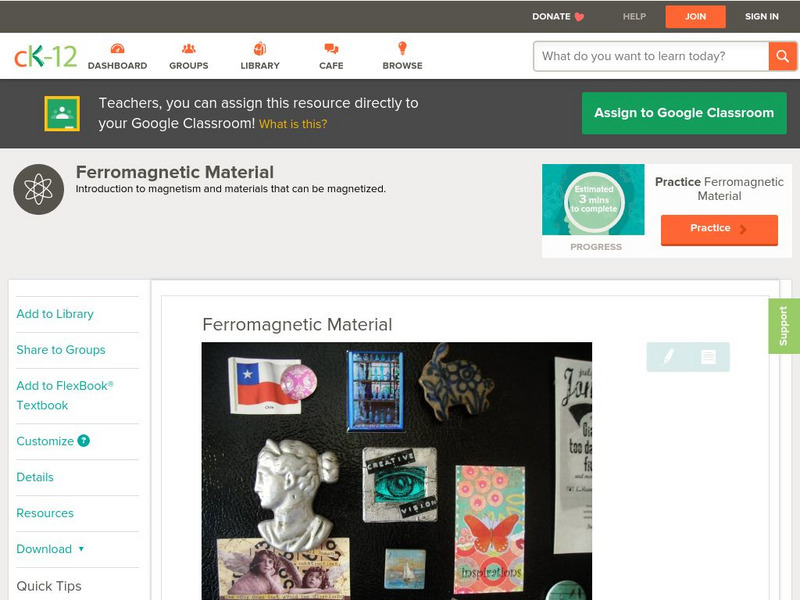
Ck 12: Physical Science: Ferromagnetic Material
[Free Registration/Login may be required to access all resource tools.] Explores what makes a material magnetic, ferromagnetic materials and how they can be magnetised, temporary and permanent magnets, and the mineral magnetite.
CK-12 Foundation
Ck 12: Physics Simulation: Electric Motor
[Free Registration/Login Required] Learn how magnetic forces acting on current-carrying wires can be used to drive an electric motor using this interactive simulation. A PDF worksheet and a video tutorial are also available. [2:47]
National High Magnetic Field Laboratory
Magnet Academy: Right and Left Hand Rules
No fancy movement in this tutorial, but these rules come in very handy when trying to understand some of what's going on in our other tutorials.
National Academy of Engineering
Greatest Engineering Achievements of the 20th Century: Electrification
Learners explore electrification in the 20th century. Some topics investigated are rural electrification, power generators, and direct current (DC). The resource consists of historical information, a timeline, and a personal essay by a...
CK-12 Foundation
Ck 12: Magnetic Force on Moving Electric Charges
[Free Registration/Login may be required to access all resource tools.] This lesson examines how moving electric charges are affected when inside a magnetic field. Students are shown how to calculate the force on a single moving electric...

Massachusetts Institute of Technology
Mit: Inventor of the Week: Nikola Tesla: The Electro Magnetic Motor
Use this site to learn about the inventor of the electro-magnetic motor, Nikola Tesla. Find out why Tesla's experimentation with alternating current was so important to later inventions and use of electricity.
Science Education Resource Center at Carleton College
Serc: Magnetism and Sound: Creating Your Own Headphones
Students will explore how magnets can create a current by making their own headphones and listening to music from their iPods.
NASA
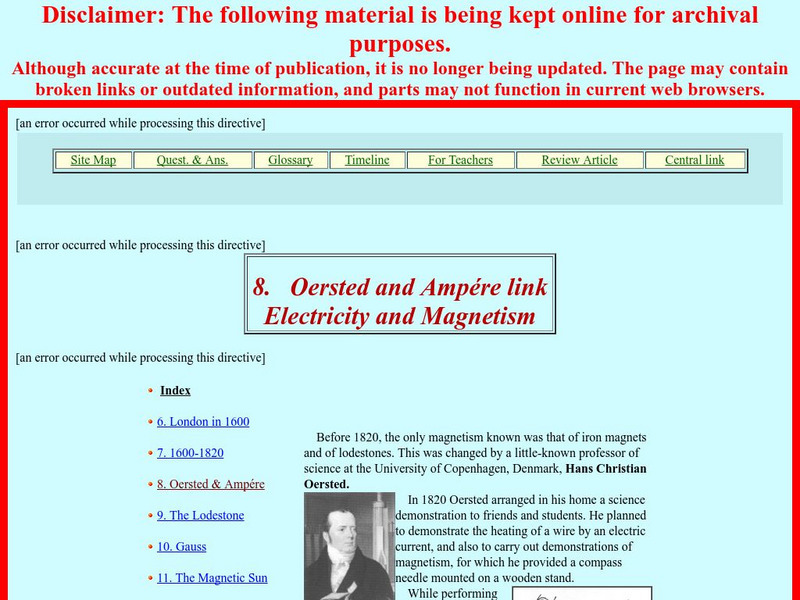
Nasa: Oersted and Ampere Link Electricity
NASA provides a nice blending of the achievements of three scientists, Oersted, Ampere, and Maxwell. This done by NASA-sponsored International Solar-Terrestrial Physics group. Lots of pictures, diagrams, and scientific explanation. Good...
Science Education Resource Center at Carleton College
Serc: Introduction to Open and Closed Electrical Circuits
This activity introduces students to the concepts of electrical current and open and closed circuits. Students will act out open and closed circuits as a whole class with some students acting as the "motors" or "light bulbs."
Math Science Nucleus
I. Science Ma Te: Integrating Science, Math and Technology
This site offers a wealth of online textbook-related materials that encourage the discovery of science in the world around us. Enter the site to access material on specific topics. Each section contains reading material (complete with...