Hi, what do you want to do?





National High Magnetic Field Laboratory
Magnet Academy: John Ambrose Fleming
John Ambrose Fleming was an electronics pioneer who invented the oscillation valve, or vacuum tube, a device that would help make radios, televisions, telephones and even early electronic computers possible. A brilliant innovator,...
National High Magnetic Field Laboratory
Magnet Academy: Enrico Fermi
Enrico Fermi was a titan of twentieth-century physics. He outlined the statistical laws that govern the behavior of particles that abide by the Pauli exclusion principle and developed a theoretical model of the atom in his mid-twenties....
National High Magnetic Field Laboratory
Magnet Academy: Siegmund Loewe
Siegmund Loewe was a German engineer and businessman that developed vacuum tube forerunners of the modern integrated circuit. He pioneered both radio and television broadcasting, and the company he established with his brother, David...
Massachusetts Institute of Technology
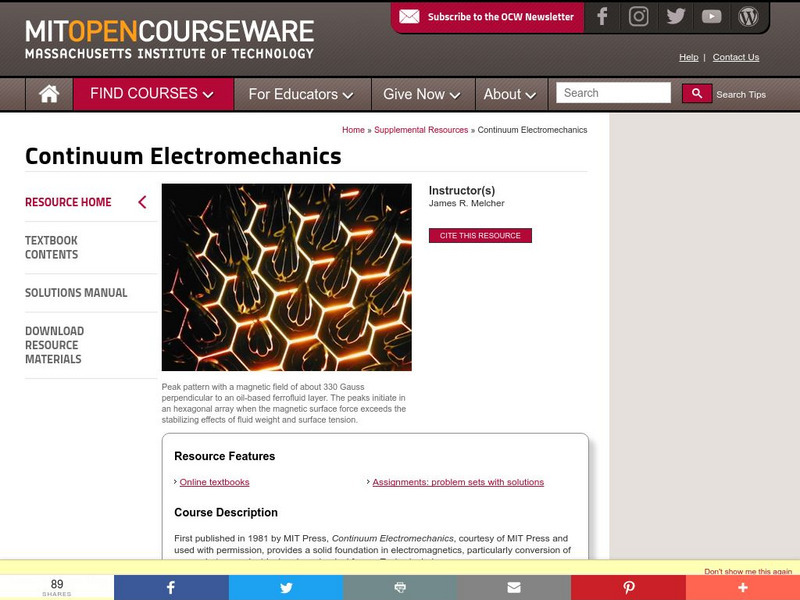
Mit: Open Course Ware: Supplemental Resources: Continuum Electromechanics
College-level electrical engineering and computer science textbook highlighting the applications of continuum electromechanics.
National High Magnetic Field Laboratory
Magnet Academy: Crookes Tube 1870
English chemist Sir William Crookes (1832 - 1919) invented the Crookes tube to study gases, which fascinated him. His work also paved the way for the revolutionary discovery of the electron and the invention of X-ray machines.
National High Magnetic Field Laboratory
Magnet Academy: John Daniel Kraus
For a man whose career involved the entire known universe, John Kraus had a remarkably insular upbringing. He was born and raised in Ann Arbor, Michigan, and earned his bachelor's, master's and doctoral degrees in physics, all at the...

National High Magnetic Field Laboratory
Magnet Academy: Inductive Reactance
Like resistance, reactance slows an electrical current down. Explained by Lenz's Law, this phenomenon occurs only in AC circuits. (Java tutorial)
National High Magnetic Field Laboratory
Magnet Academy: John Bardeen
John Bardeen was one of a handful of individuals awarded the Nobel Prize twice and the first scientist to win dual awards in physics. Both times, he shared the prize with others. The first time his co-recipients were Walter Brattain and...

Cosmo Learning
Cosmo Learning: Applied Science and Technology 210: Electrical Engineering
A collection of video lectures from a course that explores the application of electrical engineering topics. Webpage includes twenty-eight lectures from a professor at the University of California, Berkeley. Lectures vary in length and...
US National Library of Medicine
Medline Plus: Electromagnetic Fields
This site provides links to a variety of government-sponsored overviews and articles on electromagnetic fields and their associated health risks.
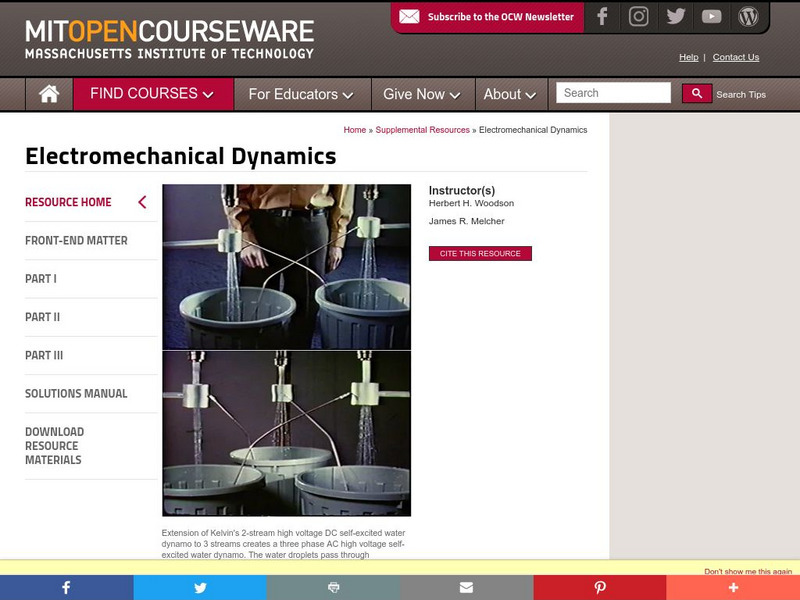
Massachusetts Institute of Technology
Mit: Open Course Ware: Supplemental Resources: Electromechanical Dynamics
College-level textbook highlighting the interaction of electromagnetic fields with media in motion. Types of electromechanical interactions discussed include rotating machinery, plasma dynamics, the electromechanics of biological...
Texas Instruments
Texas Instruments: Can a Lemon Power a Light Bulb
You will learn about a voltaic battery and to see if it's powerful enough to light up a light bulb
Texas Instruments
Texas Instruments: You'll Get a Charge Out of This!
In this activity, students make a battery using different fruits and vegetables, a copper penny, and a zinc washer. They use a voltage probe to collect data on voltage and compare the values of different batteries.

Khan Academy
Khan Academy: Light: Electromagnetic Waves, Electromagnetic Spectrum and Photons
This article discusses the properties of electromagnetic radiation and photons.
National High Magnetic Field Laboratory
Magnet Academy: Arc Lamp 1876
Fire lighted the night for many centuries. Then came Sir Humphry Davy and the birth of the arc lamp, an invention built upon in the years that followed by many.
Creative Science Centre
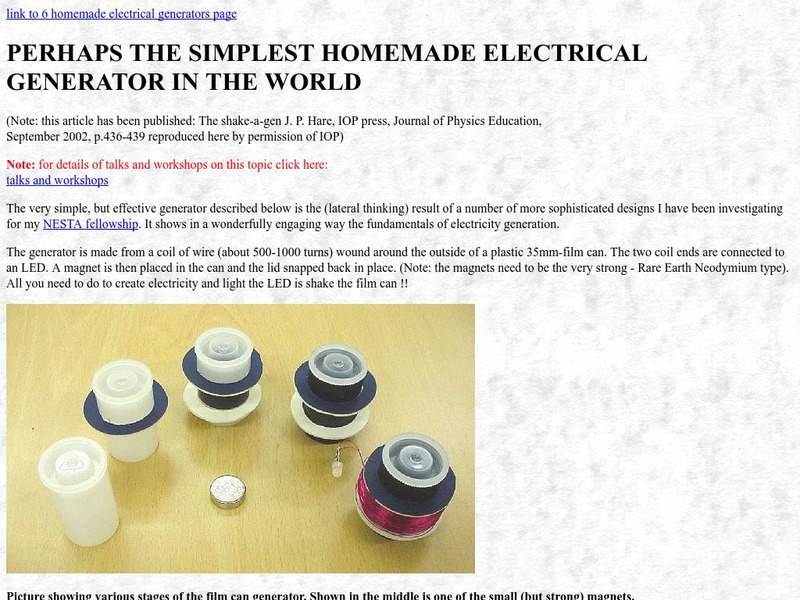
Creative Science Centre: Perhaps the Simplest Homemade Generator in the World
This very simple, but effective generator shows in a wonderfully engaging way the fundamentals of electricity generation. The generator is made from a coil of wire wound around the outside of a plastic 35mm-film can. The two coil ends...
Exploratorium
Exploratorium: Curie Temperature
In this experiment, students experience the Curie point--and what happens when a piece of iron gets too hot to attract a magnet.
CK-12 Foundation
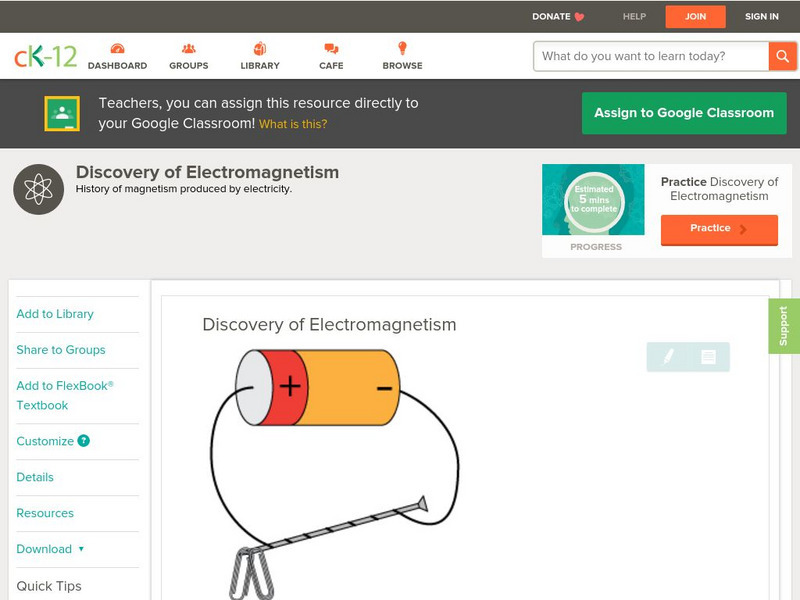
Ck 12: Physical Science: Discovery of Electromagnetism
[Free Registration/Login may be required to access all resource tools.] Covers the discovery of electromagnetism, how it relates to electricity, and Faraday's law.

ClassFlow
Class Flow: Turning on the Lights
[Free Registration/Login Required] In this lesson students learn the parts of a circuit, build series and parallel circuits, learn about insulators and conductors, and more in this interactive multimedia flipchart.
American Association of Physics Teachers
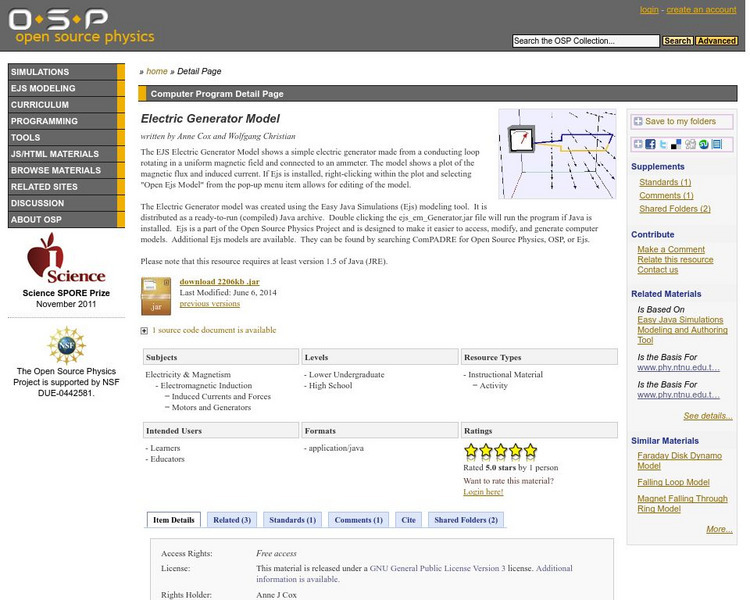
Com Padre Digital Library: Open Source Physics: Electric Generator Model
An electromagnetic induction model that simulates an electric generator made from a conducting loop rotating in a uniform magnetic field and connected to an ammeter.
Wikimedia
Wikipedia: Charles Augustin De Coulomb
Spanish-language site lets students discover the life and work of this physicist and engineer, who is known for his studies of electric charges.
Science Struck
Science Struck: The 13 Types of Energy and Their Applications
Read about all the different kinds of potential and kinetic energy. Includes energy formulas and examples of energy applications.

Discovery Education
Discovery Education: Curriculum Center: Science
The Discovery Channel provides numerous topics that are the most popular science topics taught in upper elementary and middle school. Content is organized by topics (Bacteria, Oceans, Solar System, etc.); all topics include quick facts,...
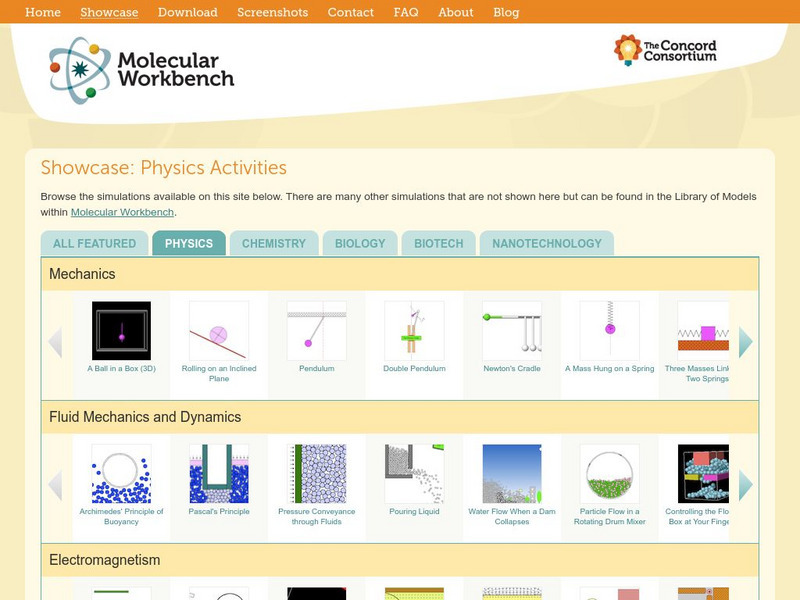
Concord Consortium
Concord Consortium: Molecular Workbench Showcase: Physics, Electromagnetism
Students can use these simulations to understand concepts in electromagnetism. Simulations are available on the following concepts: Lorentz Force, The Hall Effect, capacitor, conductor, transistor, cyclotron, static electricity....