Hi, what do you want to do?






Other
Stile: 2.1 Lesson: Electromagnetism (Part 1)
This is a sample lesson on electromagnetism. It includes animated diagrams, interactive exercises, an audio option for reading the text, and comprehension questions throughout where students can type their answers or pick from...
University of Florida
University of Florida: Episodes in Romantic Science
One of the "Episodes in Romantic Science," this is as complete as a biography gets without being a book. Includes great information about Oersted and his electromagnetic work, The definitive source. Heavily footnoted with many additional...
Cuemath
Cuemath: Vectors
Explore the world of vectors, by finding answers to questions like what are vectors, what are scalars, what is the difference between scalar and vectors, the magnitude of a vector, operations on vectors, and properties of a vector.
Sophia Learning
Sophia: Electromagnetic Waves: Lesson 2
This lesson will show how a particle can travel in a wave form, by following perpendicular electric and magnetic fields. It is 2 of 4 in the series titled "Electromagnetic Waves."
Sophia Learning
Sophia: Electromagnetic Waves: Lesson 3
This lesson will show how a particle can travel in a wave form, by following perpendicular electric and magnetic fields. It is 3 of 4 in the series titled "Electromagnetic Waves."
Sophia Learning
Sophia: Electromagnetic Waves: Lesson 4
This lesson will show how a particle can travel in a wave form, by following perpendicular electric and magnetic fields. It is 4 of 4 in the series titled "Electromagnetic Waves."
San Jose State University
Sjsu Virtual History: Joseph Henry
A concise biography on Joseph Henry gives details on his education; his experimental work in chemistry, electricity, and magnetism; and the many board positions he held throughout his life.

TED Talks
Ted: Ted Ed: How Does an Atom Smashing Particle Accelerator Work?
An atom smasher, or particle accelerator, collides atomic nuclei together at extremely high energies, using engineering that exploits incredibly cold temperatures, very low air pressure, and hyperbolically fast speeds. Don Lincoln...
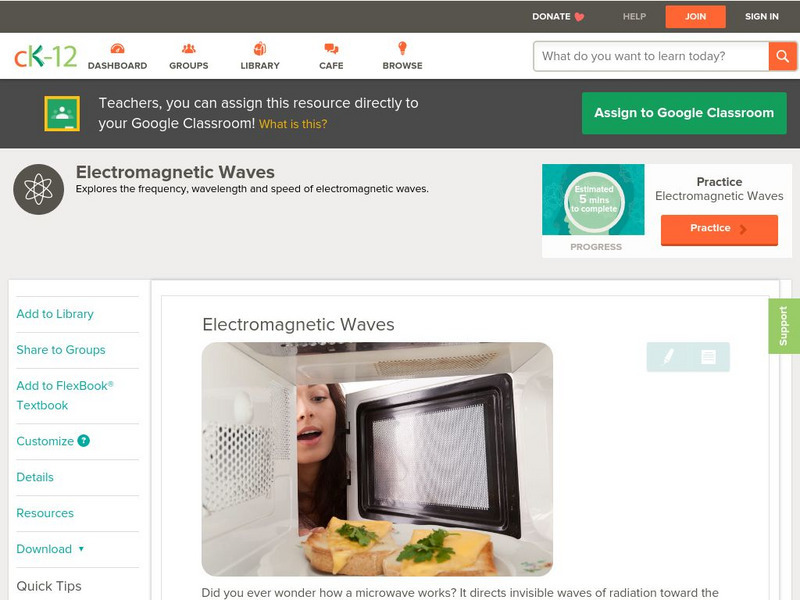
CK-12 Foundation
Ck 12: Physical Science: Electromagnetic Waves
[Free Registration/Login may be required to access all resource tools.] Provides the definition of an electromagnetic wave, electromagnetic radiation, and electric and magnetic fields. Also discusses how electromagnetic waves begin,...
Internet History Sourcebooks Project
Fordham University: Modern History Sourcebook: Michael Faraday (1791 1867)
Contains brief biographical information on Michael Faraday, as well as the text of the following lectures delivered by Faraday: The Force of Gravitation, Gravitation-Cohesion, Cohesion-Chemical Affinity, Chemical Affinity-Heat,...

National High Magnetic Field Laboratory
Magnet Academy: Duchenne Machine 1850
French physician Guillaume Benjamin Amand Duchenne invented a device that electrically stimulates muscles. The apparatus gave him new insight into neuromuscular disorders, earned him the epitaph of "father of electrotherapeutics," and...
Florida State University
Florida State University: Magnet Lab: Electric Meter 1872
The invention of the light bulb quickly created the need to track people's electricity usage. In 1872, Samuel Gardiner built the first simple power meter: a lamp with an attached clock that recorded the time the light was on.

National High Magnetic Field Laboratory
Magnet Academy: Magnetometer 1832
The Earth, the moon, the stars and just about everything in between has a magnetic field, and scientists use magnetometers when they need to know the strength of those fields.

National High Magnetic Field Laboratory
Magnet Academy: Bell Telephone 1876
Acoustics, variable resistance and allegations of foul play contribute to the exciting story of the invention of the telephone.

National High Magnetic Field Laboratory
Magnet Academy: Coaxial Cable 1929
As more and more American households acquired telephones, the pressure was on to create a better cable to accommodate the increasing demand. Engineers Lloyd Espenschied and Herman Affel answered the call.
Science and Mathematics Initiative for Learning Enhancement (SMILE)
Smile: Introduction to Magnets (Classroom Unit)
A teacher unit which includes several hands-on activities about types of magnets, magnetism, and electrostatics. An activity designed to suit all grade levels. Many parts of the activity would be easily adaptable as a student project.
Curated OER
Physics4 kids.com: Electricity & Magnetism: Resistance
Simple line graph showing the inverse relationship between the amount of electrical resistance and the amount of work possible.
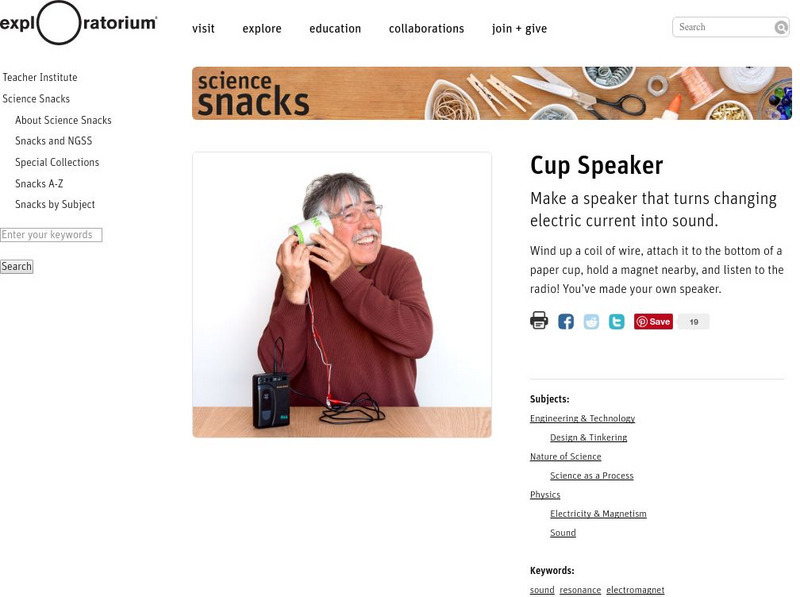
Exploratorium
Exploratorium: Science Snacks: Cup Speaker
This activity will have students creating their own speaker with a paper cup, coil of wire, and magnet. The speaker operates by changing electric current into sound.
Physics Aviary
Physics Aviary: Thomson's Cathode Ray Tube Lab
This lab is designed to have students look at the deflection of a cathode ray beam using magnetic fields and electric fields.
Florida State University
Florida State University: Lightning, a Natural Capacitor
Text and animated graphic show how lightning is an example of a natural capacitor.
Physics Classroom
The Physics Classroom: Put the Charge in the Goal
Students face a game-like challenge to use electrostatic forces to move a charged puck into a goal. By placing charges on the rink, a charged puck can be attracted and repelled around obstacles and into a goal.
Science and Mathematics Initiative for Learning Enhancement (SMILE)
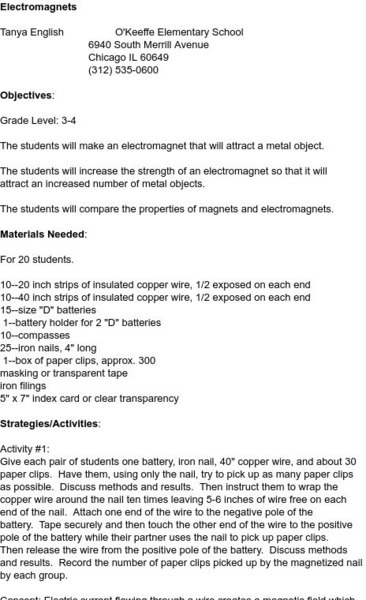
Smile: Electromagnets (Grades 3 and 4)
This lesson helps students to understand the difference between magenets and electromagnets. They will also create an electromagnet.
Cornell University
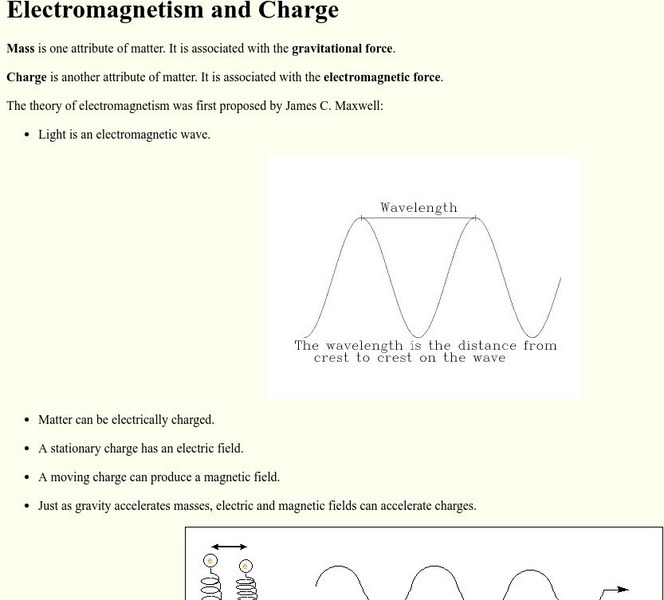
Cornell University: Astronomy: Electromagnetism and Charge
This site from Cornell University provides a very short, very telling comparison of matter and charge. This is a good site to check out on the subject, with a chart diagram to help with further information.
Wikimedia
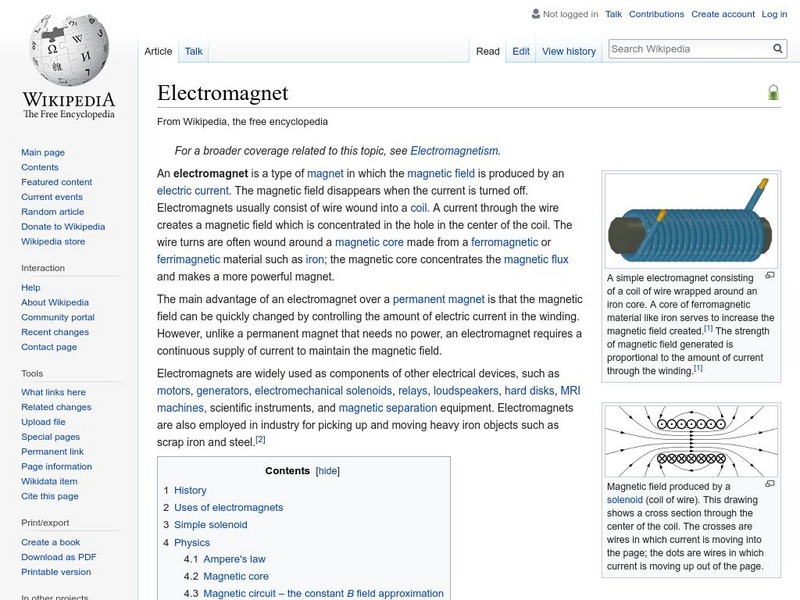
Wikipedia: Electromagnet
Easy-to-read information and an illustration of an "electromagnet," a type of magnet in which the magnetic field is induced by the flow of an electric current.