Hi, what do you want to do?






Curated OER
How Green Are We?
Students identify and interpret the importance of energy efficiency in connection with air pollution. They communicate with families and peers about ways to more effectively contribute to the reduction of air pollution. Finally,...

Curated OER
Simple Circuits
Students investigate how series and parallel circuits work. In this physics lesson, students build their own simple circuits and compare their characteristics. They explain the importance of circuit breakers in household circuits.

Curated OER
How Hot Is It?
Sixth graders use paper cups, black and white lining, thermometers and plastic wrap to conduct an experiment that measures the energy-collecting capacity of various colors. They graph the results.

Curated OER
Changing Circuits
Students participate in an online lesson to explain how to make bulbs brighter or dimmer in a series circuit by changing the number or type of components.

Curated OER
Energy Transfer
Students investigate the properties of heated air. They make predictions about what they think makes the wind blow on a worksheet, and conduct two experiments to demonstrate the properties of heated air. Students heat a bottle until a...

Curated OER
Archaeologists Puzzle Pieces
Students identify how archaeologists use typology to interpret artifacts. They interpret sample artifacts as if they discovered them.

Curated OER
Grade 6 Science Quiz
In this grade 6 science quiz, 6th graders complete a 15 question multiple choice quiz covering a variety of grade 6 concepts.

Curated OER
Science Quiz-Grade 6
In this grade 6 science quiz instructional activity, 6th graders complete a 15 question multiple choice quiz covering a variety of grade 6 concepts.

Curated OER
Applied Science- Physics
Learners investigate how something at home uses physics to work. In this practical physics lesson, students develop a theory of their own to conclude how an object might work. This lesson plan includes a worksheet.
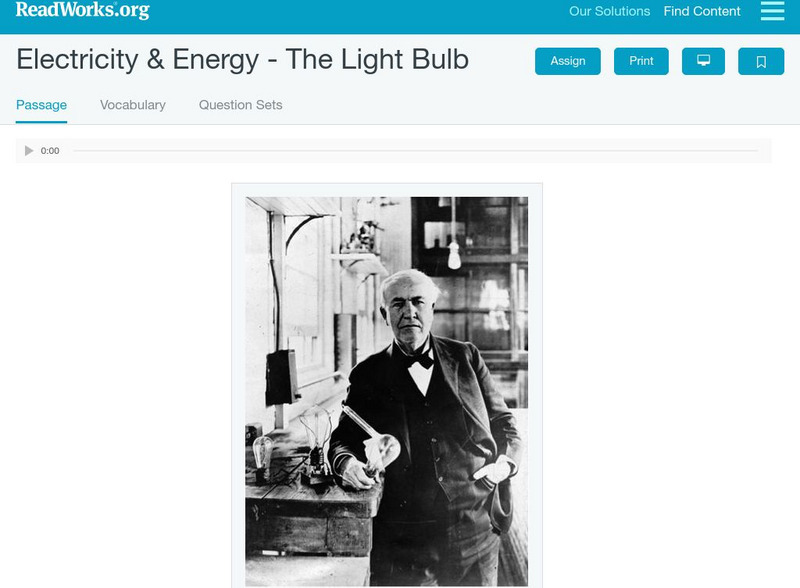
Read Works
Read Works: Electricity & Energy the Light Bulb
[Free Registration/Login Required] An informational text about the invention and use of the light bulb. A question sheet is available to help students build skills in reading comprehension.

US National Archives
Our Documents: Thomas Edison's Patent Application for the Light Bulb
This resource includes a copy of the original diagram and application that Thomas Edison submitted for the electric light bulb. Along with the interactive pictures you can access a typed transcript, larger images, a downloadable .PDF...
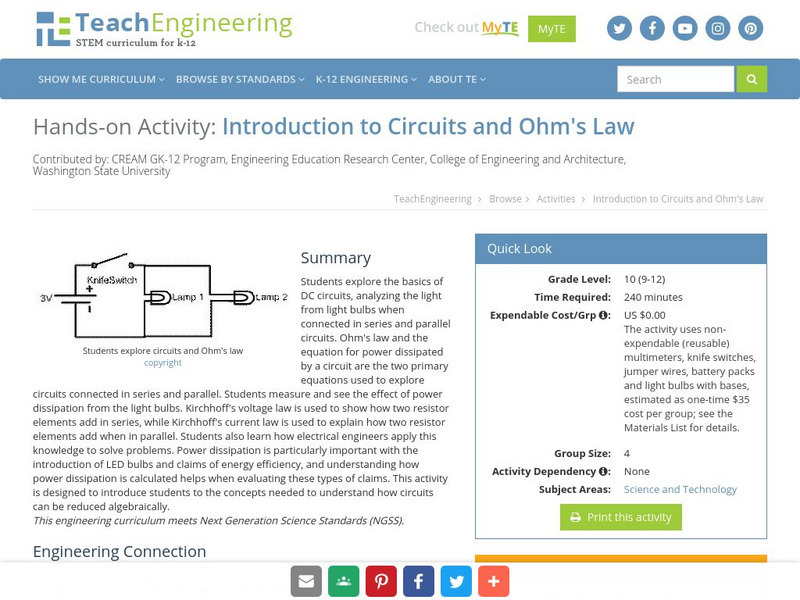
TeachEngineering
Teach Engineering: Introduction to Circuits and Ohm's Law
Students will explore the basics of dc circuits analyzing the light from light bulbs when connected in series and parallel circuits. Ohm's Law and the equation for power dissipated by a circuit will be the primary equations used. Using...
TeachEngineering
Teach Engineering: Put a Spark in It! Electricity
Uncountable times every day "with the merest flick of a finger"each one of us calls on electricity to do our bidding. What would your life be like without electricity? Students begin learning about electricity with an introduction to the...
National High Magnetic Field Laboratory
Magnet Academy: Timeline of Electricity and Magnetism: 1870 1879
The telephone and first practical incandescent light bulb are invented while the word "electron" enters the scientific lexicon.
Science Education Resource Center at Carleton College
Serc: Mn Step: Why Placing Wires Correctly on a Light Bulb Is Important
Students will learn about simple electric circuits as they investigate the structure of a light bulb and how electricity flows through it.

Smithsonian Institution
National Museum of American History: Lighting a Revolution
This website is part of a bigger exhibit exploring the history of invention. This looks at Edison's invention of the light bulb and many other electrical inventions from the following century.
Concord Consortium
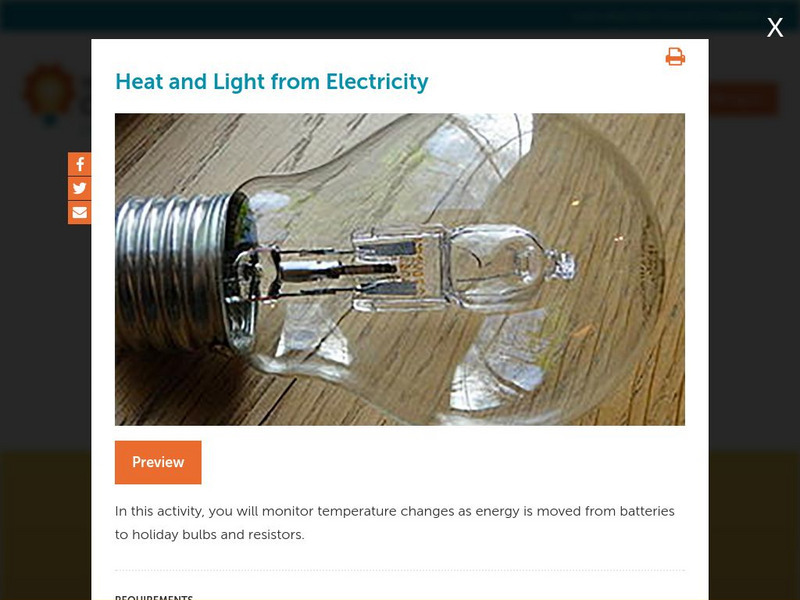
Concord Consortium: Stem Resources: Heat and Light From Electricity
Understand the energy transformations that happens when you light a bulb with a battery. Activity requires students to build a simple circuit and take temperature and time measurements. Lab includes procedure with questions that can be...
The Franklin Institute
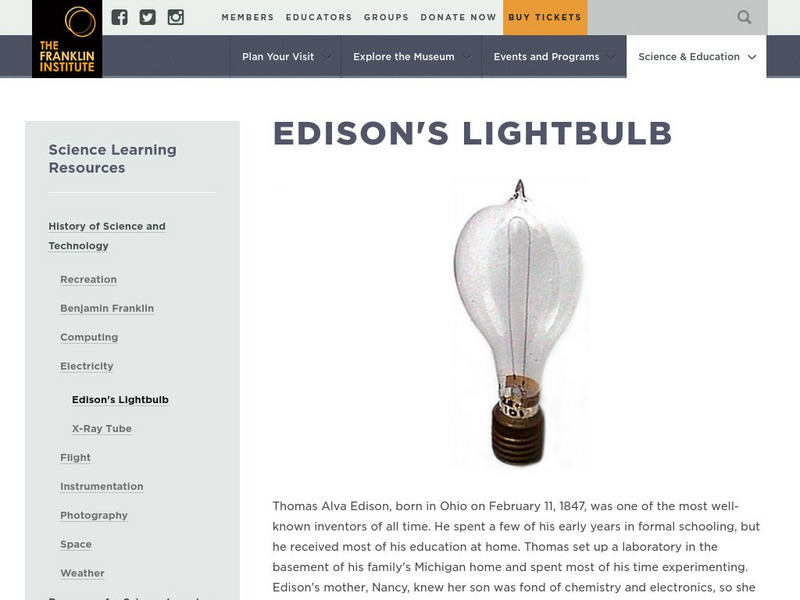
The Franklin Institute: Edison's Lightbulb: History of Science and Technology
The Franklin Institute features a biography of Thomas Edison and a complete description of the light bulb as well as an experiment.
TeachEngineering
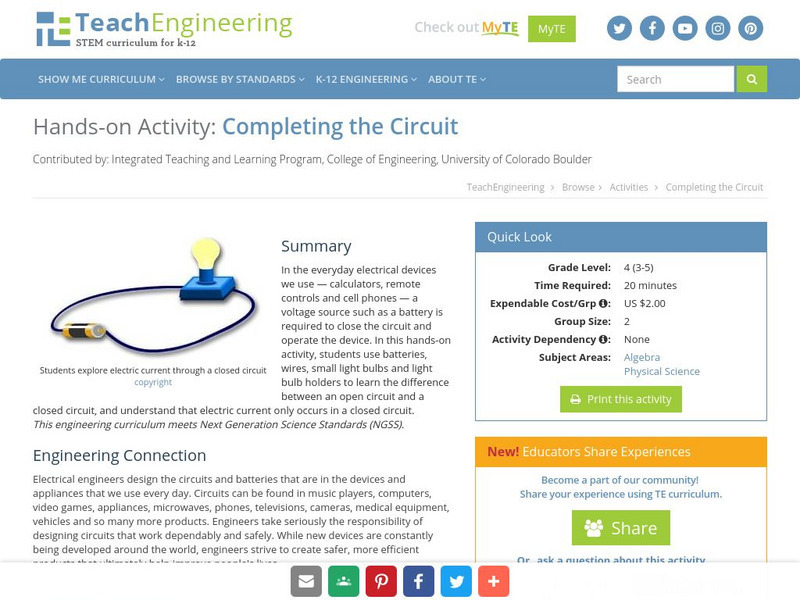
Teach Engineering: Completing the Circuit
In the everyday electrical devices we use - calculators, remote controls and cell phones - a voltage source such as a battery is required to close the circuit and operate the device. In this hands-on activity, students use a battery,...
Read Works
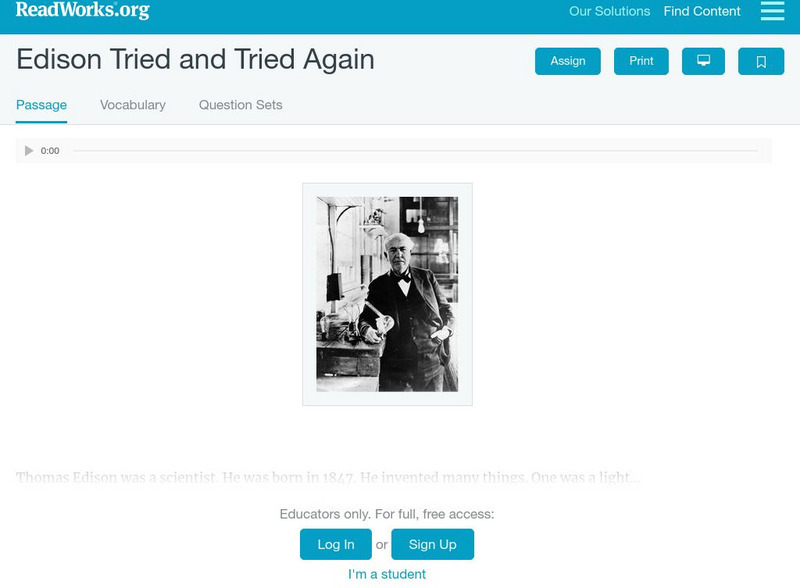
Read Works: Edison Tried and Tried Again
[Free Registration/Login Required] This biographical passage shares information about Thomas Edison, inventor of the light bulb. This passage is a stand-alone curricular piece that reinforces essential reading skills and strategies and...
Curated OER
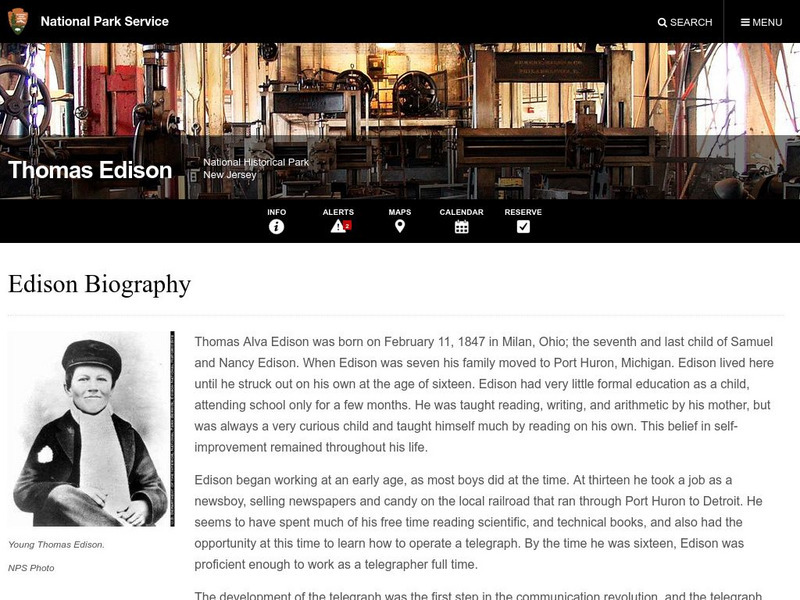
National Park Service: Thomas Edison National Historical Park: Edison Biography
Here is a very detailed biography of Thomas Edison ranging from his boyhood and his work as a telegrapher, moving on to his invention of the phonograph and incandescent light bulb, and finally, a description of his laboratories where he...
Creative Science Centre
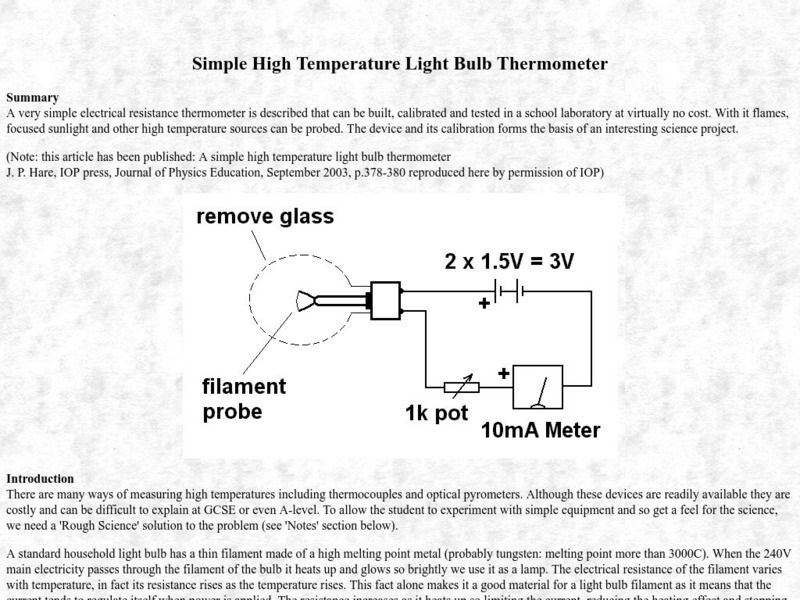
Creative Science Centre: Simple High Temperature Light Bulb Thermometer
A very simple electrical resistance thermometer is described that can be built, calibrated and tested in a school laboratory at virtually no cost. With it, flames, focused sunlight and other high temperature sources can be probed. The...
Science Buddies
Science Buddies: Measuring Light Intensity Using the Inverse Square Law
You've probably heard that compact fluorescent light bulbs are more efficient than incandescent bulbs. More of the electricity they use goes into producing light, and less into producing heat than with incandescent bulbs. How much more...

University of Colorado
University of Colorado: Ph Et Interactive Simulations: Circuit Construction Kit (Dc Only), Virtual Lab
Build circuits with resistors, light bulbs, batteries, and switches and take measurements with laboratory equipment like the realistic ammeter and voltmeter.