Hi, what do you want to do?






CK-12 Foundation
Ck 12: Interactive Physics for High School
This digital textbook covers core physics concepts and includes interactive features, real world examples, videos, and study guides.
National Academy of Engineering
Greatest Engineering Achievements of the 20th Century: Electrification
Learners explore electrification in the 20th century. Some topics investigated are rural electrification, power generators, and direct current (DC). The resource consists of historical information, a timeline, and a personal essay by a...
Science Struck
Science Struck: Electromagnetic Energy and Why It Is Important
Explains what electromagnetic energy is, the history of its discovery, some terms used when talking about it, and gives some facts about it.
Wolfram Research
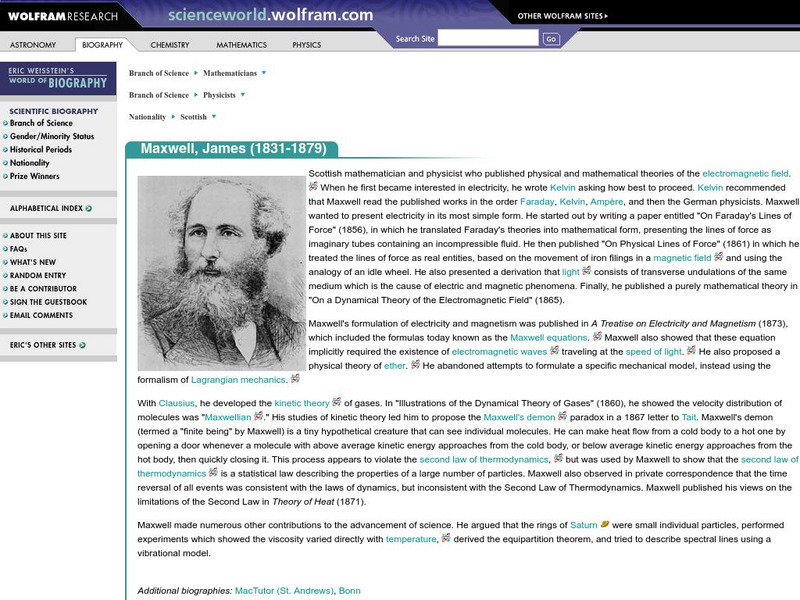
Wolfram Science World: Maxwell, James
This ScienceWorld site describes the Scottish mathematician and physicist James Maxwell (1831-1879) who published physical and mathematical theories of the electromagnetic field.
University of Wisconsin
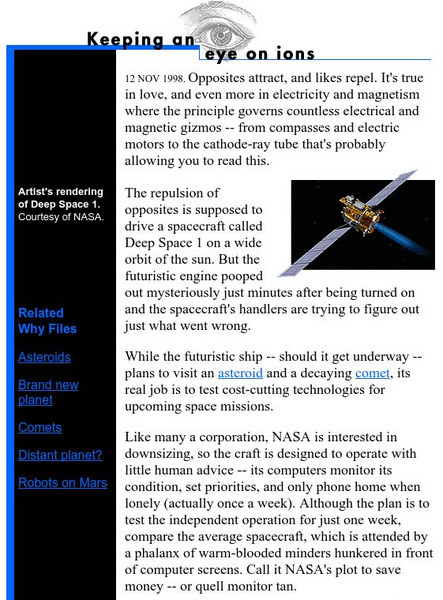
The Why Files: Keeping an Eye on Ions
Discusses the development of a new rocket engine that operates by the ion propulsion as opposed to gas propulsion. Well written and great graphics!
Wolfram Research
Wolfram Science World: Hans Oersted (1777 1851)
A solid telling of Oersted's scientific achievements, along with some interesting insight into Oersted's personal beliefs. Many links.
Science Education Resource Center at Carleton College
Serc: Investigating How to Create a Stronger Electromagnet
In this lesson, learners will investigate what they can do to produce a stronger electromagnet. Students will use the scientific thinking process to conduct investigations and build explanations. They will present their discoveries to...
Florida State University
Florida State University: The Rutherford Experiment
A simulation of the Rutherford experiment. Includes an animation and an explanation of the history behind the experiment.
University of Kentucky
University of Kentucky: Online Physics for Teachers
A set of four online courses in Physics for elementary and middle school teachers. Each course targets a different topic area - light, electricity & magnetism, temperature & heat, and force, motion, & energy.
Other
University of Liverpool: Matter Initiative for Schools a Level Resources
This site features numerous interactive resources (such as simulations, interactive exercises, experiments, etc.) designed for teachers and students of the physical sciences. Some of the resources are available only on CD-ROM, but most...
Khan Academy
Khan Academy: Electromagnetic Waves: The Electromagnetic Spectrum and Photons
An article that discusses the coupling of an electric field with a magnetic field to create electromagnetic waves. Article also discusses how different types of electromagnetic waves have different wavelengths which forms the...
Annenberg Foundation
Annenberg Learner: Physics: Early Unification for Electromagnetism
Discusses the connection between electricity and magnetism and the early work of Michael Faraday and James Clerk Maxwell. Electromagnetic interactions were first described by Maxwell. Continues on with a discussion of quantum physics and...
Princeton University
Princeton University: Joseph Henry
A really fine and complete biography, quite lengthy. Some emphasis placed on his time at Princeton. A great deal of detail can be found here. Link here to the Joseph Henry House.
Oak Ridge National Laboratory
Ornl: Teacher's Guide Superconductivity for High School Students
This site from the Human Genome Project provides a large collection of facts and information, demonstrations, experiments and project ideas. Written for teachers but easily adaptable for any type of student work. A good site to check out...
Science Buddies
Science Buddies: Batteries: The Shocking Truth
Here you can find what you need to scientifically assess battery performance. In this exercise (that should take about one week) learn how batteries work, how they wear out and most importantly, how to make valid measurements to assess...
Nobel Media AB
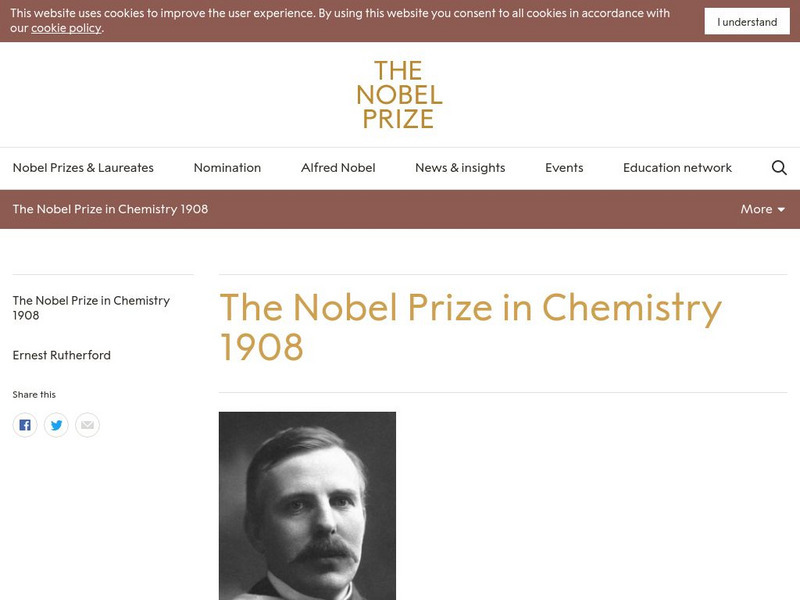
The Nobel Prize: The Nobel Prize in Chemistry 1908
At this site read about Ernest Rutherford (1871-1937 CE), the scientist who was awarded the Nobel Prize in Chemistry, "for his investigations into the disintegration of the elements, and the chemistry of radioactive substances." This...
World Health Organization
World Health Organization: International Emf Project
The World Health Organization probes into the feared associations between electromagnetic fields (EMFs) and cancer. Check out "What is EMF?" for detailed summaries on what electromagnetic fields are and the possible health effects, or...
Science Buddies
Science Buddies: Shaking Up Some Energy
Shake N' Light flashlights have been advertised on televisions across the nation in the recent year. But many do not understand just how they get energy to light up the bulb without using batteries. Do this experiment to make your own...
Other
Unit conversion.org: Online Unit Converter
Need a unit converter? Links to the most common converters provide access to the answers you need quickly.
Georgia Department of Education
Ga Virtual Learning: Ap Physics 2: Electromagnetic Induction
Through labs, readings, videos, and discussions, students learn about the concepts of Electromagnetic Induction.
Florida State University
Florida State University: Lightning, a Natural Capacitor
Text and animated graphic show how lightning is an example of a natural capacitor.
Frontiers Media
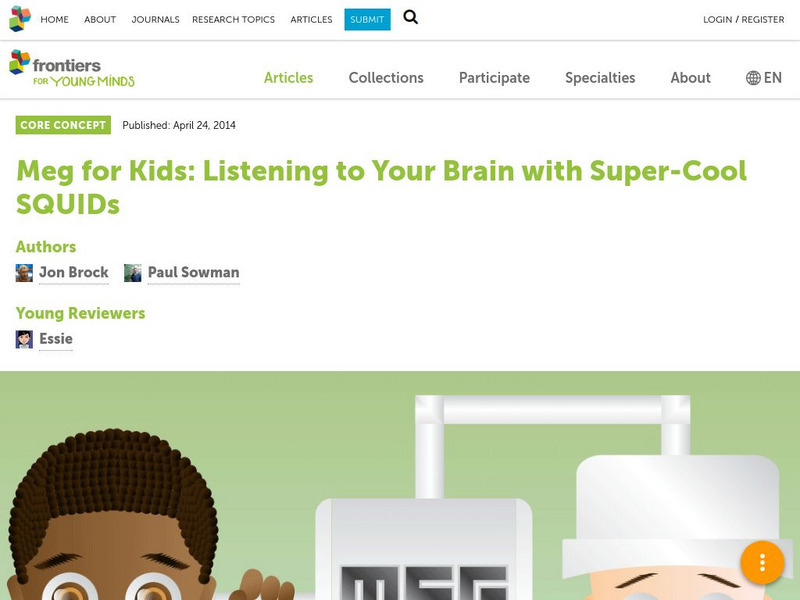
Frontiers: Meg for Kids: Listening to Your Brain With Super Cool Squi Ds
Inside your brain, you have over 80 billion neurons - tiny brain cells, all working together to make you the person you are.Neurons talk to each other by sending electrical messages. Each message creates a tiny magnetic field. If enough...
Physics Classroom
The Physics Classroom: Put the Charge in the Goal
Students face a game-like challenge to use electrostatic forces to move a charged puck into a goal. By placing charges on the rink, a charged puck can be attracted and repelled around obstacles and into a goal.

Science Education Resource Center at Carleton College
Serc: Building an Electromagnet
Students will demonstrate how an electric current can make an iron object magnetic by building an electromagnet with a steel nail, insulated wire, a simple switch, a battery/cell, and small metal washers. Students predict the number of...