Hi, what do you want to do?





TeachEngineering
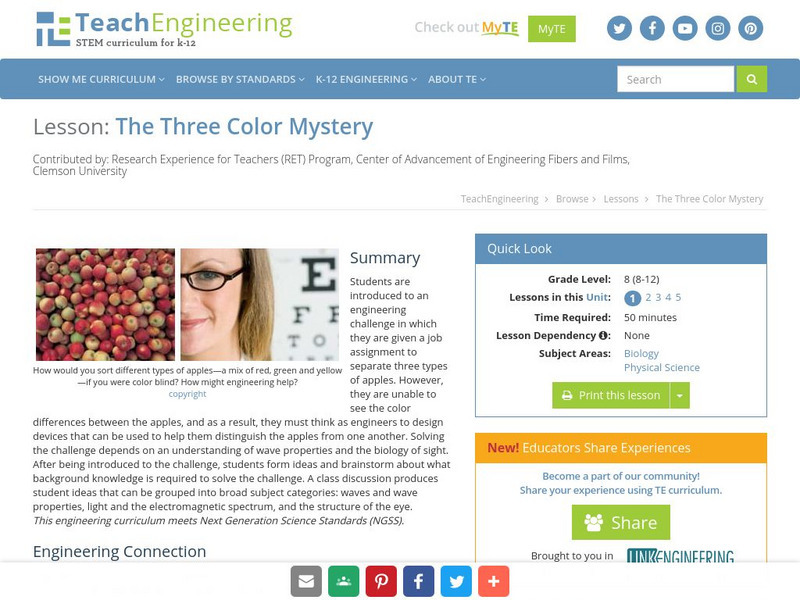
Teach Engineering: The Three Color Mystery
Students are introduced to an engineering challenge in which they are given a job assignment to separate three types of apples. However, they are unable to see the color differences between the apples, and as a result, they must think as...

NASA
The Adventures of Echo the Bat
Remote sensing, false-color satellite images, and the electromagnetic spectrum are all covered in this fun site about Echo the bat. These topics are addressed in both a story book and text book fashion and are supported by a full set of...
Georgia Department of Education
Ga Virtual Learning: Inductance and Maxwell's Equations
In this interactive tutorial students will look at the energy stored in the magnetic field of an inductor. Self-inductance and mutual inductance will be distinguished and circuits with capacitors and inductors, or LC circuits will be...
University of Florida
University of Florida: Episodes in Romantic Science
One of the "Episodes in Romantic Science," this is as complete as a biography gets without being a book. Includes great information about Oersted and his electromagnetic work, The definitive source. Heavily footnoted with many additional...
University of Colorado
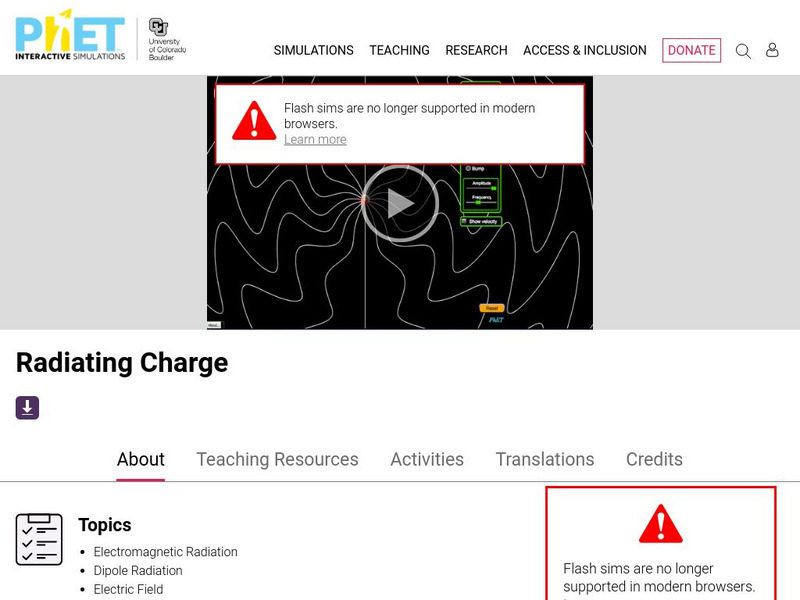
University of Colorado: Ph Et Interactive Simulations: Radiating Charge
An interactive simulation that teaches about electromagnetic radiation, dipole radiation, and electric fields by observing the effects of changes in sinusoidal, circular, and linear motion on the outward propagation of radiation. This...
TeachEngineering
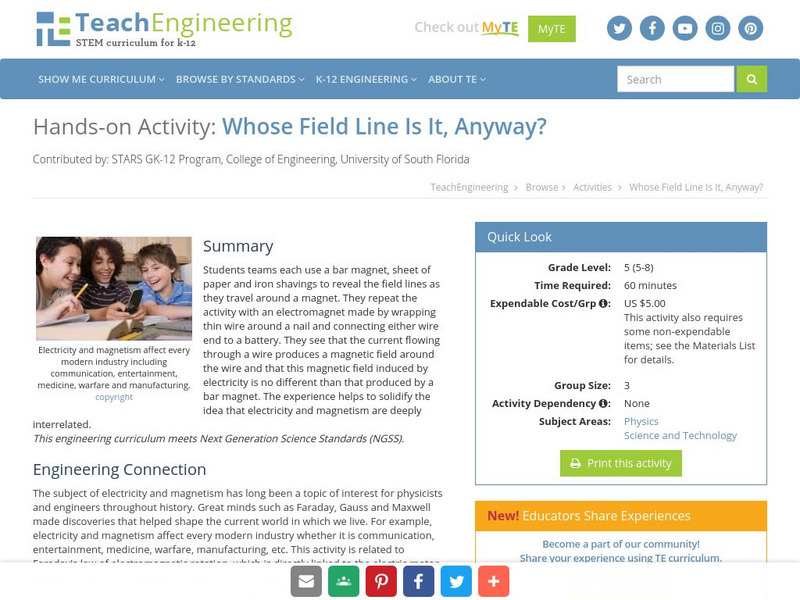
Teach Engineering: Whose Field Line Is It, Anyway?
Students teams each use a bar magnet, sheet of paper and iron shavings to reveal the field lines as they travel around a magnet. They repeat the activity with an electromagnet made by wrapping thin wire around a nail and connecting...
TeachEngineering
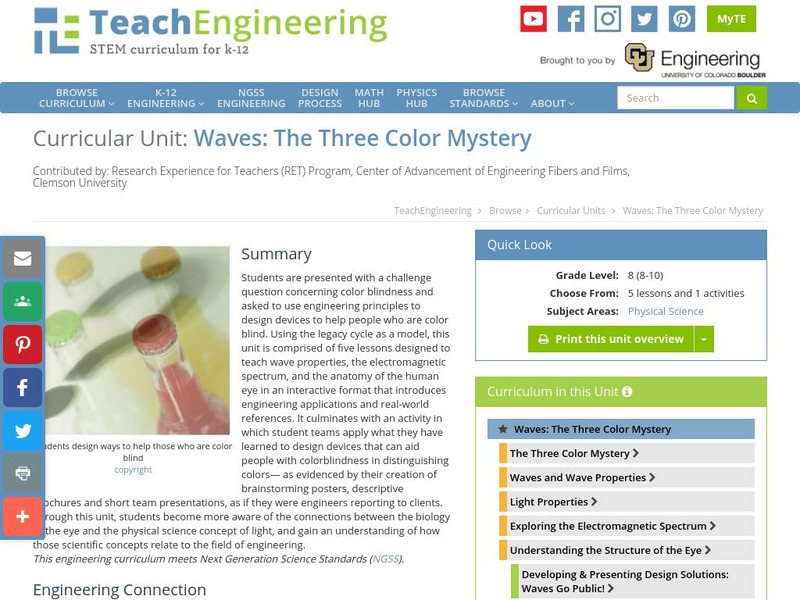
Teach Engineering: Waves: The Three Color Mystery
Students are presented with a challenge question concerning color blindness and asked to use engineering principles to design devices to help people who are color blind. Using the legacy cycle as a model, this unit is comprised of five...
TeachEngineering
Teach Engineering: Learning Light's Properties
Middle schoolers learn the basic properties of light--the concepts of light absorption, transmission, reflection and refraction, as well as the behavior of light during interference. Lecture information briefly addresses the...
BBC
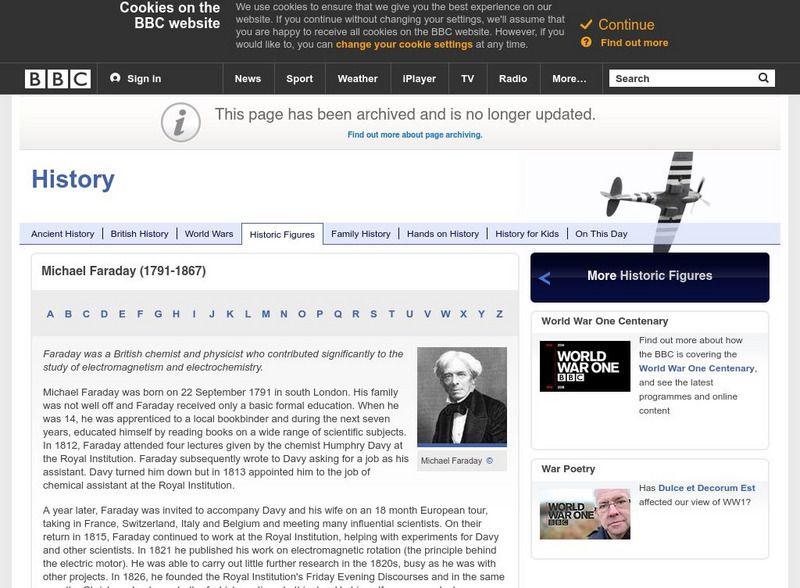
Bbc Historic Figures: Michael Faraday (1791 1867)
Contains an article on the life of scientist Michael Faraday and highlights his work in the study of electromagnetism. Archived.
NASA
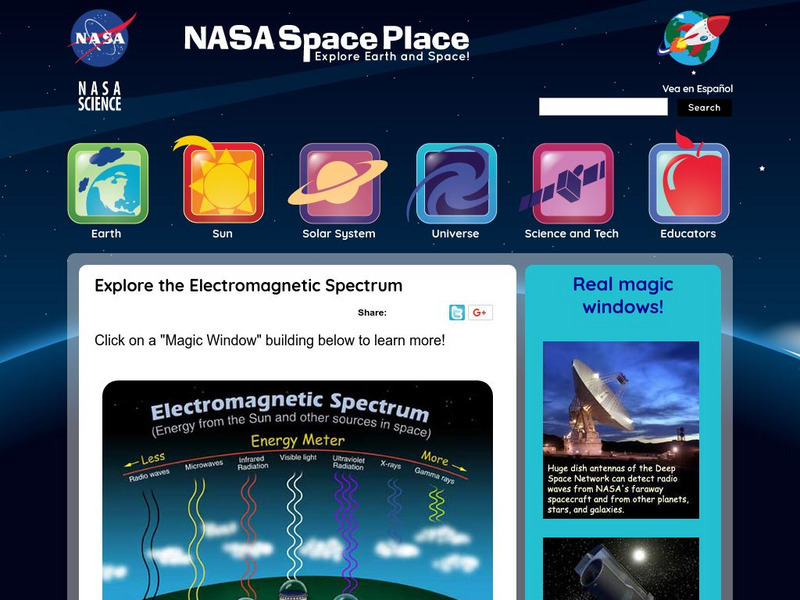
Nasa's the Space Place: A Trip to the Land of the Magic Windows
Explore the electromagnetic spectrum and learn about each type of energy on the spectrum.

Exploratorium
Exploratorium: Science Snacks: Physics/electricity & Magnetism
Exploratorium Science Snacks are miniature science exhibits and experiments that can be made with common, inexpensive, easily available materials. These electricity snacks represent a set of devices that you can build and experiment with...
Massachusetts Institute of Technology
Mit: Open Course Ware: Courses: Physics: Electricity and Magnetism
College-level physics course highlighting electromagnetism. This course also includes a wide variety of other physics topics including lightning, electrocardiograms, metal detectors, and atom smashers, to name a few. Course includes a...
PBS
Pbs Learning Media: Frequency
In this interactive activity adapted from the University of Utah's ASPIRE Lab, students will investigate frequency in terms of trampoline jumps, pendulum swings, and electromagnetic waves.
Science4Fun
Science4 Fun: Michael Faraday
Brief biographical sketch of Michael Faraday, famous scientist whose discoveries include electromagnetic rotation, Benzene, electromagnetic induction, and Laws of Electrolysis.
University of California
Center for Science Education: Gallery
A gallery of astronomy images which depict galaxies, comets, the moon, planets, nebulae, supernovae as seen in various regions of the electromagnetic spectrum. Each image in the gallery is described. Fascinating!
PBS
Pbs Teachers: Scientific American: Science in Paradise: Big Dish
Investigate the science of radio astronomy, and create a model of a curved reflecting dish that will work like the Arecibo detector to detect electromagnetic waves. Explore risk using a risk space grid.
University of Colorado
University of Colorado: Physics 2000: Cat Scans: Projecting Shadows
This page and the three pages which follow discuss how X-ray technology can be used to produce an image of the human body. Discussion is understandable and highly intriguing. Several interactive animations allow the visitor to explore...
Florida State University
Florida State University: Magnet Lab: Team Tesla: How We Keep the World's Most Powerful Magnets in Shape
Our magnets are like world-class athletes - Team Tesla, if you will. They have an awful lot of power, but to stay in that kind of shape, they need to eat and drink - a lot.
Lawrence Berkeley National Laboratory
Berkeley Lab: Micro Worlds Project: Advanced Light Source
A discussion of the Advanced Light Source (ALS) facility and its use in material analysis and medicine.
University of Colorado
University of Colorado: Physics 2000: Speed of Light
Using an interesting and intriguing format, this page discusses the question of "How does one measure the speed of light." Explanation focuses on Galileo's and Roemer's efforts to obtain a reasonable value. Also discusses Heinrich...

American Association of Physics Teachers
Com Padre Digital Library: Open Source Physics: Magnetic Bar Field Model
A bar magnet model built by placing a group of magnetic dipoles along the magnet. This simulation shows the magnetic field of a bar magnet, and has a movable compass which shows the magnetic field values.
University of Minnesota
University of Minnesota: Ships: Science & Religion of Michael Faraday
Here's a whole different look at Faraday. His religion, Sandemanian, greatly influenced both his life and his science. This article looks deeply at that aspect of his life.
TeachEngineering
Teach Engineering: The Electric and Magnetic Personalities of Mr. Maxwell
Learners are briefly introduced to Maxwell's equations and their significance to phenomena associated with electricity and magnetism. Basic concepts such as current, electricity and field lines are covered and reinforced. Through...
OpenSciEd
Open Sci Ed: 8.3 Forces at a Distance
This unit allows students to investigate the cause of a speaker's vibration in addition to the effect.
Other popular searches
- Electromagnetic Spectrum
- Electromagnetic Waves
- Electromagnetic Wave
- Electromagnetic Radiation
- Electromagnetic Energy
- Home Made Electromagnet
- The Electromagnetic Spectrum
- Magnets and Electromagnets
- Electromagnets Motors
- Electromagnetic Induction
- Making an Electromagnet
- Electromagnet Experiments