Hi, what do you want to do?





University of New South Wales (Australia)
University of New South Wales: Einstein Light
Einstein Light highlights the Theory of Special Relativity and related topics. Learn how Galileo, Maxwell, and Einstein contributed to our knowledge of relativity, electricity, magnetism, and time by watching fun, interactive modules.
Science Buddies
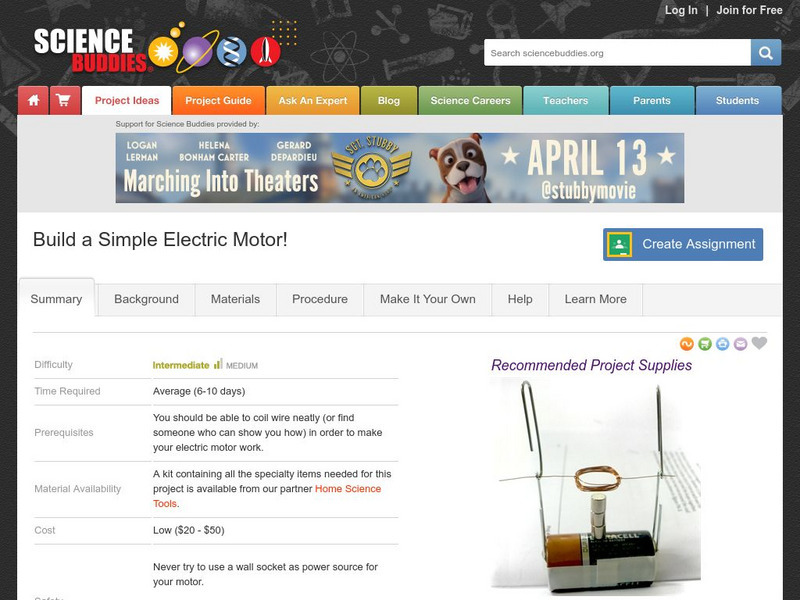
Science Buddies: Spin Right 'Round With This Simple Electric Motor
If you put on clothes that were washed in a washing machine, rode in a car, ate food from a fridge, warmed up lunch in a microwave, or played a video game, you used an electric motor. Try this science fair project and you'll learn how to...
Other
Topological Quantum Field Theory Club: Home Page
Visit the Topological Quantum Field Theory club's website. Find out about their organization and visit links to club events and other related topics.

Museum of Science
Museum of Science and Industry: Online Science: Build an Electric Motor
Step-by-step illustrated instructions show how to build a simple electric motor using everyday materials to make a wire coil spin. An explanation of the science involved is given at the end, as well as tips on troubleshooting any...
Other
Lunar and Planetary Institute: The Surveyor Program
A good site about the Surveyor missions to the moon, which includes findings from the experiments that were aboard the lander.
National High Magnetic Field Laboratory
Magnet Academy: Magnets From Mini to Mighty
If your knowledge of magnets ends with posting a to-do list on the fridge, add this to the list. Learn more about magnets! You can start here with a straightforward rundown of magnet types, uses and strengths, explained in a way that...
Georgia Department of Education
Ga Virtual Learning: Waves
Through informational text, interactive activities, and practice problems, students learn about the properties of waves, and how they transfer energy.
Georgia Department of Education
Ga Virtual Learning: Magnetism
In this interactive unit students will see how magnets work and how they are used in some of the most useful and common devices today.
TeachEngineering
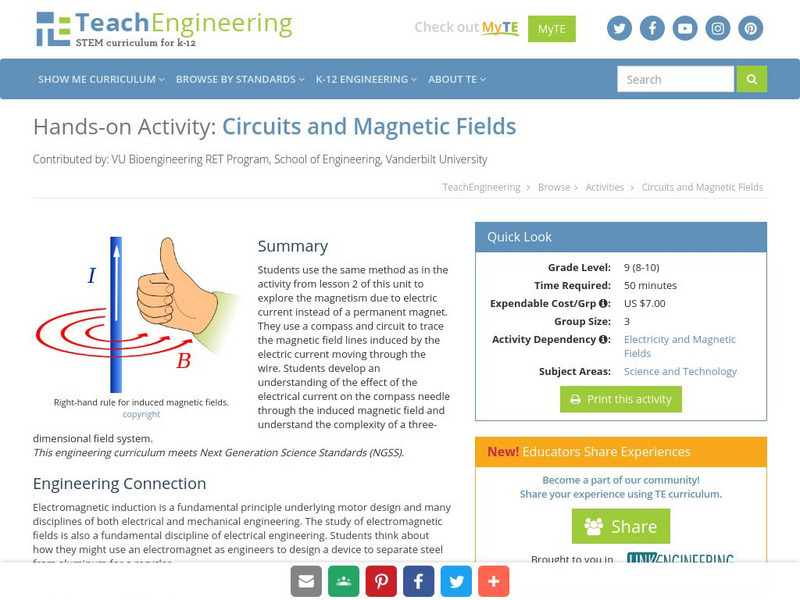
Teach Engineering: Circuits and Magnetic Fields
In this activity, students use the same method as in the activity from lesson 2 to explore the magnetism due to electric current instead of a permanent magnet. Students use a compass and circuit to trace the magnetic field lines induced...
TeachEngineering
Teach Engineering: Induced Emf in a Coil of Wire
Students use a simple set up consisting of a coil of wire and a magnet to visualize induced EMF. First, students move a coil of wire near a magnet and observe the voltage that results. They then experiment with moving the wire, magnet,...
TeachEngineering
Teach Engineering: Mri Safety Grand Challenge
This module was written for a first year accelerated or AP physics class. It is intended to provide hands on activities to teach end of the year electricity and magnetism topics including the magnetic force, magnetic moments and torque,...
TeachEngineering
Teach Engineering: Energy Forms, States and Conversions
Young scholars participate in many demonstrations during the first day of this lesson to learn basic concepts related to the forms and states of energy. This knowledge is then applied the second day as students assess various everyday...
TeachEngineering
Teach Engineering: Electricity and Magnetic Fields
The grand challenge for this legacy cycle unit is for young scholars to design a way to help a recycler separate aluminum from steel scrap metal. In previous lessons, they have looked at how magnetism might be utilized. In this...
TeachEngineering
Teach Engineering: Both Fields at Once?!
This instructional activity discusses the result of a charge being subject to both electric and magnetic fields at the same time. It covers the Hall effect, velocity selector, and the charge to mass ratio. Given several sample problems,...
TeachEngineering
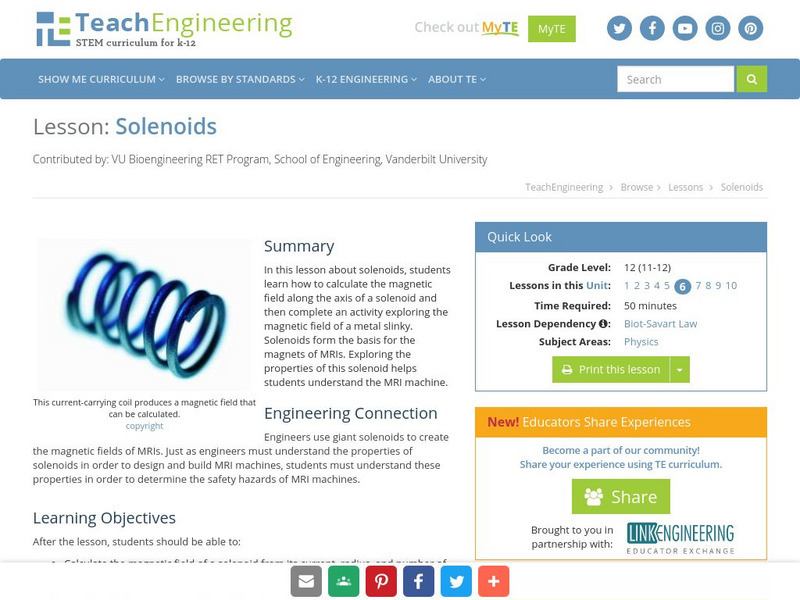
Teach Engineering: Solenoids
This activity discusses solenoids. Students learn how to calculate the magnetic field along the axis of a solenoid and complete an activity exploring the magnetic field of a metal slinky. Solenoids form the basis for the magnet of an...

PBS
Pbs Nova: Relativity and the Cosmos
This well-written explanation of relativity includes animations and pictures which may be helpful in understanding a tough topic.
Other
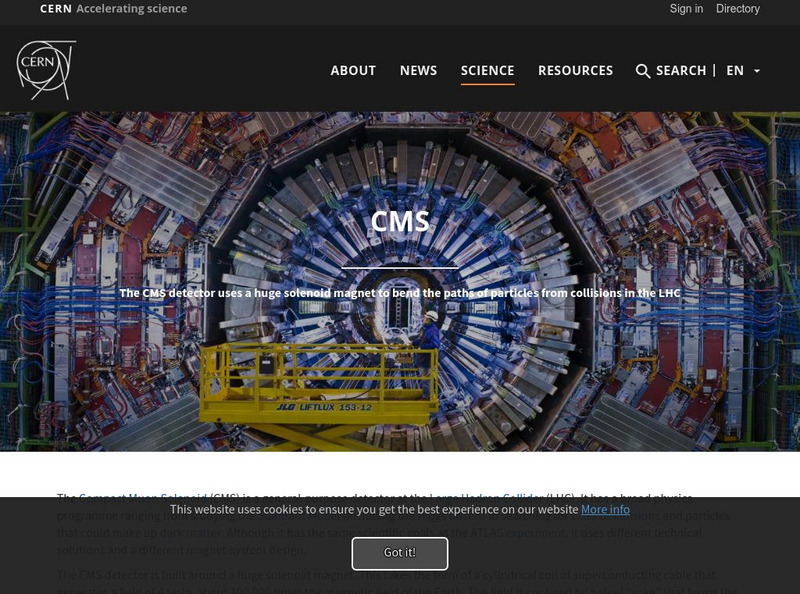
Cern: The Compact Muon Solenoid Experiment
The Compact Muon Solenoid Experiment (CMS), an LHC experiment, detects muons, electrons and photons, provides momentum measurements, and, like ATLAS, is responsible for detecting the Higgs boson. This CERN website offers news about CMS,...
Physics Classroom
The Physics Classroom: Polarization
"How Do We Know Light Behaves as a Wave?" An answer is provided in this discussion of the polarization of light and the use of Polaroid filters in sunglasses. The four methods discussed on this page are: polarization by transmission,...
Open Ed
Open Ed Sci: 8.3 Forces at a Distance
This unit launches with a slow-motion video of a speaker as it plays music. In the previous unit, students developed a model of sound. This unit allows students to investigate the cause of a speaker's vibration in addition to the effect.

Khan Academy
Khan Academy: Experiment: What's the Shape of a Magnetic Field?
See drawing from Hans Christian Orsted's lab notebook showing an experiment in which an electric charge passing through a wire seemed to create a magnetic field!
Science Education Resource Center at Carleton College
Serc: Investigating Motors and Magnetism
Young scholars will build a simple DC motor out of metal coat hangers, a 24-guage wire armature and field magnet, 14-guage wire brushes, and build the motor so that it rotates when connected to a 10-volt DC power supply. Students will...

National High Magnetic Field Laboratory
Magnet Academy: Carl Friedrich Gauss
Although he is best known as one of the greatest mathematicians of all time, Carl Friedrich Gauss was also a pioneer in the study of magnetism and electricity. To facilitate an extensive survey of terrestrial magnetism, he invented an...

Khan Academy
Khan Academy: Right Hand Rule
Learn the convention for describing the direction of magnetic fields. Challenge questions are included.

Khan Academy
Khan Academy: Diffraction and Constructive and Destructive Interference
Article goes into detail about what exactly is interference.
Other popular searches
- Electromagnetic Spectrum
- Electromagnetic Waves
- Electromagnetic Wave
- Electromagnetic Radiation
- Electromagnetic Energy
- Home Made Electromagnet
- The Electromagnetic Spectrum
- Magnets and Electromagnets
- Electromagnets Motors
- Electromagnetic Induction
- Making an Electromagnet
- Electromagnet Experiments