Hi, what do you want to do?





TeachEngineering
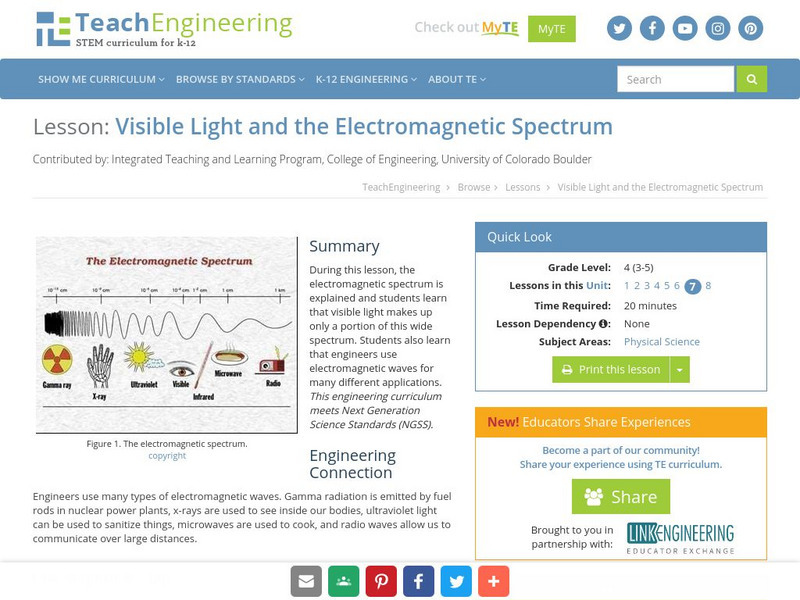
Teach Engineering: Visible Light and the Electromagnetic Spectrum
In this lesson, the electromagnetic spectrum is explained and students learn that visible light makes up only a portion of this wide spectrum. Students also learn that engineers use electromagnetic waves for many different applications.

PBS
Pbs Learning Media: Light Waves: Interactive Lesson
Light is all around you, with wavelengths bigger than mountains and smaller than atoms. Learn about light waves, and the ways in which light interacts with matter, with this lesson plan.
Massachusetts Institute of Technology
Mit: Open Course Ware: Supplemental Resources: Electromagnetic Fields and Energy
College-level textbook highlighting electromagnetism concepts. Many of the topics are explained in video demonstrations.
Science Struck
Science Struck: Electromagnetic Energy and Why It Is Important
Explains what electromagnetic energy is, the history of its discovery, some terms used when talking about it, and gives some facts about it.
My Science Site
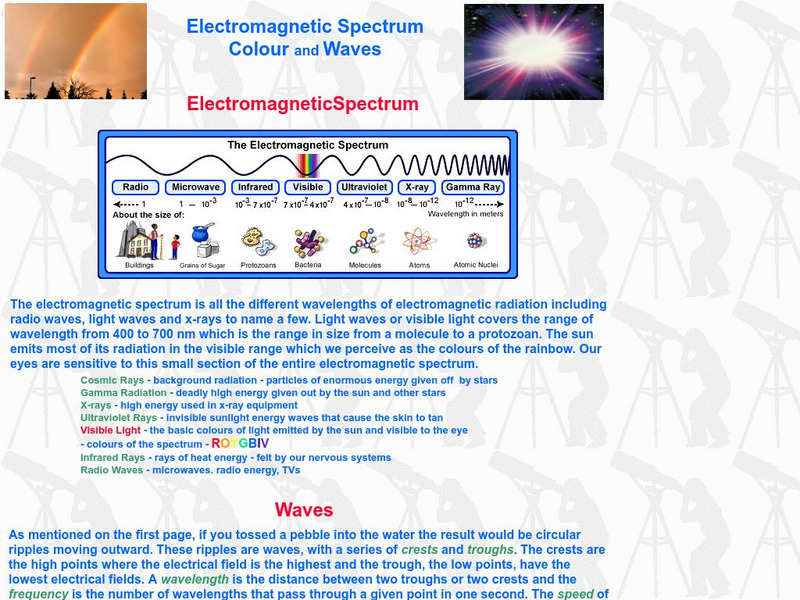
Electromagnetic Spectrum: Colour and Waves
This resource provides information on the different wavelengths that make up the electromagnetic spectrum. Also contains information on waves and color.
PBS
Pbs Learning Media: Frequency
In this interactive activity adapted from the University of Utah's ASPIRE Lab, students will investigate frequency in terms of trampoline jumps, pendulum swings, and electromagnetic waves.
University Corporation for Atmospheric Research
Ucar: Waves of Energy More or Less
Students create and observe wavelengths at both high and low energy levels using safety glasses, rope, and a power drill
Geography 4 kids
Geography4 kids.com: Electromagnetic Radiation
Electromagnetic radiation waves are found all around us. Young researchers will discover more about these energy waves with these highlights.

Alabama Learning Exchange
Alex: Understanding Solar Energy. Part 1
This lesson discusses how electromagnetic radiation transfer the sun's energy to earth. This lesson will also talk about the eight types of electromagnetic waves in the electromagnetic spectrum and how each type is used or found in our...
PBS
Pbs Teachers: Scientific American: Science in Paradise: Big Dish
Investigate the science of radio astronomy, and create a model of a curved reflecting dish that will work like the Arecibo detector to detect electromagnetic waves. Explore risk using a risk space grid.

Ducksters
Ducksters: Physics for Kids: Light Spectrum
Kids learn about the science of the light spectrum. Wavelengths and frequencies of the electromagnetic waves including visible light, primary colors, and subtractive colors.
TeachEngineering
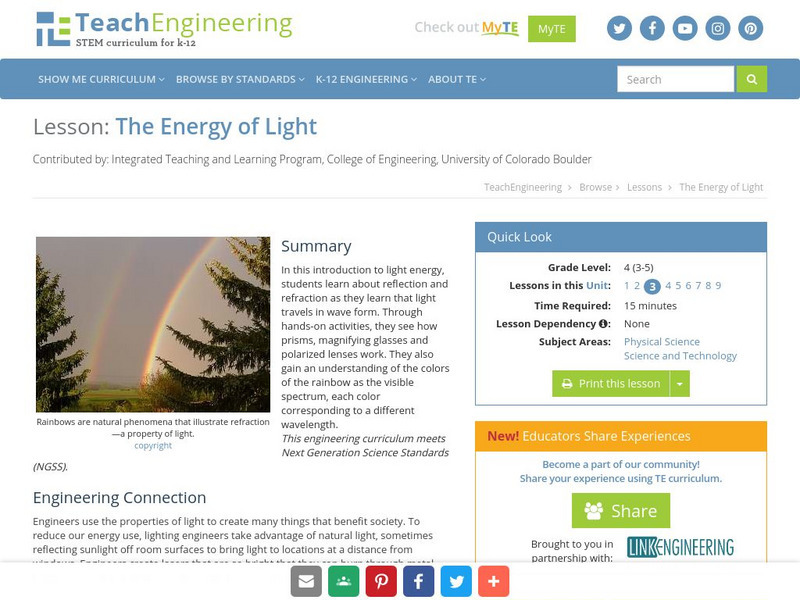
Teach Engineering: The Energy of Light
In this introduction to light energy, students learn about reflection and refraction as they learn that light travels in wave form. Through hands-on activities, they see how prisms, magnifying glasses and polarized lenses work. They also...
NASA
Nasa: Imagine the Universe: What's the Frequency, Roy G. Biv
In this very detailed lesson plan from NASA, students investigate wavelength and frequency within the electromagnetic spectrum.
CK-12 Foundation
Ck 12: Fundamentals of Light
[Free Registration/Login may be required to access all resource tools.] Students investigate the fundamentals of light including its source, how it is defined for measurements, how we perceive color, and the situations that make an...
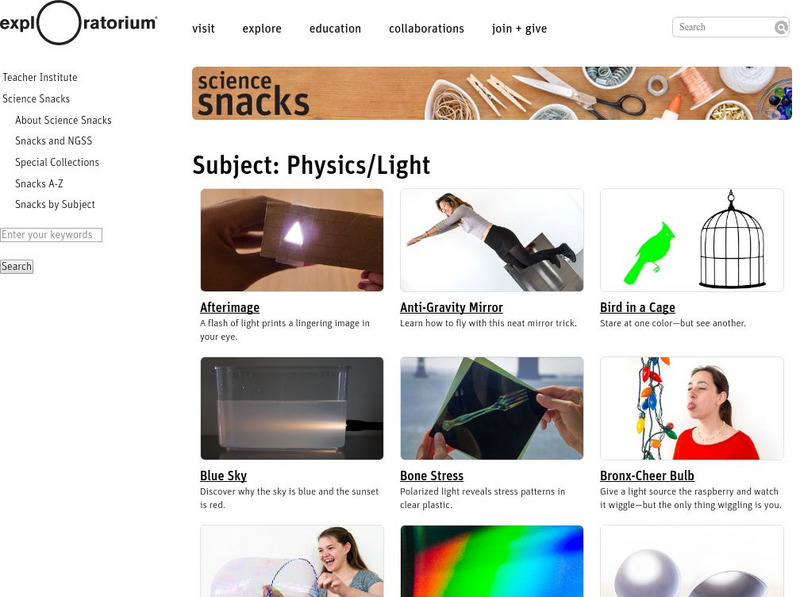
Exploratorium
Exploratorium: Science Snacks: Physics/light
Here is a large collection of simple science class activities for understanding the physics of light.
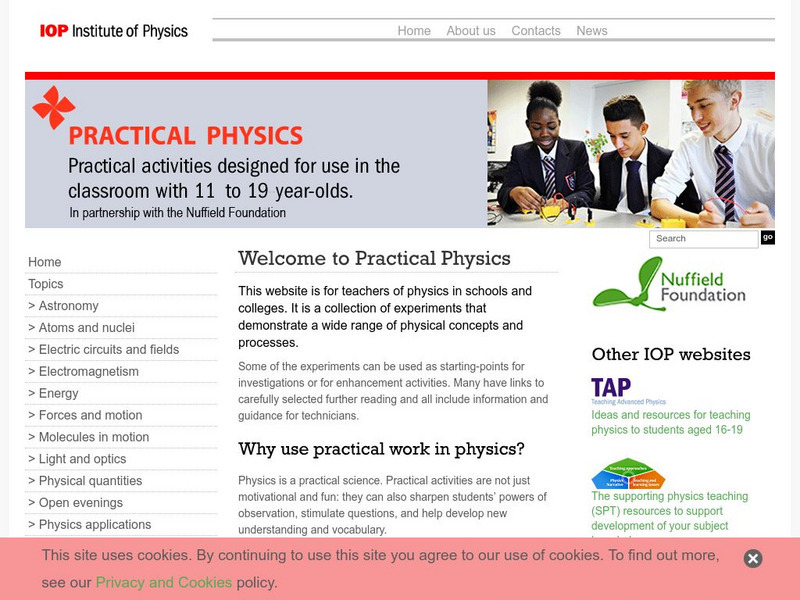
Other
Institute of Physics: Practical Physics
Access hundreds of teacher-tested, practical physics lessons on this well-organized, illustrated site. Find just the right demonstration, attention-grabber, or lab for any physics teaching objective at your fingertips.

Khan Academy
Khan Academy: Infrared and Ultraviolet/visible Spectroscopy Questions
Practice questions over infrared and ultraviolet/visible spectroscopy questions.

TeachEngineering
Teach Engineering: The Visual Spectrum
In this activity, students make simple spectroscopes (prisms) to look at different light sources. The spectroscopes allow students to see differing spectral distributions of different light sources.
Science Struck
Science Struck: Wavelength of Light
Describes the characteristics of light, presents two formulas for calculating its wavelength, and provides a table of the different wavelength ranges across the electromagnetic spectrum.