Hi, what do you want to do?






Chem Tutor
Chem tutor.com: Atomic Structure
This page provides a thorough and comprehensible discussion of the structure of the atom. Includes helpful diagrams and instructions for filling electron shells, reading the Periodic Table, and drawing Lewis Structures.
Concord Consortium
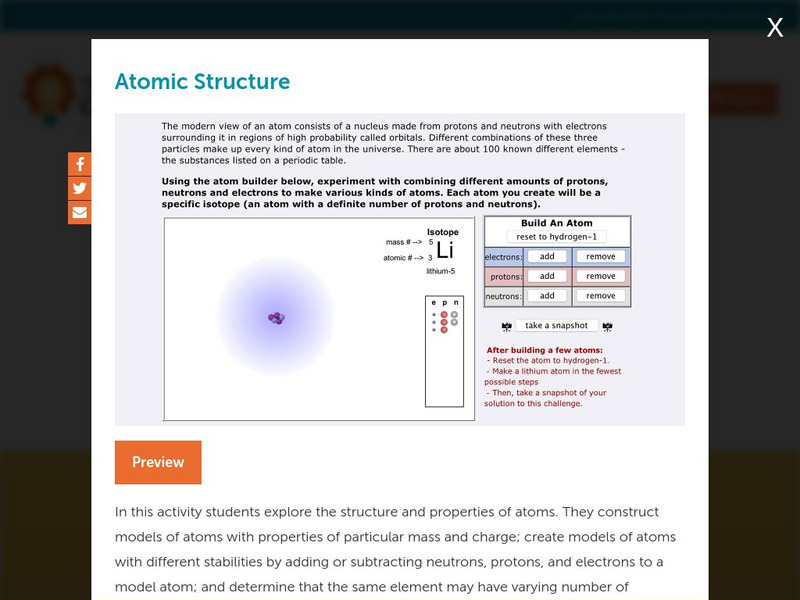
Concord Consortium: Stem Resources: Atomic Structure
Introduces learners to atomic models of the past and present, focusing on the orbital model and an explanation of its basis. Learners then have the opportunity to "make an atom" and contrast it with an ion, followed by an isotope. The...
CK-12 Foundation
Ck 12: Ions
[Free Registration/Login may be required to access all resource tools.] In the following online tutorial students will be able to determine the number of valence electrons for any element and draw an electron dot diagram for any atom....
PBS
Pbs Learning Media: Periodic Table of the Elements
This interactive periodic table developed for Teachers' Domain provides detailed information about the chemical properties of elements and illustrates the electron configurations that determine those characteristics.

Concord Consortium
Concord Consortium: Stem Resources: Scanning Tunneling Microscopy
A learning module with built-in interactive features where students can observe how electrons behave. Using a virtual scanning tunneling microscope (STM), they experiment with moving the electrons inside an atom around. The STM has two...
American Chemical Society
American Chemical Society: Hompage
ChemCenter, available from the American Chemical Society, provides chemistry news, reference sources and other public services.
PBS
Pbs Learning Media: Periodic Table of the Elements Essay
This essay, written for Teachers' Domain, describes the foresight and pattern recognition that Russian chemist Dmitri Mendeleyev used to develop the modern periodic table of elements.
Lawrence Berkeley National Laboratory
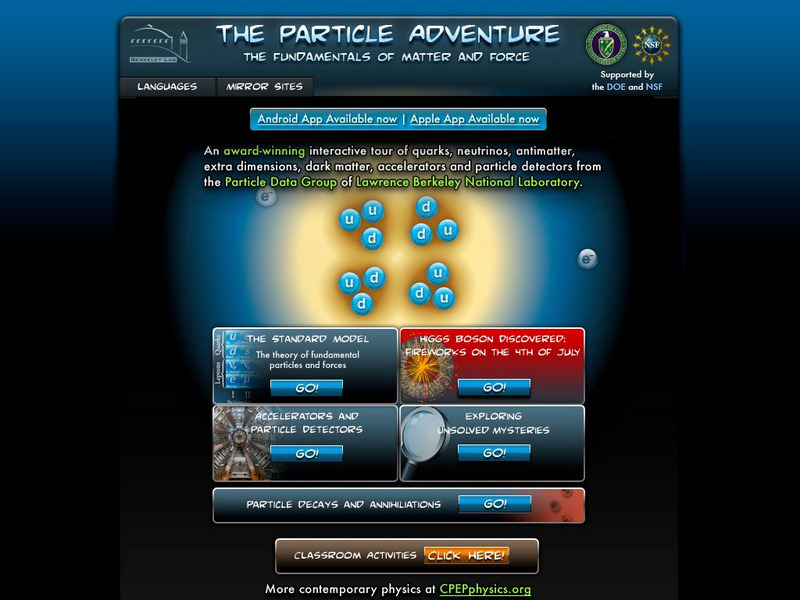
Berkeley Lab: The Particle Adventure
Visit this site for an interactive tour of the atom and all aspects of particle physics. View the animations available with almost every description on this site. A great place for the fundamentals of particles and forces including a...

BBC
Bbc: Gcse Bitesize Science: Atomic Structure
An explanation of atomic structure and the element groups in the periodic table using plain language. Supported by diagrams and charts.
Khan Academy
Khan Academy: Electromagnetic Waves: The Electromagnetic Spectrum and Photons
An article that discusses the coupling of an electric field with a magnetic field to create electromagnetic waves. Article also discusses how different types of electromagnetic waves have different wavelengths which forms the...
TeachEngineering
Teach Engineering: Static Cling
This hands-on activity explores the concept of static electricity. Students attract an O-shaped piece of cereal to a charged comb and watch the cereal jump away when it touches the comb. Students also observe Styrofoam pellets pulling...
TeachEngineering
Teach Engineering: Charge It!
Students use a balloon to perform several simple experiments to explore static electricity and charge polarization.
TeachEngineering
Teach Engineering: Build a Charge Detector
In this hands-on activity, students explore the electrical force that takes place between two objects. Each student builds an electroscope and uses the device to draw conclusions about objects' charge intensity. Students also determine...
Quia
Quia: Chemical Bonds (Ionic and Covalent) Quiz
This is 21-question multiple choice quiz over chemical bonds was written for a 7th-grade science class.
CK-12 Foundation
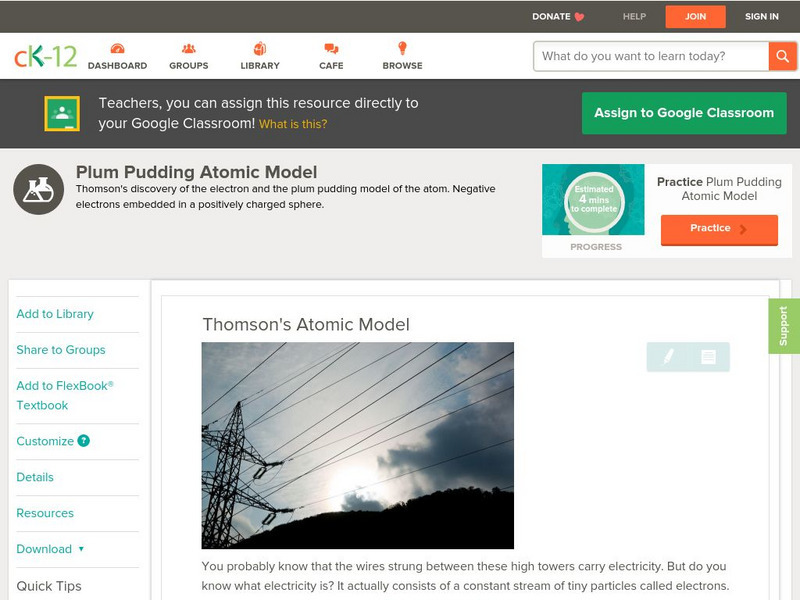
Ck 12: Physical Science: Thomson's Atomic Model
[Free Registration/Login may be required to access all resource tools.] Thomson's discovery of the electron and his plum pudding model of the atom.
Concord Consortium
Concord Consortium: What Are Nature's Building Blocks?
Activity 2 of the module explores: If you can't see it, how do you know it's there? Activities include the concepts of J.J. Thomson, electrons, and the Plum Pudding Model of the Atom.
BBC
Bbc: Gcse Bitesize: Covalent Bonds
A covalent bond is formed between non metal atoms, which combine together by sharing electrons. Covalent compounds have no free electrons and no ions so they don't conduct electricity.
Frostburg State University
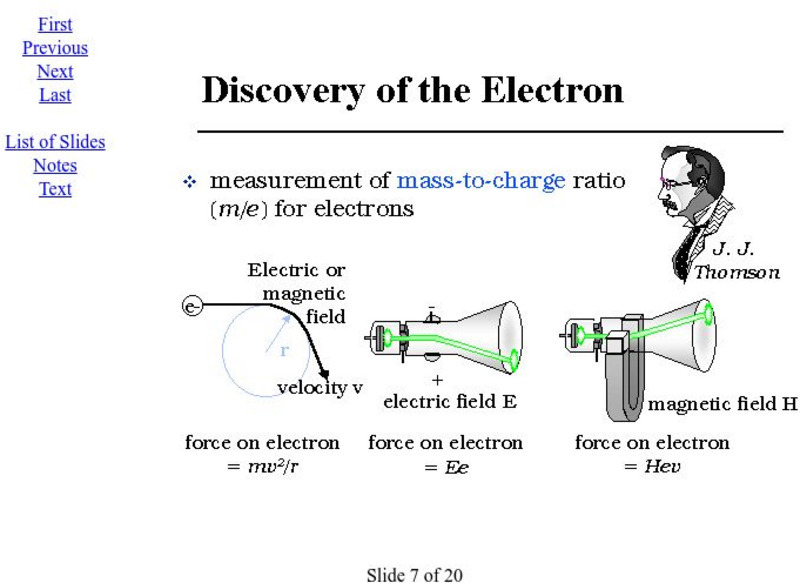
General Chemistry Online: Discovery of the Electron
This site from General Chemistry Online of the Frostburg State University provides an explanation of Thomson's discovery of the electron using a cathode ray tube and also his plum cake model of the atom.

Alabama Learning Exchange
Alex: Emission Spectrum
We will reintroduce the students to the electromagnetic spectrum and visible light. We will talk about the states of electrons(ground and excited). The teacher will show a video link (Electrons in Atoms). We will then perform the science...

State University of New York
State University of New York: Determining Electron Pair Geometry
The electron-pair geometry of a molecule or ion depends on the number of structurally significant electron pairs in the central atom. Here students are asked to count the number of lone electron pairs and bonded atoms on the central...
Georgia State University
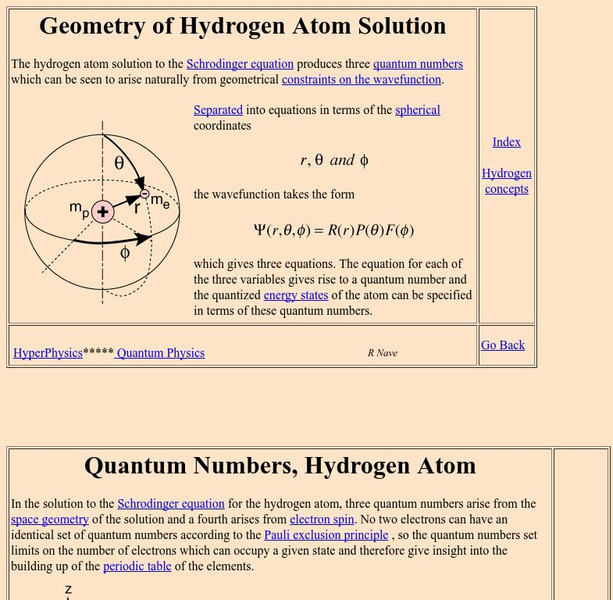
Georgia State University: Hyper Physics: Quantum Numbers, Hydrogen Atom
This tutorial contains links to explanations of the four different quantum numbers (principal, orbital, magnetic, and spin). Equations for each are provided.

Ducksters
Ducksters: Chemistry for Kids: Glossary and Terms
Kids learn about important glossary and terms used in the science of chemistry. Words and definitions you need to know from acids to valence electrons.
Science Struck
Science Struck: Shielding Effect
Explains what the electron shielding effect is, how to calculate the amount of nuclear charge in an atom, how to use the number of orbitals to find the number of electrons in an atom, and Slater's method of calculating the shielding...
CK-12 Foundation
Ck 12: Modern Atomic Theory
[Free Registration/Login may be required to access all resource tools.] Rutherford's model of the atom was better than earlier models. But it wasn't the last word. Danish physicist Niels Bohr created a more accurate and useful model....