Hi, what do you want to do?





TeachEngineering
Teach Engineering: The Great Gravity Escape
Students use water balloons and a length of string to understand how gravity and the velocity of a spacecraft balance to form an orbit. They see that when the velocity becomes too great for gravity to hold onto an object, the object...
Harvard University
Harvard University: The Solar System
These hands-on activities are a great way for students to gain perspective on the relative sizes and distances of each planet, the relationship between the sun and Earth, and much more.

Massachusetts Institute of Technology
Mit: Open Course Ware: Courses: Physics: Classical Mechanics
College-level online course highlighting the study of classical mechanics. This course focuses on Newtonian mechanics, fluid mechanics, and kinetic gas theory. Course features include a 35 video lecture series by Walter Lewin. Also link...
Fourmilab Switzerland
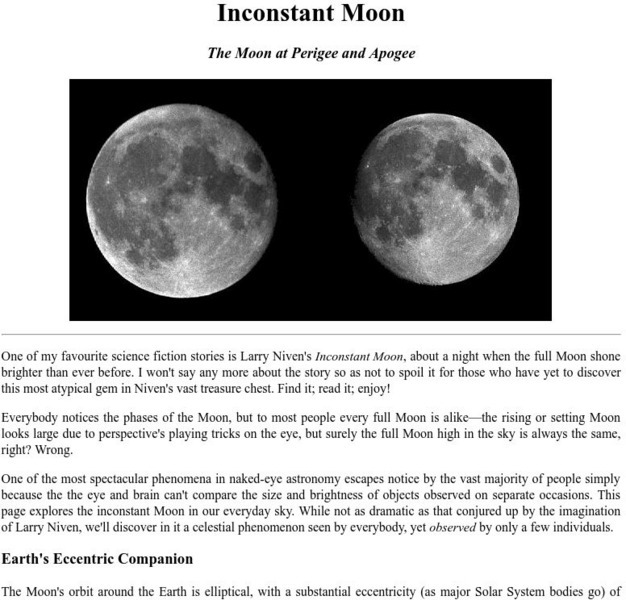
John Walker: Inconstant Moon: Moon at Perigee and Apogee
Most people think of every full moon as appearing the same, but careful observation allows us to see that sometimes the Moon appears larger than at others. This is caused by the elliptical orbit of our natural satellite.
Texas Instruments
Texas Instruments: Multiple Choice Planetary Motion Study Cards
Kepler's Laws 1,2,3 including eccentricity of elliptical orbits. Good for reviewing planetary motions (NYS Earth Science).
National Earth Science Teachers Association
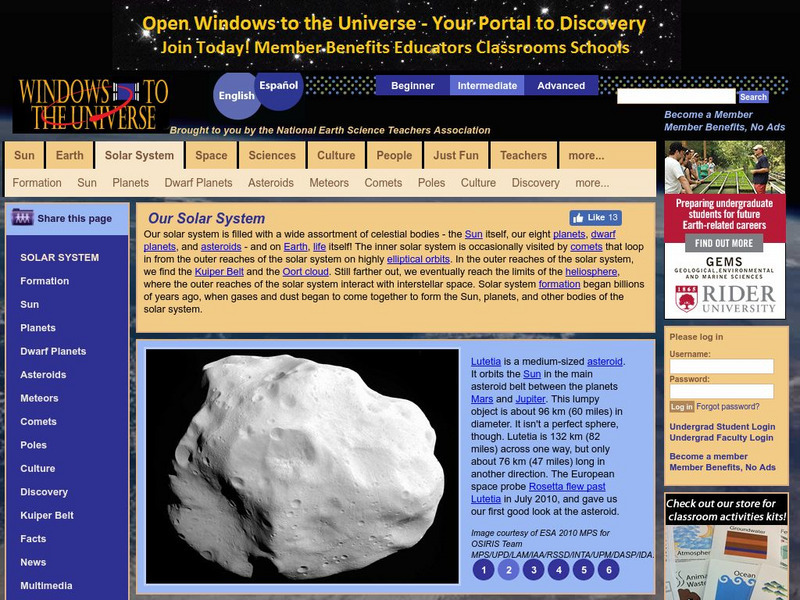
Windows to the Universe: Our Solar System
Our solar system is filled with a wide assortment of celestial bodies - the Sun itself, our eight planets, dwarf planets, and asteroids - and on Earth, life itself! The inner solar system is occasionally visited by comets that loop in...

Cornell University
Cornell University: Astronomy: Orbital Motion and Kepler's Laws
At this site from the Astronomy Department of Cornell University, Kepler's three laws of planetary motion are stated. There are brief explanations of each, along with links to additional information on related subjects.
University of Maryland
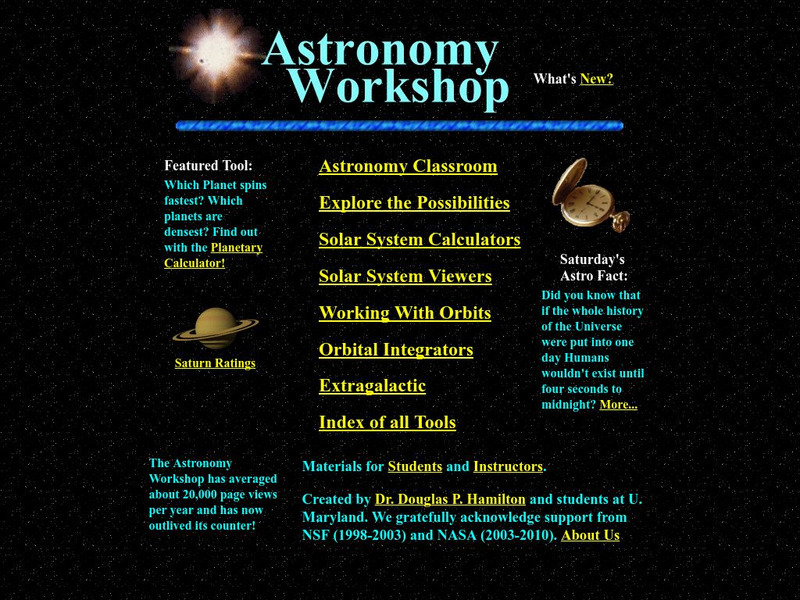
University of Maryland: The Astronomy Workshop
Find tools to calculate astronomical distances and sizes, to view various Solar System models, to compare gravity's affect on weight, and more. A good place to find interesting facts, simple animations, and astronomy links to physics and...
Mathigon
Mathigon: Geometry: Circle and Pi: Conic Sections
The circle is one of four different shapes which can be created using "slices" through a cone, a 3-dimensional solid that has a circular base joined to a single point (called the vertex) by a curved side. If you tilt a cone, you get an...
PBS
Pbs Learning Media: The Sun and Planets
Observe the sun and the rotation of the planets in this moving image from NASA. Observe the axial tilts and directional rotation of planets and how they differ for each planet. Be sure to read the background information on how planets...
NASA
Nasa: Heliophysics: New Science of the Sun Solar System Connection
This site from NASA lists common and uncommon misconceptions about Sun-Earth Science. Site also provides links to activities and lesson plans as well as background reading.
Physics Classroom
The Physics Classroom: Circular and Satellite Motion: Energy in Satellites
Through interactive practice problems and illustrated examples, students explore energy relationships for satellites.

Georgia State University
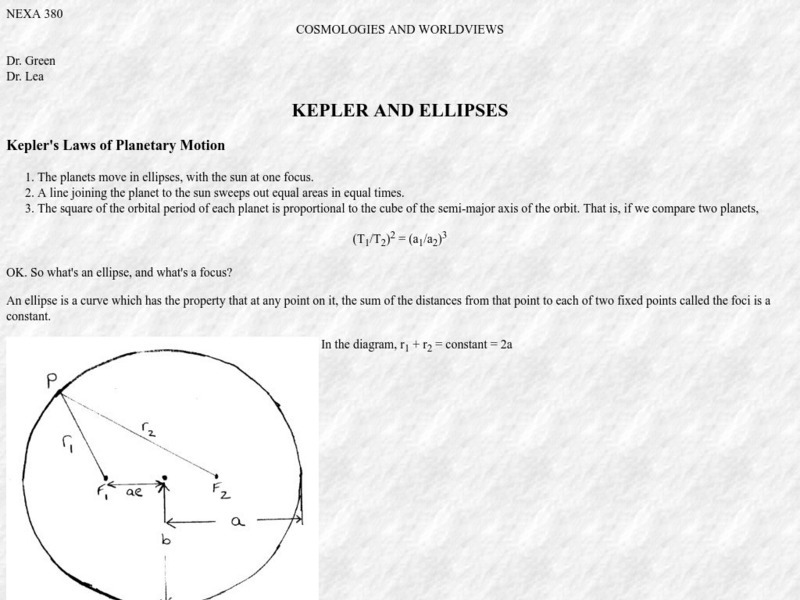
Georgia State University: Hyper Physics: Kepler's Laws
An outstanding page describing Kepler's three laws of planetary motion.