Hi, what do you want to do?






Curated OER
Thanksgiving Quilt
Students discuss what they are thankful for this year. They create their own quilt square to illustrate what they are most thankful for. They use the quilt after it is sewn together by their teacher.

Curated OER
Find Somebody Who... 2-- Icebreaker Game
For this icebreaker game, students get to know their classmates by finding people who fit each of the 30 descriptions on the page and writing their names in the blanks.

Curated OER
Lesson Plan XII
Seventh graders research the problem of homeless youth. For this homelessness lesson, 7th graders read the worksheet 'Kids Who Can't Go Home.' Students discuss the reading and the social services in place to help homeless youth. Students...

Curated OER
Picture Match
Pupils match pictures with words that have specific phonics connotations. In this picture matching lesson plan, students have groups of words with the same phonics sayings.

Pennsylvania Department of Education
Writing With Environmental Print
Students develop literacy skills by exploring street signs, cereal boxes, and billboards. In this writing with environmental print lesson, students build word recognition in every day print. Students decode words and discover new words.

Curated OER
Breaking News English: The Word "Dear" Disappearing in E-mails
In this English worksheet, students read "The Word "Dear" Disappearing in E-mails," and then respond to 1 essay, 47 fill in the blank, 7 short answer, 20 matching, and 8 true or false questions about the selection.

Curated OER
Thanksgiving Friends
Students listen to teacher read alouds of books that include facts about Thanksgiving. They discuss what they are thankful for and share this discussion with another class through e-mail.

Curated OER
Addicted to Your E-Mail?
Ninth graders determine how to set up an e-mail account. They send and receive e-mail using the account. They discuss privacy and legal issues associated with e-mail messages.

Curated OER
Words in the News: EU Telecoms
Students, in groups, brainstorm different ways to communicate. They practice using new vocabulary. They read an article about communication in Europe and answer questions.

Curated OER
Instructional Software Resources for Grades K-3
Learners become familiar with teh selection, evaluation, and use of instructional software for 4-8 classroom. They download software demos from the web and discuss critiquing software. Students browse software evaluations on web sites.

Curated OER
DNA in the Garden - Families and Friends: Grouping and Sorting
In this grouping and sorting worksheet, students learn about sorting objects and living things into larger and smaller groups. They complete an exercise in which they sort cutlery, and then students answer the 3 questions on the page.

Curated OER
Headline Poems
Students create poems using selected newspaper headlines, magazines, on-line publications etc. They choose headlines and compose their poems using their selected material. They add punctuation, photos and/or drawings as desired.

Curated OER
Homework Worksheet- ESL Commands
In this ESL command form vocabulary learning exercise, students examine 7 pictures and select the proper command for the picture shown. There are 4 choices for each.

Curated OER
English Exercises: Passive Voice
In this passive voice learning exercise, students fill in blanks in sentences with the correct present simple, present perfect, future simple and past simple passive, then join sentences correctly.
Other
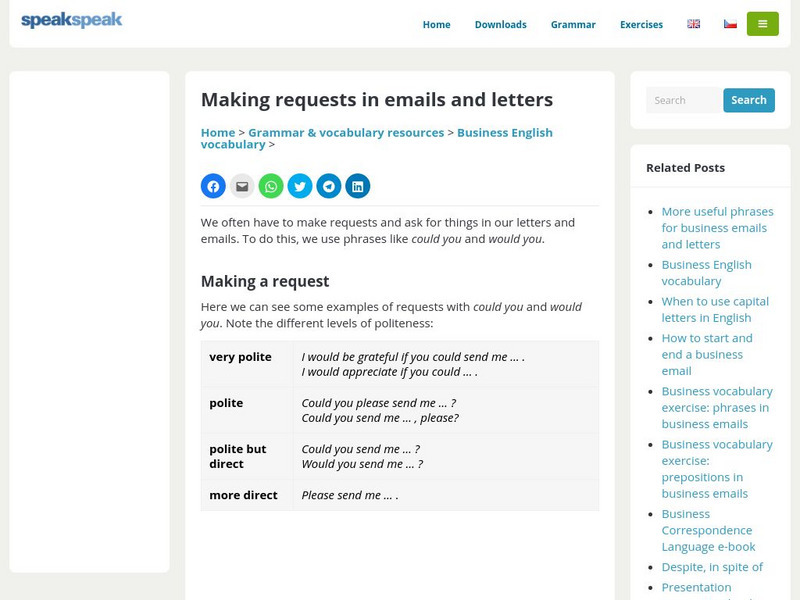
Speak Speak: Making Requests in Emails and Letters
We often have to make requests and ask for things in our letters and emails. To do this, we use phrases like 'could you' and 'would you.' Here we can see some examples of requests using these. Note the different levels of politeness.
PBS
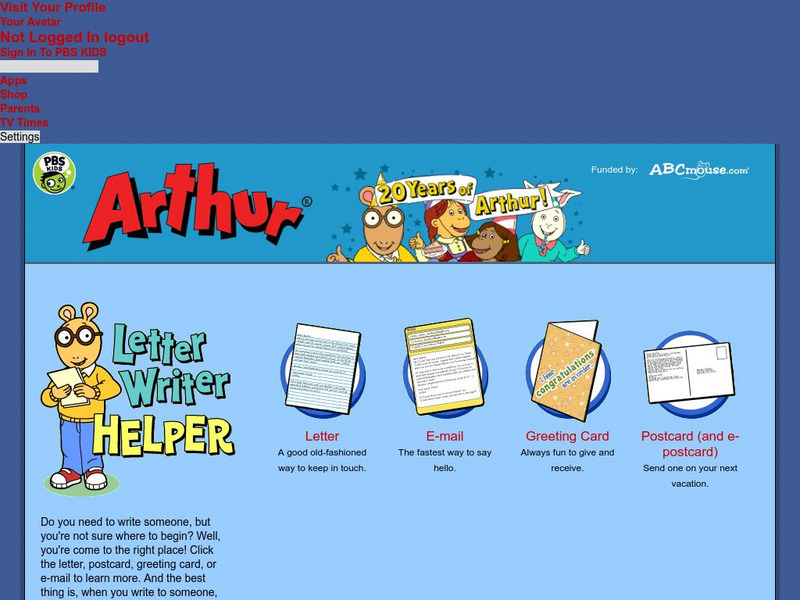
Arthur: Letter Writer Helper
This interactive site gives examples of how to write a letter, an email, a postcard, and a greeting card. It even explains how to address an envelope. As students roll their mouse over the letter it explains what each part is called and...
ReadWriteThink
Read Write Think: Beginning Writers Compare E Mail With Letter Writing
Contains plans for three lessons that teach younger students the differences between letter writing and e-mail writing. In addition to objectives and standards, this instructional plan contains links to sites used in the lessons as well...
ReadWriteThink
Read Write Think: Reading/writing About Whales Using Fiction and Nonfiction Texts
Students will have a whale of a good time in this lesson in which they use fiction and nonfiction texts to write a letter to an online scientist.
Other
A Beginner's Guide to Effective Email: Intonation
A good site as a resource for changing tone and voice in the written medium of email. Discusses asterisks, capital letters, punctuation, whitespace, and lower-case letters.

Better Lesson
Better Lesson: Email Clarifying Questions
At the end of this activity, students will demonstrate the use of commas, clarifying questions, and a friendly letter format by sending an email. Email is part of student's lives, and it is part of the digital landscape they will need to...

Letter Writing Guide
Letter Writing Guide: Letter Writing & Sample Letters
Click through links to learn how to write a business letter, a business email, and a friendly letter. Notes and sample letters for various types of letters are also available including complaint, interest, cover, apology, request,...

Alabama Learning Exchange
Alex: Snail Mail or E Mail Blast!
Students will use business letters and email to recruit professional members for the Career Technical Student Organization (CTSO) using the Chamber of Commerce member listing. This lesson plan is targeted toward Future Business Leaders...

Khan Academy
Khan Academy: Salutations, Valedictions, Dates, and Addresses
Commas are needed when starting or ending a letter/email, writing out dates, or writing out addresses.
NC State University
North Carolina State University: Ethics in Computing: Speech Issues
Curated collection of links to articles, essays, and related topics on responsible use of the Internet and information technologies with respect to speech and online hate compiled and maintained by a university instructor.