Hi, what do you want to do?






Curated OER
Beach Zonation
Young scholars identify and separate the different zones of the beach by observation. They investigate beach zonation by gathering and comparing sand samples gathered from different areas of the beach.

Curated OER
Electrical motors
Students investigate and experiement with a 9-volt motor. They will use the connecting wire and battery pack to discover fans.

Curated OER
Shake, Rattle and Erupt
Students study myths regarding four earthquakes myths. They receive a list of supplies each family should have at home to prepare for an earthquake and construct an "Earthquake Preparation" poster showing some of the most important items...

Curated OER
Super Scientists Bingo
In this science activity, students select twenty-five scientists from the list to fill in their bingo card. Then they match each of the scientists listed to their correct description strip.

Curated OER
Super Scientists Code
In this science worksheet, middle schoolers use the key code on the right to unscramble each of the scientists. They also match each of the scientists found to their correct description.
University of California
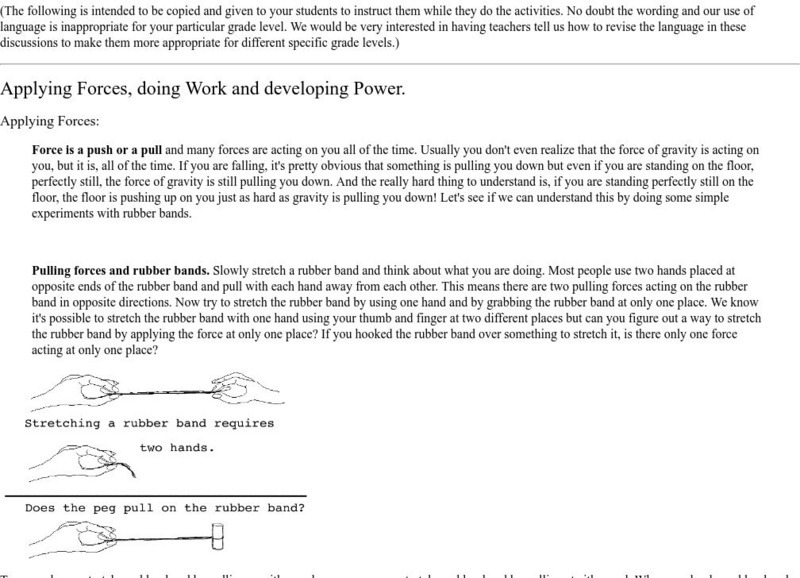
University of California Los Angeles: Force, Work and Power
Describes the definition and relationships between force, work and power. Includes nice drawings to increase conceptual understanding.
CK-12 Foundation
Ck 12: Work
[Free Registration/Login may be required to access all resource tools.] In this module, calculate work and explain how it relates to the overarching idea of energy.
OpenStax
Open Stax: Potential Energy and Conservative Forces
In the following interactive students will define conservative force, potential energy, and mechanical energy. They will explain the potential energy of a spring in terms of its compression when Hooke's Law applies. Students will also...
OpenStax
Open Stax: Nonconservative Forces
In the following interactive students will begin to define nonconservative forces and explain how they affect mechanical energy. They will show how the principle of conservation of energy can be applied by treating the conservative...
Texas Education Agency
Texas Gateway: Ap Physics: Gravitational Potential Energy
By the end of this section, you will be able to explain gravitational potential energy in terms of work done against gravity, show that the gravitational potential energy of an object of mass m at height h on Earth is given by PEg = mgh,...
Texas Education Agency
Texas Gateway: Nonconservative Forces
By the end of this section, you will be able to define nonconservative forces and explain how they affect mechanical energy, and to show how the principle of conservation of energy can be applied by treating the conservative forces in...
Texas Education Agency
Texas Gateway: Work Energy Theorem
Using diagrams, illustrations, and relevant data, students will calculate the net work done on an object, the change in an object's velocity, and the change in an object's kinetic energy.
OpenStax
Open Stax: Work: The Scientific Definition
In the following interactive students will begin to explain how an object must be displaced for a force on it to do work. They will also explain how relative directions of force and displacement determine whether the work done is...
Texas Education Agency
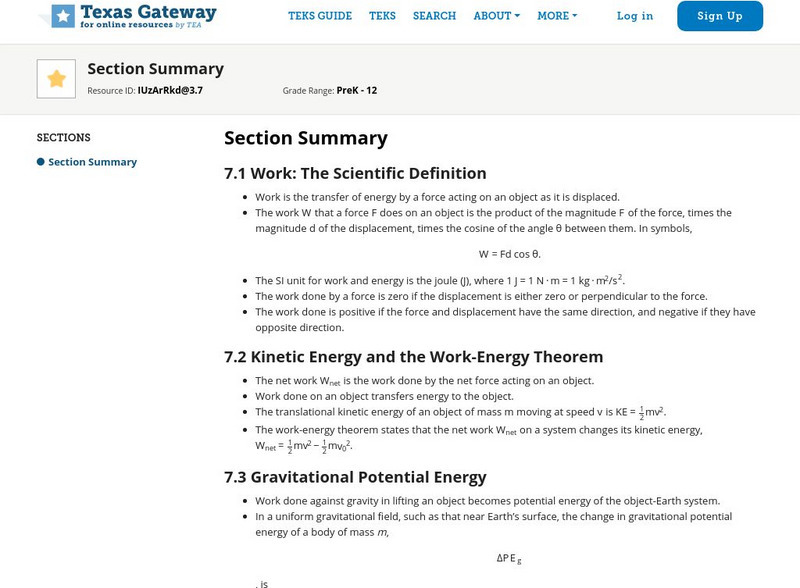
Texas Gateway: Work, Energy, and Energy Resources: Summary
This is a summary of the information in Chapter 7: Work, Energy, and Energy Resources for the AP Physics I course online.
Texas Education Agency
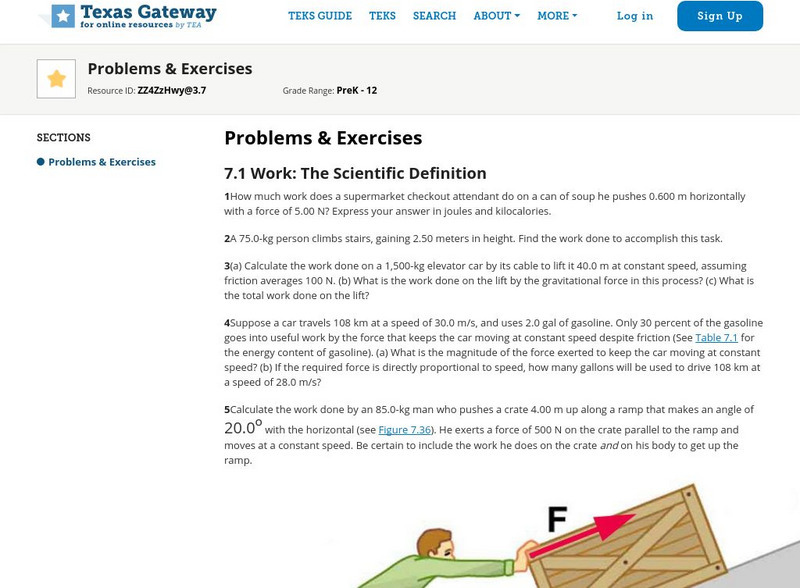
Texas Gateway: Work, Energy, and Energy Resources: Problems & Exercises
This is a list of 74 problems/exercises to solve over the content of Chapter 7: Work, Energy, and Energy Resources from the AP Physics online text.

Georgia State University
Georgia State University: Hyper Physics: Potential Energy
This site from Georgia State University Physics Department defines and explains the concept of potential energy. Using equations and graphics to illustrate the idea, it discusses the many types of potential energy (gravitational,...
Texas Education Agency
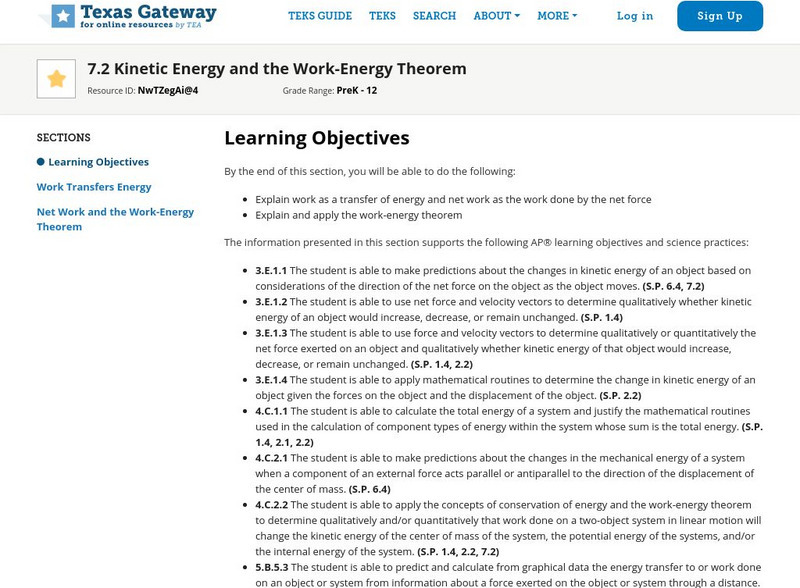
Texas Gateway: Kinetic Energy and the Work Energy Theorem
By the end of this section, you will be able to explain work as a transfer of energy and net work as the work done by the net force and to explain and apply the work-energy theorem.
Texas Education Agency
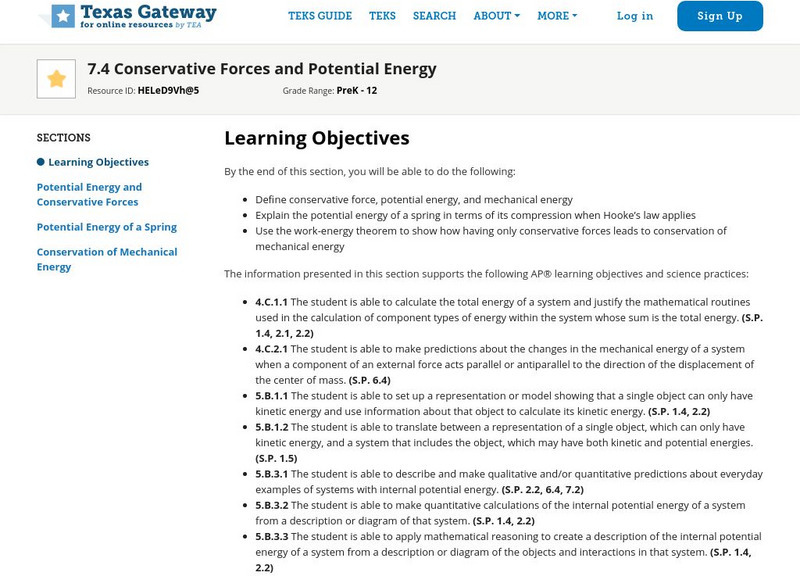
Texas Gateway: Ap Physics: Conservative Forces and Potential Energy
By the end of this section, you will be able to define conservative force, potential energy, and mechanical energy; explain the potential energy of a spring in terms of its compression when Hooke's law applies; and use the work-energy...
OpenStax
Open Stax: Kinetic Energy and the Work Energy Theorem
In the following interactive students will begin to explain work as a transfer of energy and net work as the work done by the net force. They will also explain and apply the work-energy theorem.

Physics Classroom
The Physics Classroom: The Work Energy Theorem
This page explores the quantitative relationship between work and mechanical energy in situations in which there are no external forces doing work. It is a basic analysis of situations in which mechanical energy is conserved. Examples...
TeachEngineering
Teach Engineering: Energy of Motion
By taking a look at the energy of motion all around us, students learn about the types of energy and their characteristics. They first learn about the two simplest forms of mechanical energy: kinetic and potential energy, as illustrated...
Sophia Learning
Sophia: Introduction to Work Energy Theorem
Watch this screencast to understand the work-energy theorem in regards to energy. [8:45]

Khan Academy
Khan Academy: Calculating Change in Kinetic Energy From a Force
Find the change in kinetic energy from a force using the work-energy theorem.
Physics Classroom
The Physics Classroom: Work, Energy, and Power: Calculating Work Done by Forces
Through interactive practice problems and examples, students calculate the amount of work done by forces.