Hi, what do you want to do?






Physics Classroom
The Physics Classroom: Work and Energy: Which Path Requires the Most Energy?
Suppose that a car traveled up three different sloped roadways from the base of a mountain to the summit of the mountain. Which path would require the most energy? See this animation and explanation for help.

TeachEngineering
Teach Engineering: Energy Basics
Demos and activities in this activity are intended to illustrate the basic concepts of energy science--work, force, energy, power etc., and the relationships among them. The "lecture" portion of the activity includes many demonstrations...
Harvard University
Harvard University: Math 21a Supplement 1 on Work and Energy [Pdf]
A handout for a university calculus course. It looks at the application of Newton's Laws to calculate work and energy for a particle of mass with a force being exerted on it.

Georgia Department of Education
Ga Virtual Learning: Ap Physics 1: Work, Energy, and Power
The mathematical model for the relationships between work and energy serves to model physical problems and, more importantly, predict natural and man-made phenomena. Students discover the relationships which serve as a powerful...
Texas Education Agency
Texas Gateway: Work, Energy, and Energy Resources: Glossary
This is a glossary of words and definitions of terms having to do with work, energy, and energy resources.
Other
University of Virginia: How Things Work
A site maintained by A. Bloomfield, the author of "How Things Work: The Physics of Everyday Life." You can read old questions or ask Bloomfield your own. Great explanations of everyday physics.
CK-12 Foundation
Ck 12: Work
[Free Registration/Login may be required to access all resource tools.] In this online lesson students will learn to calculate work and explain how it relates to the overarching idea of energy.
TryEngineering
Try Engineering: Working With Watermills
Teams of students design, build, test, and evaluate a working watermill made from everyday materials. Lesson explores how watermills generate energy from water, while students gain an understanding of the structural engineering design...
Physics Classroom
The Physics Classroom: Work, Energy, and Power: Internal vs. External Forces
Through illustrated examples and interactive examples, students learn about the two categories of forces are referred to as internal forces and external forces.
Sophia Learning
Sophia: Expanding the Work Energy Theorem
A narrated tutorial which illustrates how the work-energy theorem can be expanded to include other kinds of energy. [10:07]
Bozeman Science
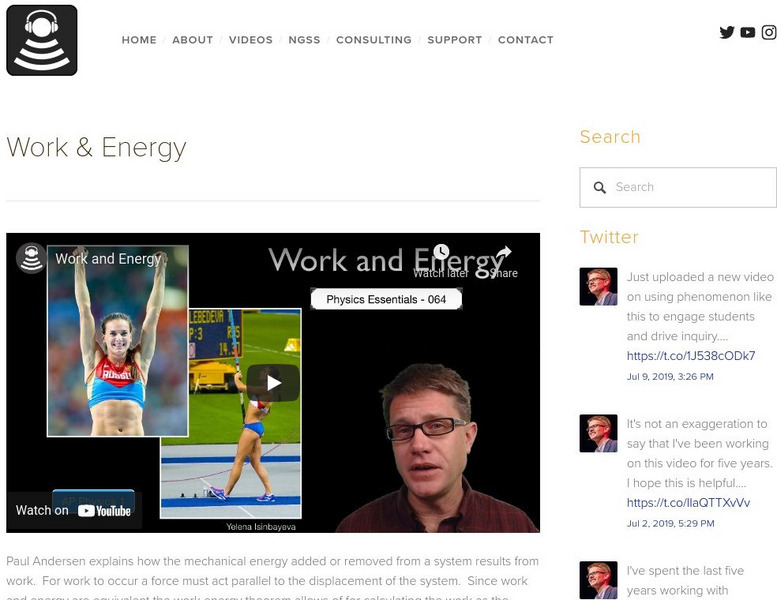
Bozeman Science: Work and Energy
In the following video Paul Andersen explains how the mechanical energy added or removed from a system results from work. For work to occur a force must act parallel to the displacement of the system. Since work and energy are equivalent...
Physics Classroom
The Physics Classroom: Work and Energy: Energy Transformation Downhill Skiing
The intricate relationship between work and mechanical energy is depicted in the animation for students to be able to visualize.
Massachusetts Institute of Technology
Mit: Open Course Ware: Force and Potential Energy
The activity investigates conservation of energy. Some topics explored are friction, kinetic energy, conservation of energy, and potential energy. The resource consists of video clips, lecture notes, practice problems, and exam...
Physics Classroom
The Physics Classroom: Work, Energy, Power: Situations Involving External Forces
Through interactive exercises and illustrated examples, students analyze situations involving external forces.

FT Exploring
Ft Exploring: Energy, Heat Flow, and Life
Here you can learn all about heat flow, one of the major driving forces of nature, and how it works. It is the force behind weather, photosynthesis, animal behavior, and much more.
University of Colorado
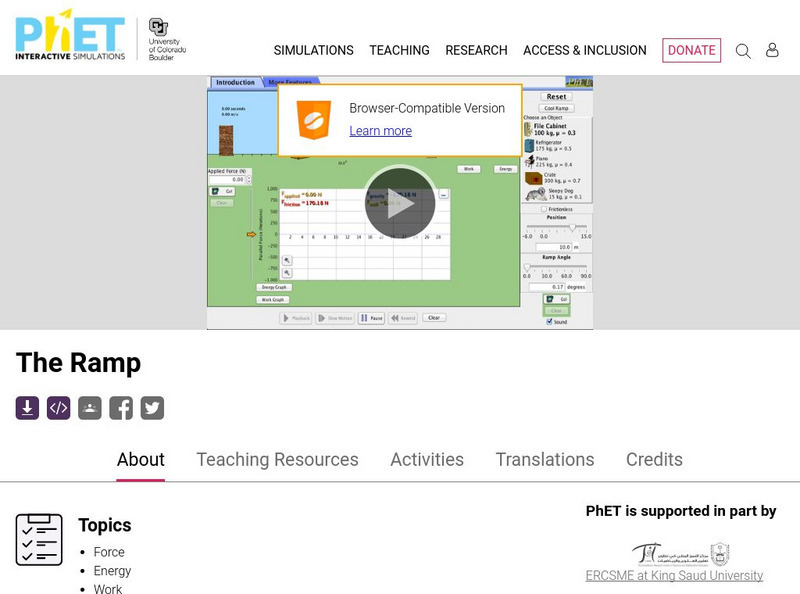
University of Colorado: Ph Et Interactive Simulations: The Ramp
Explore forces, energy, and work as you push household objects up and down a ramp. Lower and raise the ramp to see how the angle of inclination affects the parallel forces acting on the file cabinet. Graphs show forces, energy and work.
TeachEngineering
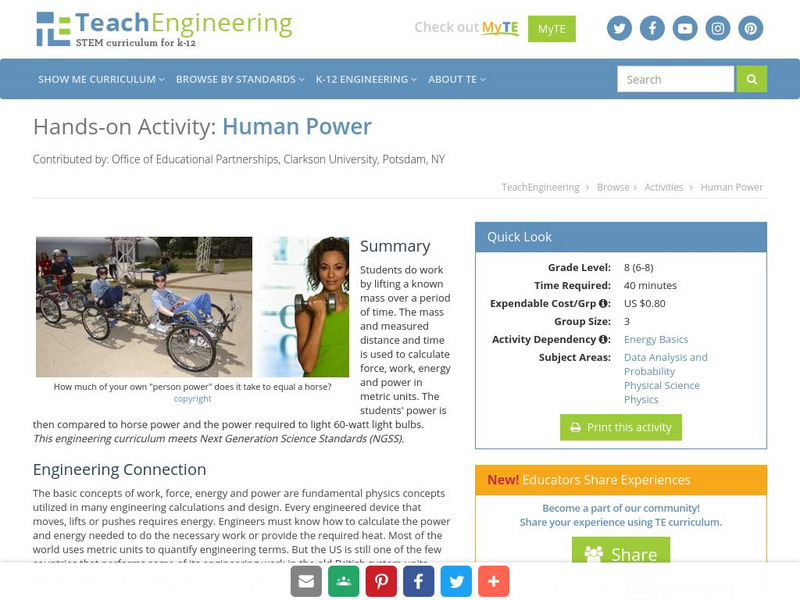
Teach Engineering: Human Power
Students do work by lifting a known mass over a period of time. The mass and measured distance and time is used to calculate force, work, energy and power in metric units. The students' power is then compared to horse power and the power...
CK-12 Foundation
Ck 12 Exploration Series: Simulations: Physics: Block and Tackle
[Free Registration/Login Required] A video module where students learn about the relationship between force, work, energy, and mechanical advantage using a simple machine.

TED Talks
Ted: Ted Ed: How Does Work, Work?
In this video, Peter Bohacek explains the interplay between work and power and how it can be seen in the functioning of a clock. [4:31] Followed by a short quiz and a list of additional resources to explore.
TeachEngineering
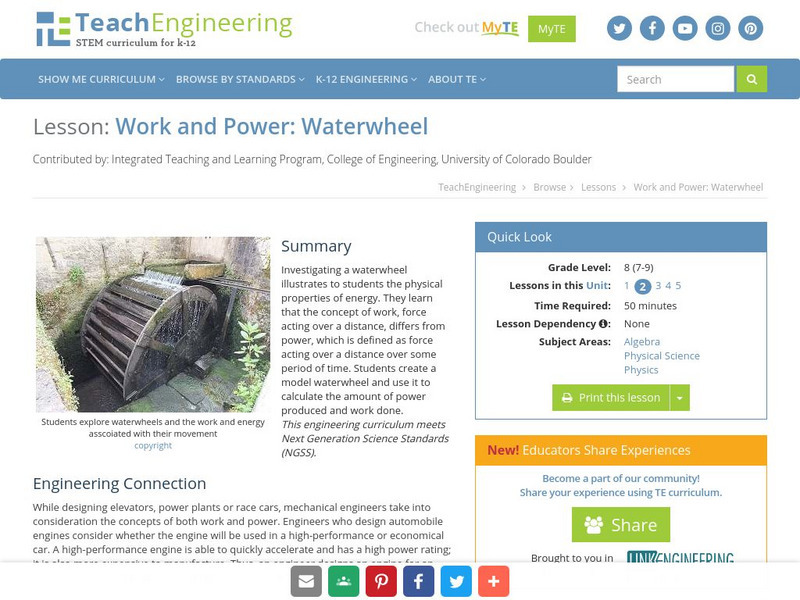
Teach Engineering: Work and Power: Waterwheel
Investigating a waterwheel illustrates to students the physical properties of energy. They learn that the concept of work, force acting over a distance, differs from power, which is defined as force acting over a distance over some...

Georgia State University
Georgia State University: Hyper Physics: Conservation of Energy
This site is from the Physics Department at Georgia State University. The conservation of energy as a fundamental conservation law is presented and compared to other conservation laws (momentum and angular momentum). Links to further...

Georgia State University
Georgia State University: Hyper Physics: Energy of Falling Object
This site is from the Physics Department at Georgia State University. The reliance upon the law of conservation of energy as an approach to problem-solving is presented and encouraged. It is modeled through a problem involving a...

Science Education Resource Center at Carleton College
Serc: Com Padre: Introduction to Work and Energy: The Hopper Popper Surprise
This activity will provide students with a qualitative understanding of the Work-Energy Theorem, especially on how the energy transferred depends on the distance over which the force is applied.
Physics Classroom
The Physics Classroom: Energy Relationships for Satellites
The orbits of satellites are described and an energy analysis is performed. Kinetic, potential and total mechanical energy are explained and applied to the motion of satellites.