TeachEngineering
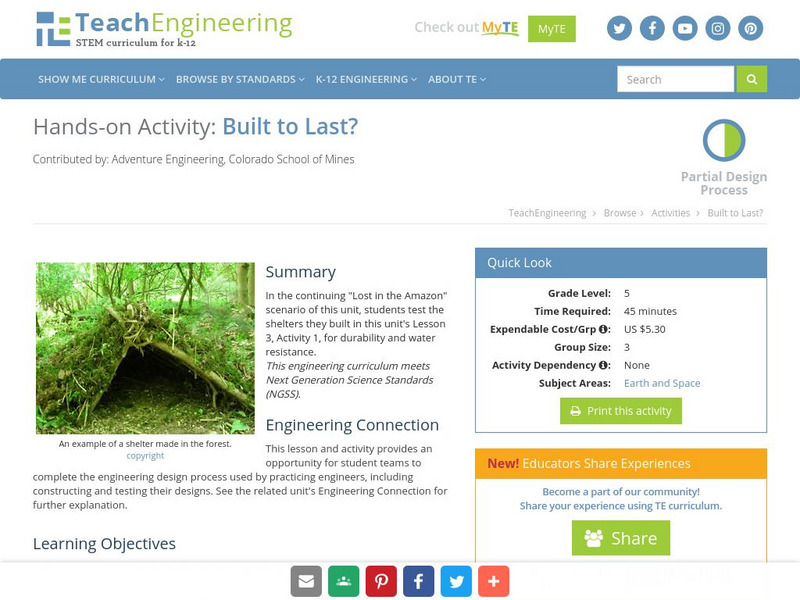
Teach Engineering: Built to Last?
In this activity, the students test the shelters they built in Lesson 3, Activity 1 for durability and water resistance.
TeachEngineering
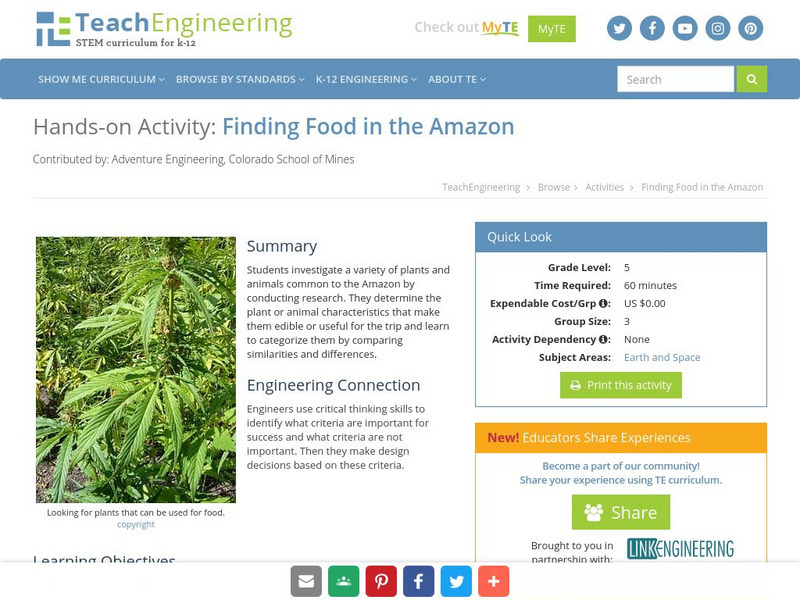
Teach Engineering: Finding Food in the Amazon
In this activity, the students will investigate a variety of plants and animals common to the Amazon through research. They will determine the plant or animal characteristics that make them edible or useful for the trip and learn to...
TeachEngineering
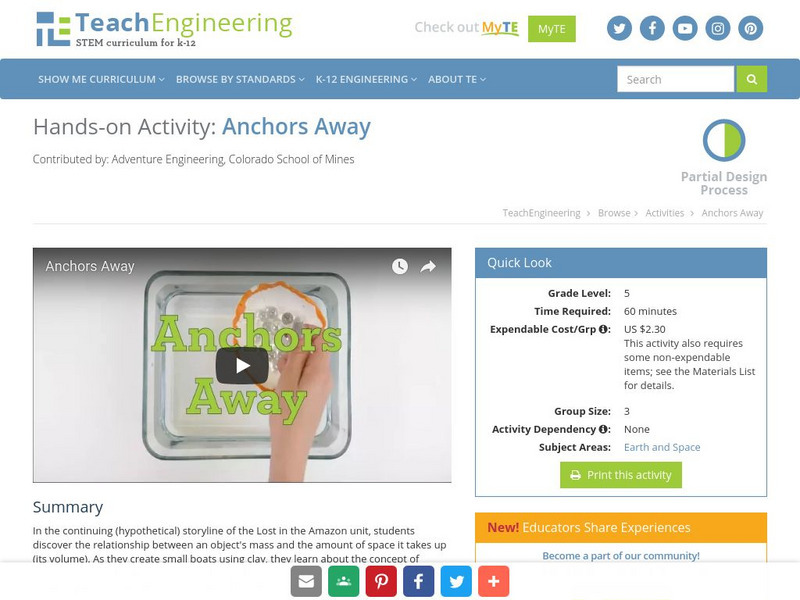
Teach Engineering: Anchors Away
In this activity, the students will discover the relationship between an object's mass and the amount of space it takes up (its volume). The students will learn about the concept of displacement and how an object can float if it...
TeachEngineering
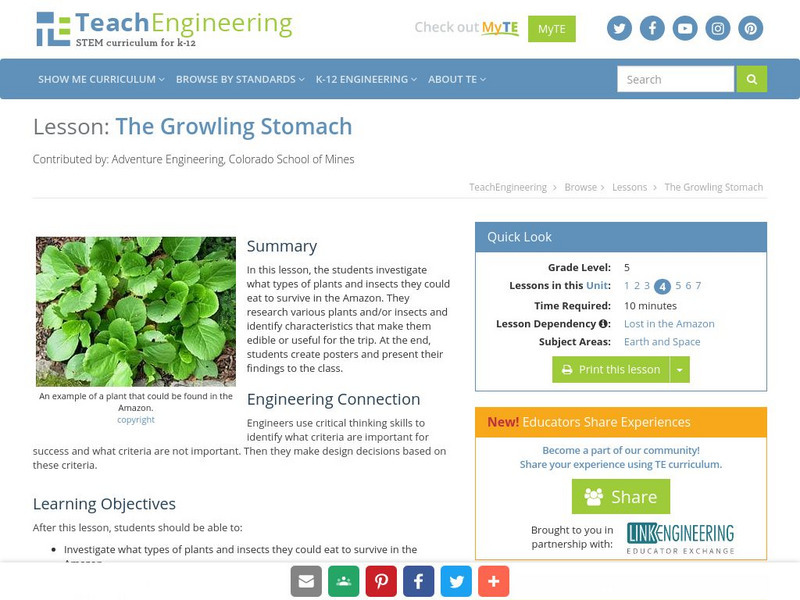
Teach Engineering: The Growling Stomach
For this lesson, the students will investigate what types of plants and insects they could eat to survive in the Amazon. They will research various plants and/or insects and identify characteristics that make them edible or useful for...

Other
National Renewable Energy Laboratory: Junior Solar Car Competition
A design challenge through which students design and construct a solar-powered model car to compete in a road race. Students work in teams using the engineering design process to select the optimal gear ratio and components.

Exploratorium
Exploratorium: Science Snacks: Marshmallow Puff Tube
An engineering design process project where you will try different lengths of cardboard tubes to see how far you can blow a marshmallow. Project uses Newton's principles of unbalanced force to shoot the marshmallow far.
Center for Innovation in Engineering and Science Education, Stevens Institute of Technology
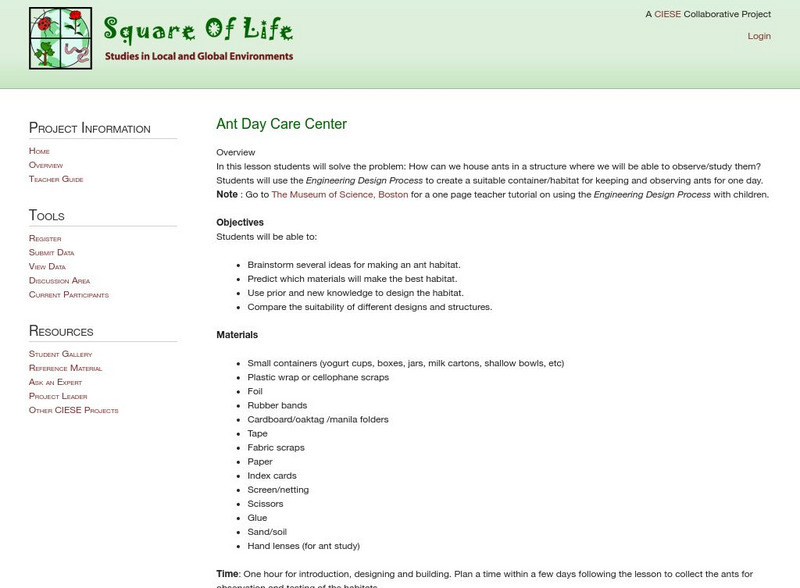
Ciese: Square of Life: Ant Day Care Center
For this lesson, students use the engineering design process to create a home for ants where they can be observed for one day.

Exploratorium
Exploratorium: Science Snacks: Coffee Can Cuica
In this activity students will use the engineering design process to make a musical instrument called a cuica. This musical instrument uses "stick-and-slip" vibrations to make the sound.

Exploratorium
Exploratorium: Science Snacks: Falling Rhythm
An engineering design process project for students to create a regular rhythm of beats by spacing weights along a string and then dropping the string.
Center for Innovation in Engineering and Science Education, Stevens Institute of Technology
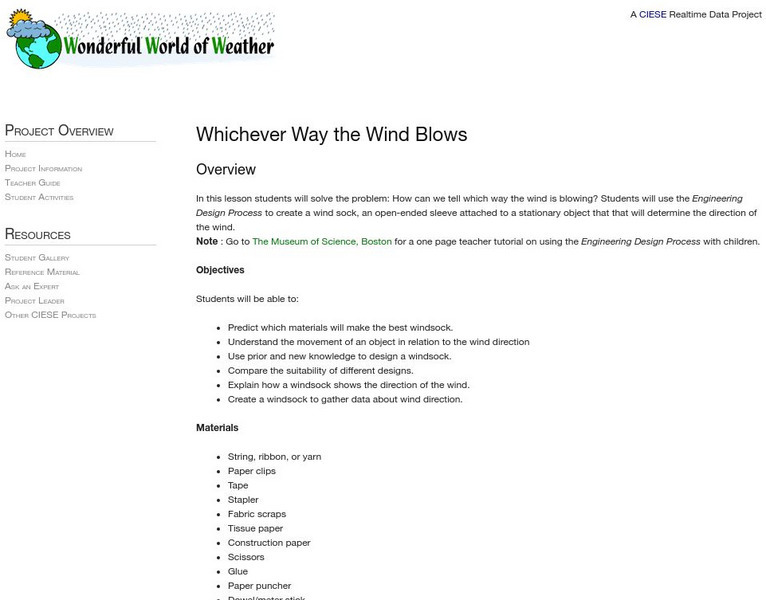
Ciese: Wonderful World of Weather: Whichever Way the Wind Blows
Students use the Engineering Design Process to create a windosck that can determine which way the wind is blowing.
PBS
Pbs Learning Media: The Ruff Ruffman Show: Hamster Run
Use the engineering design process to build, test, and redesign structures to help the hamsters reach their food.
TryEngineering
Try Engineering: Pollution Patrol
Students will work in teams to design and construct outdoor air pollution detectors from everyday items. They will then test the designs for presence of pollutants in the air and communicate their results to the class.
The Tech Interactive
The Tech Museum of Innovation: Escape the Lava [Pdf]
In this engineering challenge, students will design devices to help "Justin Case" escape lava by using items in their backpacks to get Justin from one tree to another. Students will use the knowledge they gain from this engineering...
Science Buddies
Science Buddies: Balloon Car
Students will design, build, and race balloon-powered cars in this fun lesson that teaches about engineering design and kinetic and potential energy.
University Corporation for Atmospheric Research
Ucar: Planning a Disaster Relief Mission: Storyboarding
Students plan a disaster relief mission employing a UAV (drone) by filling in a comic book-like storyboard of engineering design steps.

TeachEngineering
Teach Engineering: Make an Alarm!
After reading the story "Dear Mr. Henshaw" by Beverly Cleary, students will build an alarm system for something in the classroom, as the main character Leigh does to protect his lunchbox from thieves. Students will learn about alarms and...
PBS
Pbs Learning Media: Off the Grid
This interactive activity produced for Teachers' Domain presents users with three hypothetical scenarios in which they are challenged to design a wind power system that will meet their electrical needs.
Education.com
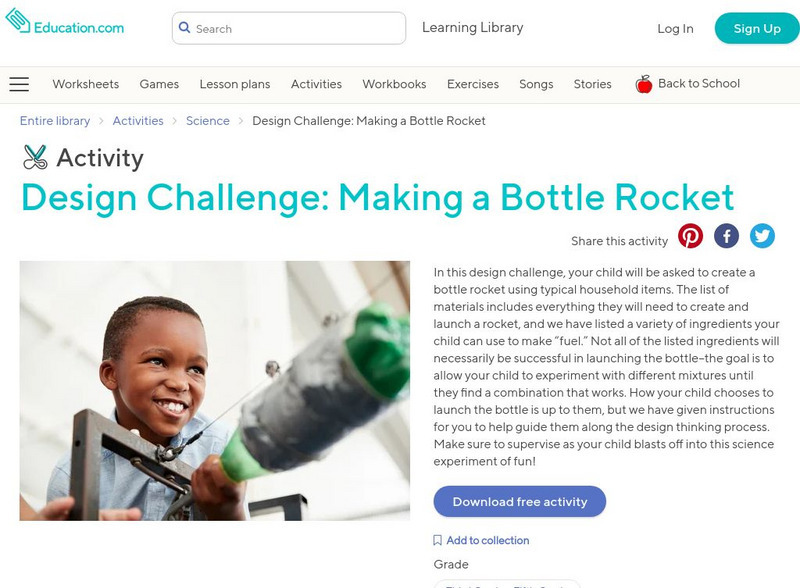
Education.com: Design Challenge: Making a Bottle Rocket
[Free Registration/Login Required] In this design challenge, your child will be asked to create a bottle rocket using typical household items. The list of materials includes everything they will need to create and launch a rocket, and we...
Other
Teecom: What Do We Mean by "Flexibility" in Design?
A technology consultant discusses what "flexibility" means in the context of design. He tries to understand what a client means when they say they want a flexible design. His goal is to come up with a design that focuses on the user. The...
Other
Oxo: Behind the Design of the New Oxo Pop Containers
This article describes the process by which an engineer at OXO looked at design, size, and variety when he redesigned OXO's line of POP containers.
PBS
Pbs Learning Media: Sci Girls | Industrial Engineering
Industrial engineers improve processes by eliminating any waste of time, money, energy, or other resources. They need to understand how every part can affect the entire process and figure out how to balance each part to design the most...
Science Buddies
Science Buddies: Gingerbread House Stem Challenge
In this activity, you will become an engineer and design and build a gingerbread house that must fulfill specific design requirements.
Other
4 Ways to Help Students Identify Needs and Opportunities and to Design Solutions
One of the key aspects of the design thinking process is to be able to identify needs and opportunities for design endeavors. Students need to investigate, explore and critique needs, opportunities, and information in order to define the...

TeachEngineering
Teach Engineering: Adaptations for Aeronautical Engineering
This activity first asks the students to study the patterns of bird flight and understand that four main forces affect the flight abilities of a bird. They will study the shape, feather structure, and resulting differences in the pattern...