
TryEngineering
Try Engineering: Series and Parallel Circuits
The core of this lesson is simple circuits and the differences between parallel and series circuit design. Students perform experiments to test the differences between the two circuit designs using low voltage light bulbs.
TryEngineering
Try Engineering: Tinkering With Tops
Lesson explores the history, design, and motion of spinning tops. Student teams design and build their own tops that can spin for at least 10 seconds within a circle 30 centimeters in diameter.
TryEngineering
Try Engineering: Give Me a Brake
Activity investigates the concept of how bicycle brakes use force and friction to stop or slow mechanical motion. Students work in teams to devise a simple braking system while suggesting improvements to current bicycle brake design.
TryEngineering
Try Engineering: Hand Biometrics Technology
Lesson probes how biometrics technologies have been used worldwide to address security and identification systems. After exploring different biometric techniques, students work in teams to find their own hand geometry biometrics, then...
TryEngineering
Try Engineering: Shake It Up With Seismographs
During this lesson, young scholars learn how seismographs work and how technology has impacted the world by helping save lives from earthquakes. They will work in teams to design, test, and evaluate the results of their own seismographs,...
TryEngineering
Try Engineering: Here Comes the Sun
Students work in teams to learn about solar panel design, simple circuits, and how solar energy is used to provide power to simple machines such as calculators.
TryEngineering
Try Engineering: Infrared Investigations
Engineers use infrared technology to develop equipment and systems for a variety of industries. Teams of young scholars are challenged to test the limitations of infrared in a basic television remote control to conceive a way to point...
TryEngineering
Try Engineering: Filtration Investigation
Working in teams of "engineers", students learn about filtration systems and how they can remove impurities from drinking water.
TeachEngineering
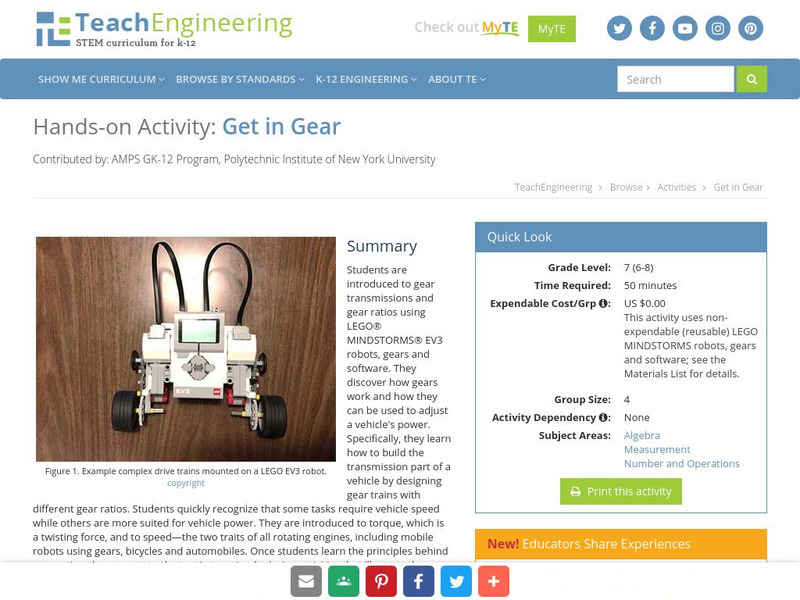
Teach Engineering: Get in Gear
Students discover how gears work and how they can be used to adjust a vehicle's power. Specifically, they learn how to build the transmission part of a vehicle by designing gear trains with different gear ratios.

Other
National Institute of Building Sciences: Whole Building Design Guide: Building Science Concepts
This resource page is the first of a series on relevant topics in building science. It is aimed at explaining the key concepts involved in building science, as well as the relationship of this discipline to the architecture / engineering...
TeachEngineering
Teach Engineering: Learn to Build a Rocket in 5 Days or Your Money Back
In this lesson plan, students discover the entire process that goes into designing a rocket for any customer. In prior lessons, students learned how rockets work, but now they learn what real-world decisions engineers have to make when...
TeachEngineering
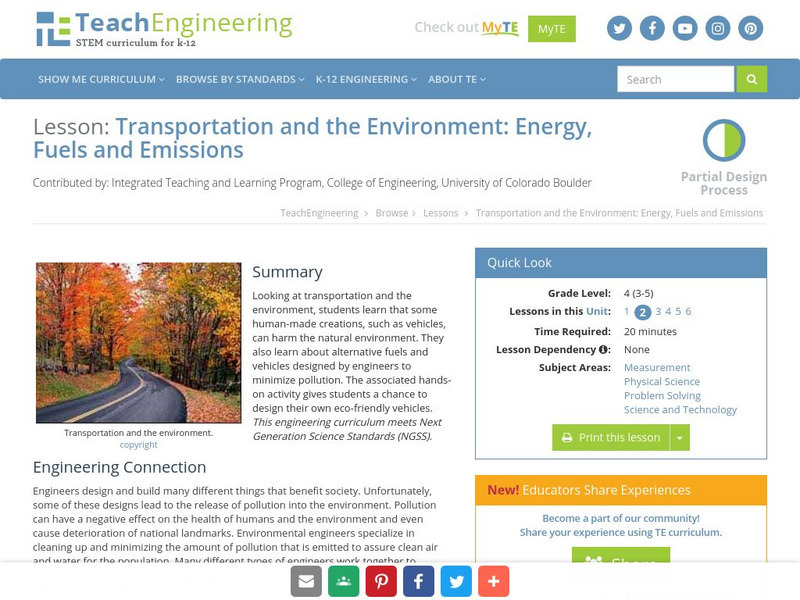
Teach Engineering: Transportation and the Environment
Looking at transportation and the environment, students learn that some human-made creations, such as vehicles, can harm the environment. They also learn about alternative fuels and vehicles designed by engineers to minimize pollution....
TeachEngineering
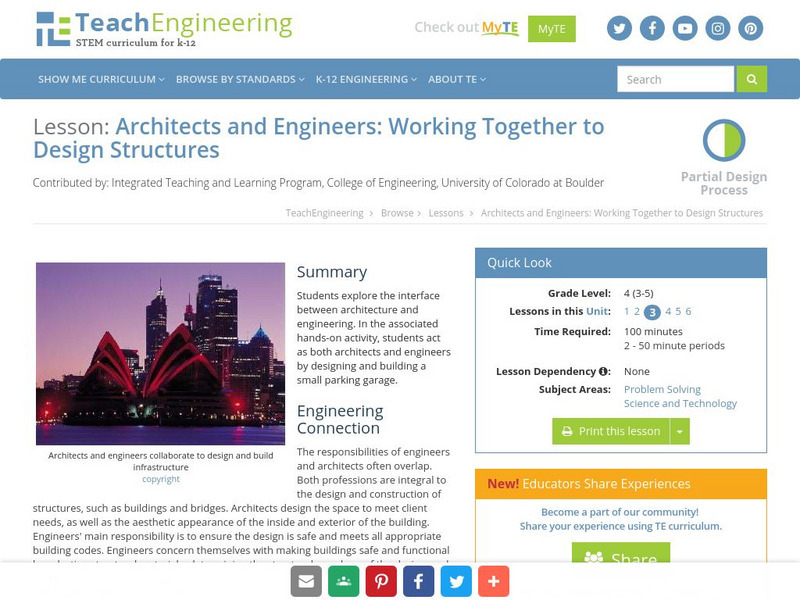
Teach Engineering: Architects and Engineers
Students explore the interface between architecture and engineering. In the associated hands-on activity, students act as both architects and engineers by designing and building a small parking garage.
TeachEngineering
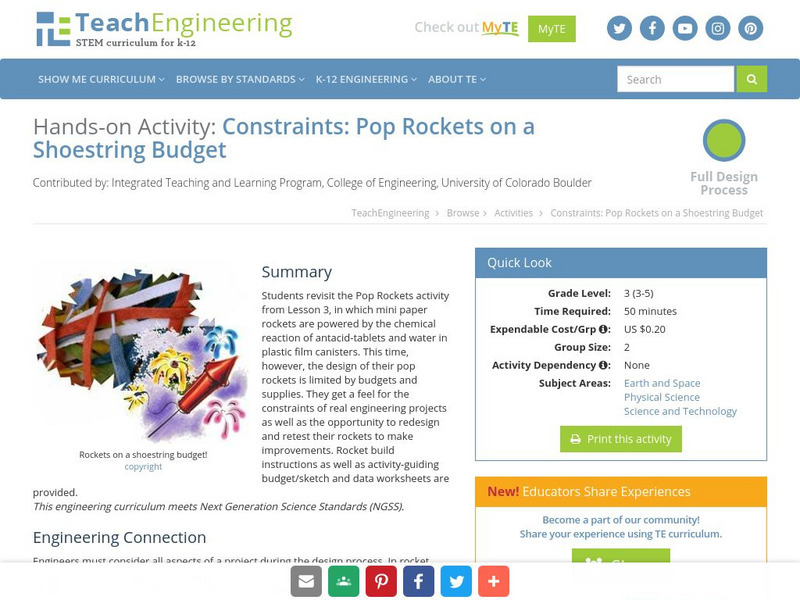
Teach Engineering: Rockets on a Shoestring Budget
In this activity, students revisit the Pop Rockets activity from Lesson 3. This time, however, the design of their pop-rockets will be limited by budgets and supplies. They will get a feel for the limitations of a real engineering...
TeachEngineering
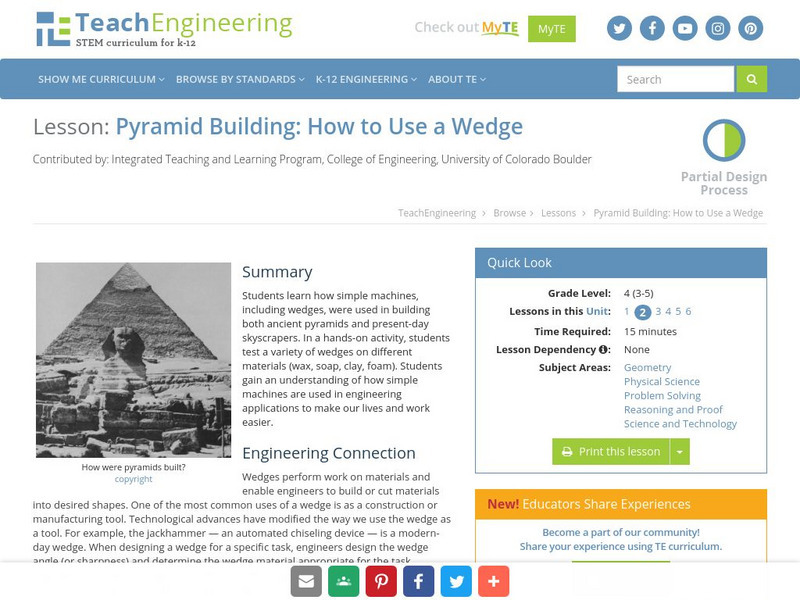
Teach Engineering: Pyramid Building: How to Use a Wedge
Students learn how simple machines, including wedges, were used in building both ancient pyramids and present-day skyscrapers. In a hands-on activity, students test a variety of wedges on different materials (wax, soap, clay, foam)....
TeachEngineering
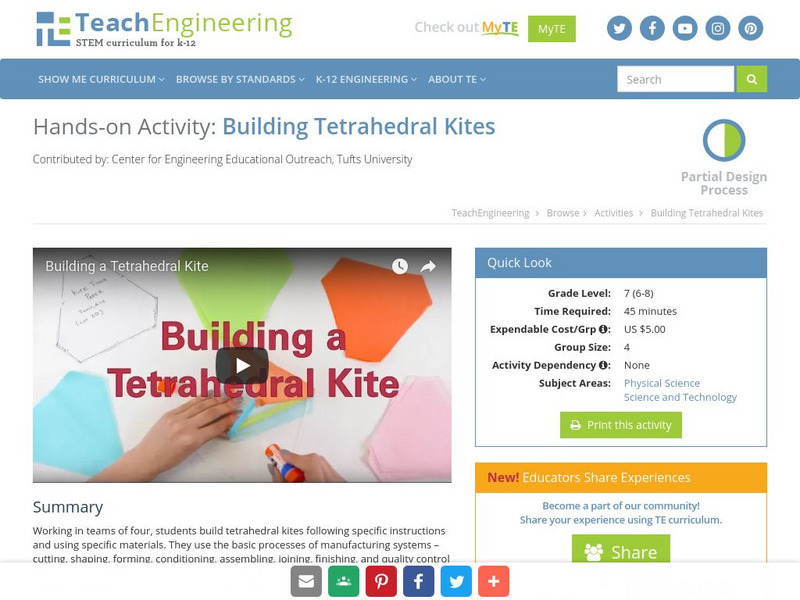
Teach Engineering: Building Tetrahedral Kites
Students build a tetrahedral kite and test it out. While building they are learning about flight and the manufacturing process
TeachEngineering
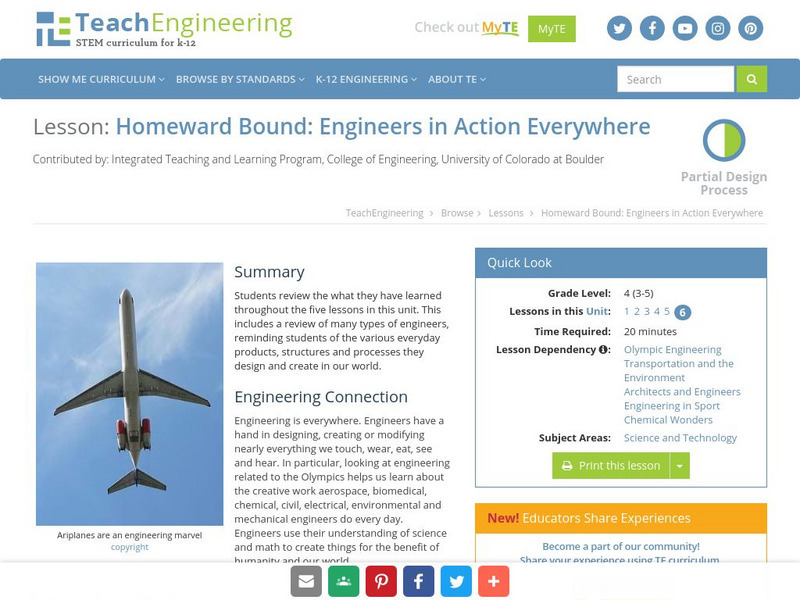
Teach Engineering: Homeward Bound
Students review the what they have learned throughout the five lessons in this unit. This includes a review of many types of engineers, reminding students of the various everyday products, structures and processes they design and create...
TeachEngineering
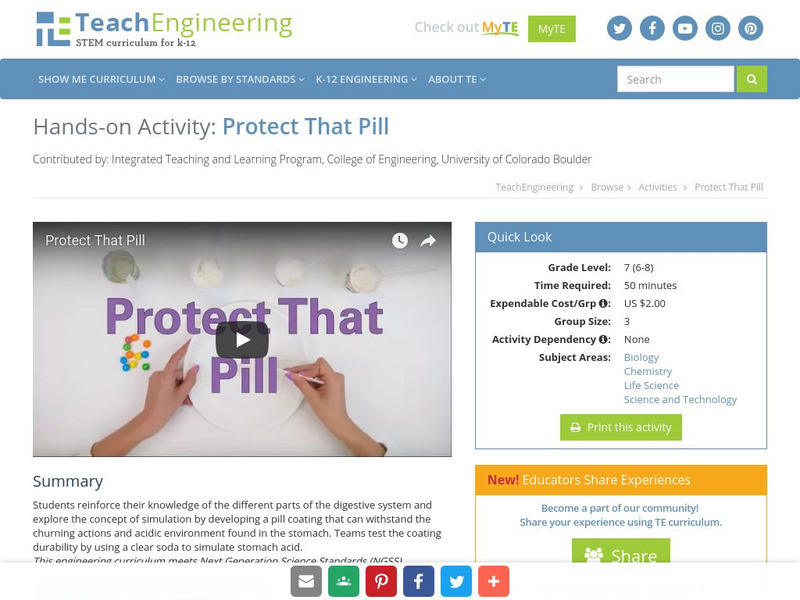
Teach Engineering: Protect That Pill
Students reinforce their knowledge of the different parts of the digestive system and explore the concept of simulation by developing a pill coating that can withstand the churning actions and acidic environment found in the stomach....
TeachEngineering
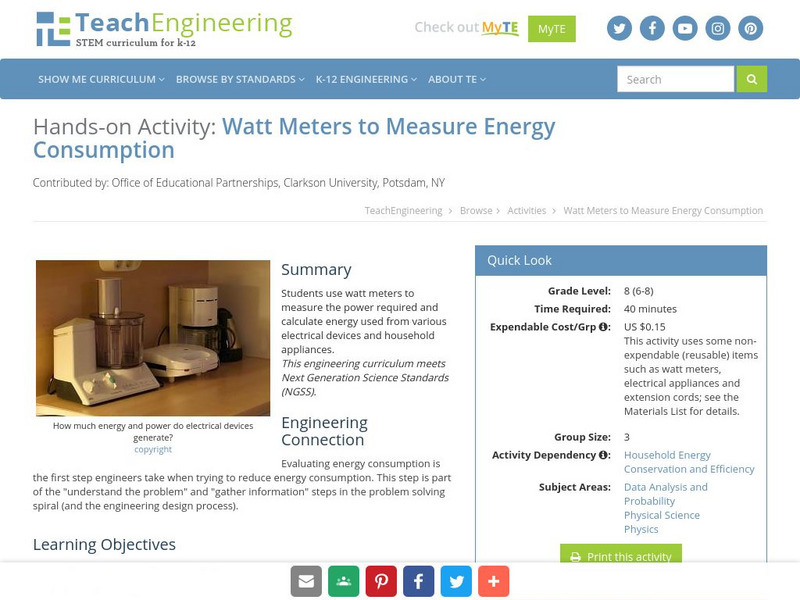
Teach Engineering: Watt Meters to Measure Energy Consumption
Students use watt meters to measure the power required and calculate energy used from various electrical devices and household appliances.
TeachEngineering
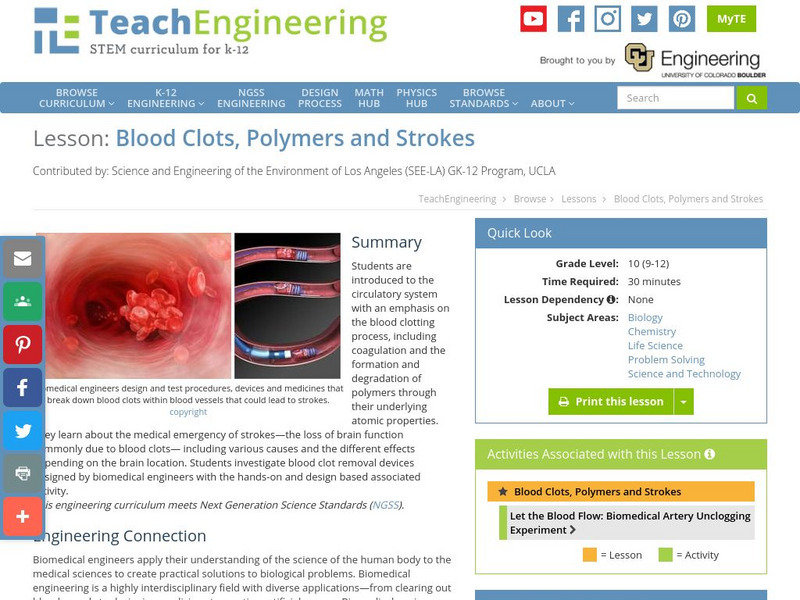
Teach Engineering: Blood Clots, Polymers and Strokes
Students are introduced to the circulatory system with an emphasis on the blood clotting process, including coagulation and the formation and degradation of polymers through their underlying atomic properties. They learn about the...
Other
Design Build: Exploring the Fundamental Requirements of Structural Design [Pdf]
For this lesson unit from the Science Teachers' Association of Ontario (STAO), young scholars fold paper to explore the properties and shapes of materials that give structures their stability and strength. They record their ideas as they...
TeachEngineering
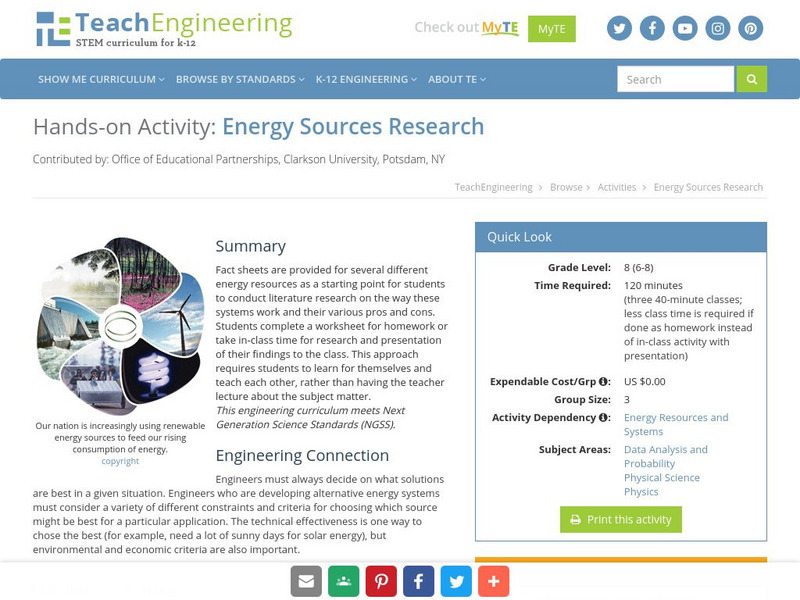
Teach Engineering: Energy Sources Research
Fact sheets are provided for several different energy resources as a starting point for students to conduct literature research on the way these systems work and their various pros and cons. Students complete a worksheet for homework or...
TeachEngineering
Teach Engineering: Energy Perspectives
Students utilize data tables culled from the US DOE Energy Information Agency to create graphs that illustrate what types of energy we use and how we use it. An MS Excel workbook with several spreadsheets of data is provided. Students...
TeachEngineering
Teach Engineering: Solving Energy Problems
The culminating energy project is introduced and the technical problem solving process is applied to get students started on the project. By the end of the class, students should have a good perspective on what they have already learned...